
Andrew Jackson
Andrew Jackson was the seventh U.S. president, a frontier general who built the Democratic Party and forced southeastern Native nations from their land.
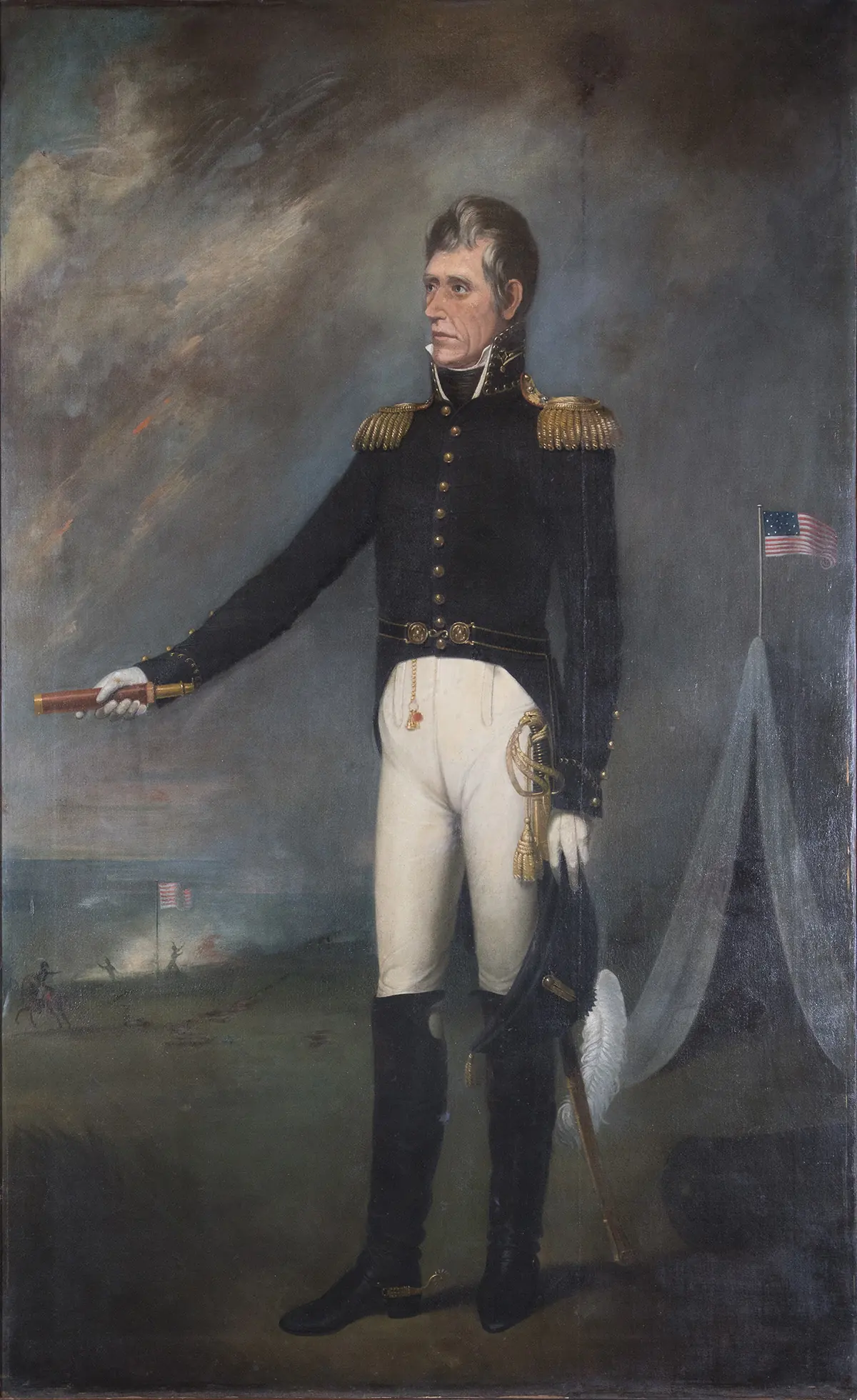
Andrew Jackson was the seventh president of the United States, serving from 1829 to 1837. He was the first president who did not come from the Virginia planter class or from the family of a founding father. Jackson grew up on the Carolina frontier, was orphaned during the American Revolution, and was on his own by the age of fifteen. He became a lawyer, a slave trader, and a militia general. In 1815 he defeated a British army at New Orleans and became the most famous man in the country. As president, he built the first mass political party, used the veto to make the presidency a rival power center to Congress, and forced the removal of Native nations from the southeastern United States. He enslaved about 150 people at his plantation in Tennessee.
How Andrew Jackson rose to power
Jackson was known for his violent temper. In 1806, he fought a duel with a man named Charles Dickinson over a horse-racing bet. Dickinson shot first and hit Jackson in the chest near his heart. Jackson pressed his hand over the wound, stayed standing, and killed him. He carried the bullet in his chest for the rest of his life.
On January 8, 1815, Jackson's forces defeated a British assault outside New Orleans. The British suffered about 2,000 casualties. Jackson's side lost about 70. The battle took less than an hour. A peace treaty ending the War of 1812 had already been signed in Europe, but Americans did not know that yet, and the victory made Jackson a national hero.
In the 1824 presidential election, Jackson won the most popular votes and the most electoral votes, but no candidate won a majority. The election went to the House of Representatives, where Speaker Henry Clay threw his support to John Quincy Adams. Adams became president and then made Clay his secretary of state. Jackson denounced the result as a "corrupt bargain." He devoted the next four years to campaigning on that charge. His ally Martin Van Buren built a national political organization around him, using rallies, newspapers, and patronage jobs to turn elections into mass events. Jackson won the 1828 election in a landslide. That organization grew into the Democratic Party. No political party in the world has operated continuously for longer.
Jackson's removal of the southeastern Native nations
Jackson had built his military reputation fighting the Creek nation in Alabama. Jackson was convinced that Native peoples could not remain east of the Mississippi, and as president he set out to remove them.
The Indian Removal Act passed the House of Representatives on May 26, 1830, by a vote of 102 to 97. The vote split along regional lines: slave states voted for removal by more than three to one, while free states voted against it by more than two to one. Jackson signed the bill two days later.
The Cherokee nation challenged the state of Georgia in court and won. In Worcester v. Georgia (1832), the Supreme Court ruled that states could not impose their laws on Native land. Jackson refused to enforce the decision. In a letter that year, he wrote that the Court's decision "has fell still born."
The Cherokee removal itself was carried out under Jackson's successor, Van Buren. In 1838 and 1839, the U.S. Army forced roughly 16,000 Cherokee west to what is now Oklahoma. Estimates of how many died range from about 2,000 to 8,000. The Choctaw, Creek, Chickasaw, and Seminole nations were also driven from their land. The emptied territory became the cotton-growing heartland of the South.
How did Andrew Jackson change the presidency?
Jackson vetoed twelve bills. All six previous presidents combined had vetoed fewer. Previous presidents had used the veto mostly when they believed a law was unconstitutional. Jackson vetoed bills because he disagreed with them. That set a precedent: the president was not just carrying out Congress's will but claiming to speak for the people directly.
Jackson was willing to use federal power to hold the country together. In 1832, South Carolina declared it could nullify a federal tariff and refuse to collect it. Jackson, a slaveholder and a Southerner, treated the declaration as treason. He persuaded Congress to authorize the use of the military and told allies in private that he would hang the nullification leaders. South Carolina backed down.
But Jackson also tore down federal institutions he opposed. He vetoed the recharter of the Second Bank of the United States in 1832, calling it a tool that served the rich. He pulled federal deposits out of the Bank and moved them into favored state banks. The flood of easy credit helped set off a speculative boom that ended in the Panic of 1837, a financial crisis that broke Van Buren's presidency.
Is Andrew Jackson still on the $20 bill?
Yes. Jackson has appeared on the $20 bill since 1928. In 2016, the U.S. Treasury announced that Harriet Tubman, who had escaped slavery to become an abolitionist, would replace him on the bill. The redesign was delayed repeatedly. In July 2026, Treasury Secretary Scott Bessent said the administration had no plans to proceed with it. As of 2026, Jackson remains on the bill.