
Brexit
Brexit was the United Kingdom's withdrawal from the European Union after a 2016 referendum, the first reversal of European integration.
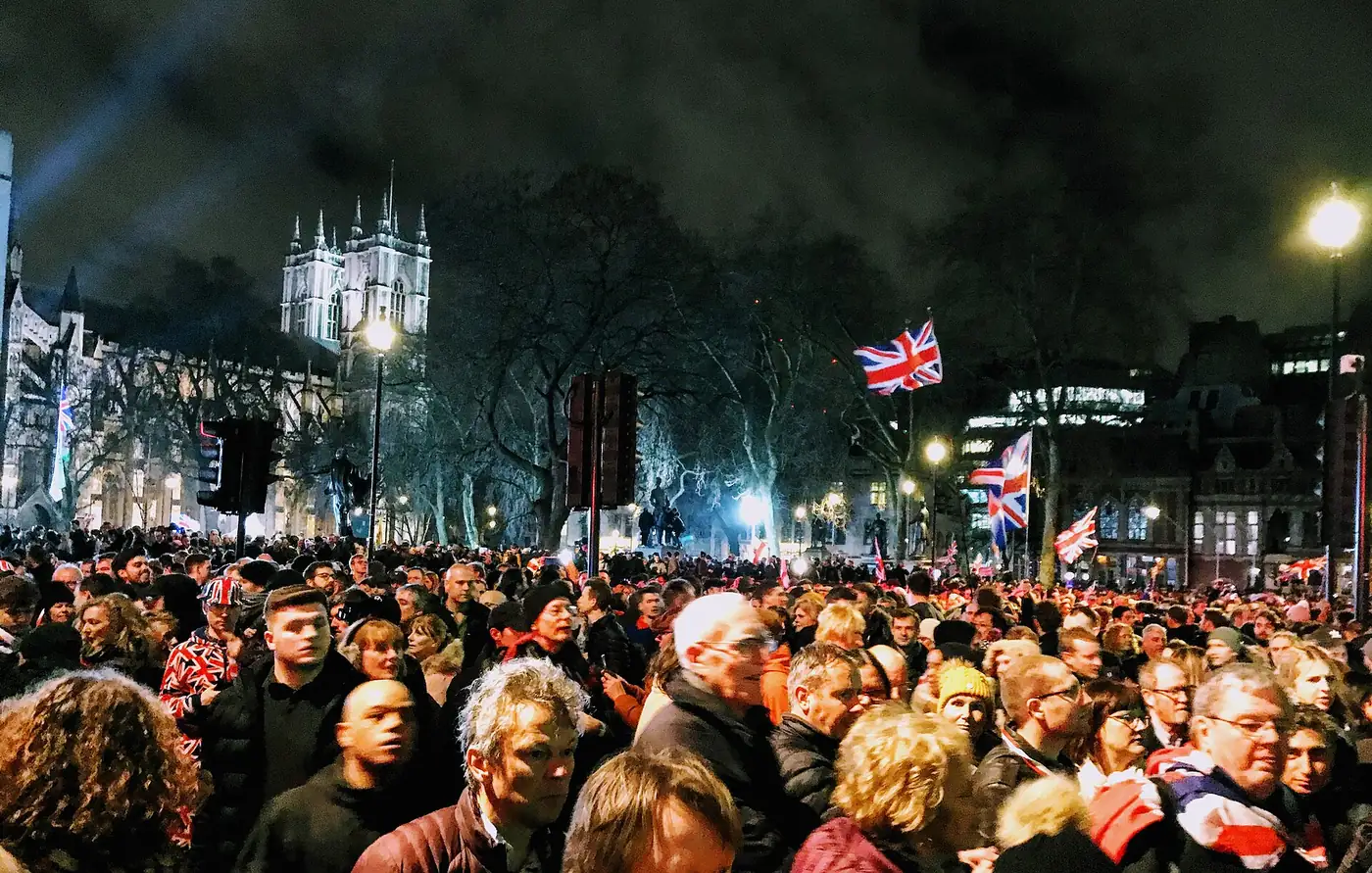
Brexit was the United Kingdom's withdrawal from the European Union. In a referendum on 23 June 2016, Leave won with 51.9 percent of the vote against 48.1 percent for Remain. Turnout was 72.2 percent. It was the first time any member state had reversed the process of European integration. David Cameron, the prime minister who called the vote, announced his resignation the next morning. The exit took four and a half years. Britain went through two more prime ministers before formally leaving the EU on 31 January 2020, followed by a transition period that ended on 31 December 2020.
Why the UK voted to leave the European Union
David Cameron promised the referendum in a speech at Bloomberg's London office on 23 January 2013. He was under pressure from two directions. Eurosceptic members of his own Conservative Party wanted a harder line on Europe. And the UK Independence Party, known as UKIP, was drawing Conservative voters away by campaigning on a single issue: leaving the EU. Cameron believed he could win a public vote and settle the argument for good. He had won the Scottish independence referendum in September 2014, when 55 percent of Scottish voters chose to stay in the United Kingdom. He expected to win on Europe too.
Three forces pushed the country toward Leave. The first was sovereignty: the argument that British laws were increasingly shaped by EU institutions in Brussels that British voters had no power to change. The second was immigration. In 2004, when ten new countries joined the EU, Britain was among the few EU members that immediately opened their labor markets to citizens of those new countries. The number of people who came was far larger than the government had forecast, and they settled mainly in towns where housing and public services were already strained. The third was economic geography. The parts of Britain that voted most heavily to leave were the same places that had lost their industries over previous decades and then lived through years of austerity after the 2008 financial crisis. The Remain campaign argued that leaving would hurt the economy. That argument had little effect in places where people felt the economy had already failed them.
How the UK negotiated its exit
Cameron's successor, Theresa May, formally began the exit process by invoking Article 50 on 29 March 2017. That started a two-year deadline for reaching a deal. She then called a snap general election to strengthen her position in Parliament. It went the other way: she lost her majority and had to govern with the support of Northern Ireland's Democratic Unionist Party.
The hardest problem in the negotiation was the Irish border. The Good Friday Agreement, which ended decades of conflict in Northern Ireland in 1998, depends on there being no visible frontier on the island of Ireland. But if the UK left the EU's single market and customs union, goods crossing between the two sides would need to be checked somewhere. A checkpoint dividing the island would undermine the peace agreement. A checkpoint in the waters separating Northern Ireland from Great Britain would anger unionists, who saw it as cutting their part of the country off from the rest. No alternative existed, and every other question in the negotiation kept returning to this one.
May brought her withdrawal agreement to a vote in the House of Commons three times. It was rejected three times, by some of the widest margins a sitting government had suffered in the House of Commons in living memory. She resigned, and Boris Johnson, a former mayor of London and one of the most prominent Leave campaigners, replaced her in July 2019. Johnson accepted the Irish Sea border and wrote it into a revised Northern Ireland Protocol. He won a large majority in the December 2019 general election campaigning on "Get Brexit Done," and pushed his deal through Parliament.
The Trade and Cooperation Agreement that followed provided for tariff-free trade in goods, but trade was no longer frictionless. Exporters now faced customs forms, rules-of-origin paperwork, and veterinary inspections. Services, which account for about 80 percent of the UK's output, were barely covered. The UK and EU renegotiated the Northern Ireland trade arrangements in 2023 as the Windsor Framework, and adjusted them further in 2025.
How Brexit affected the British economy
The UK's Office for Budget Responsibility estimates that leaving the EU will lower Britain's long-run productivity by about 4 percent. The main reason is that new trade barriers make it harder for British firms to do business with their closest and largest market. By 2021, about two-fifths of that impact had already occurred.
The costs fell unevenly. The fixed cost of a customs declaration is roughly the same whether a shipment is worth ten thousand pounds or ten million, so small exporters were hit hardest. Many stopped selling to the EU altogether. Financial, legal, and consulting firms lost the automatic right to serve EU clients that came with EU membership.
In May 2025, the Labour government led by Prime Minister Keir Starmer held a summit with the EU, signed a defense partnership, and agreed to explore closer cooperation on energy and data sharing. Starmer called it a "reset." But he ruled out returning to the single market, customs union, or free movement, so the main trade barriers stayed in place.
Did Brexit reduce immigration to the UK?
Ending free movement with the EU changed where immigrants came from, but for several years it increased the total number. Net migration to the UK peaked at 944,000 in the year to March 2023, driven by non-EU workers, international students, and people arriving through humanitarian programs. Industries that had depended on workers from EU countries, including agriculture, hospitality, and social care, still needed to fill those jobs. The new points-based immigration system let them recruit from a wider set of countries.
Net migration fell sharply after the government tightened visa rules, dropping to about 331,000 in 2024 and 171,000 in 2025. But the years of record-high migration after Brexit were the opposite of what many Leave voters had expected. Immigration was one of the issues that most motivated Leave voters, and the first result of ending free movement was higher overall immigration than before.
Since Brexit, no other EU member state has seriously proposed leaving. The cost and difficulty of the UK's departure made the idea far less appealing to Eurosceptic movements elsewhere in Europe.