
Confucius
Confucius was a Chinese teacher whose ideas about virtue, ritual, and government shaped East Asian civilization for over two thousand years.
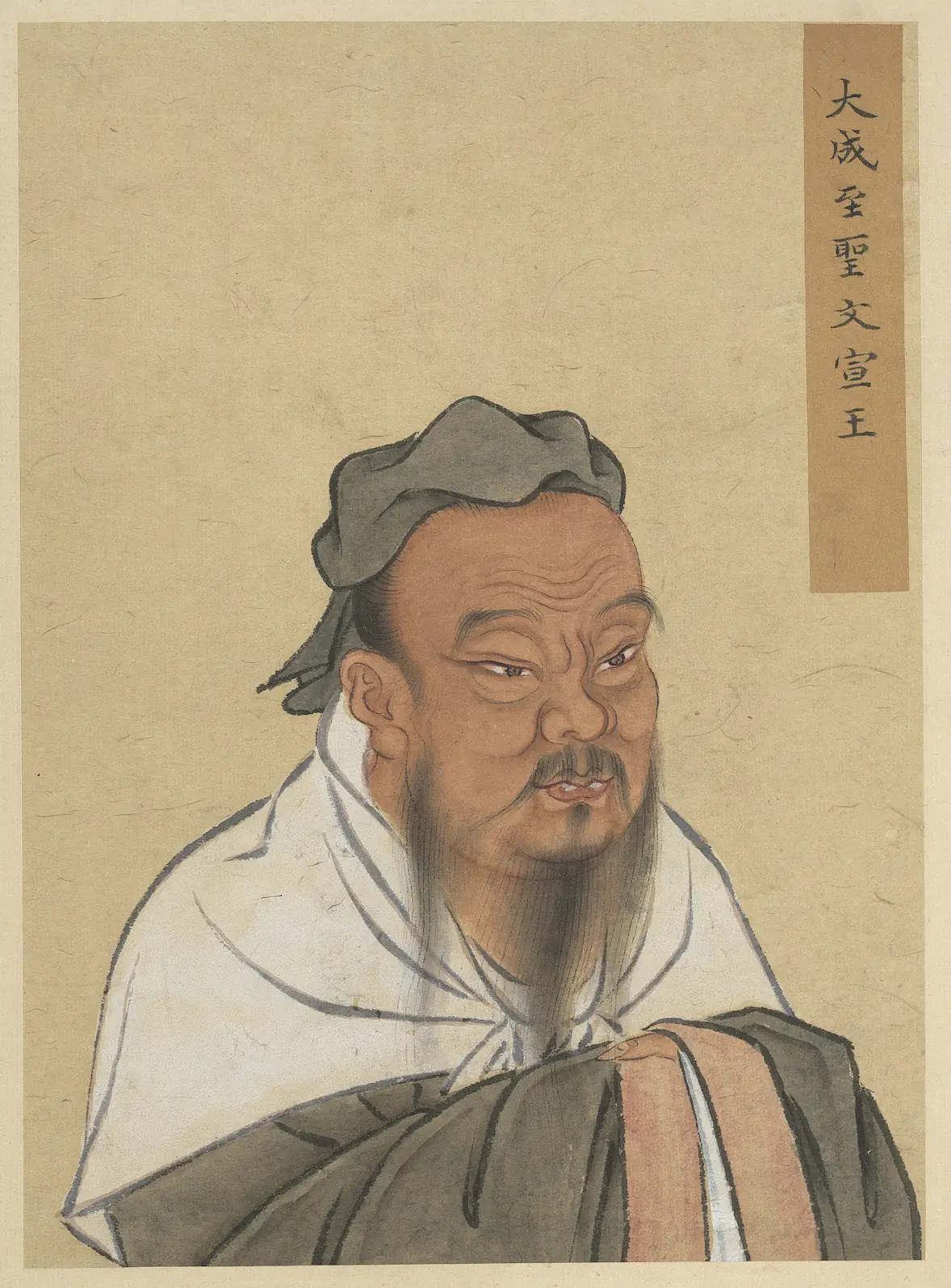
Confucius was a Chinese philosopher and teacher born in the state of Lu in 551 BC, in what is now Shandong province. His birth name was Kong Qiu. He spent more than a decade traveling among the small states of a divided China, offering himself as a moral adviser to rulers. Few gave him a lasting position. When he died in 479 BC, he believed he had accomplished nothing. But the words his followers recorded went on to become the moral foundation of Chinese society for the next two millennia. They became deeply influential in Korea, Japan, and Vietnam as well. Confucius did not write a book. His ideas survive through the Analects, a collection of sayings compiled by his disciples over several generations and given their final form under the Han dynasty.
Confucius's early life and years of wandering
Confucius's father, Kong He, was an elderly military officer in the state of Lu. He was about 70 when Confucius was born, and he died when the boy was three years old. Confucius's mother, Yan Zhengzai, raised him in poverty. He studied what were known as the Six Arts: ritual, music, archery, charioteering, calligraphy, and mathematics.
Confucius worked as a minor official in Lu, managing granaries and livestock, before rising to become the state's minister of crime around 500 BC. He was effective in the role, but his effort to limit the power of the three noble families that overshadowed Lu's ruler came to nothing. Around 497 BC, Confucius left Lu.
For the next thirteen years, Confucius traveled among the states of Wei, Song, Chen, Cai, and Chu with a group of students. He was looking for a ruler willing to govern by his principles. He found indifference and, at times, real danger. One account describes him and his students running out of food between the states of Chen and Cai, with some disciples too weak to stand.
Confucius returned to Lu around 484 BC as an old man and spent his final years teaching. He died in 479 BC at about 72 years old. His students mourned him at his grave for three years. One disciple, Zigong, stayed for three more.
What did Confucius teach?
The central idea in Confucius's teaching is ren, a word most often translated as benevolence or humaneness. Ren means genuine care for other people. Confucius taught that ren takes shape through li, the system of rituals and everyday courtesies that hold social life together. Greeting a guest properly, serving your parents in the right way: Confucius saw these acts as how people practice care for each other, not as empty custom.
Ren begins at home, with xiao, filial piety, the devotion children owe to their parents and elders. Confucius called this the root of all virtue. A person who is devoted to their parents will naturally treat others well.
Confucius argued that government should work the same way. A ruler who cultivates virtue in himself earns the loyalty of his people. Punishments can force obedience, but they cannot earn trust. He taught the rectification of names: when a ruler acts as a ruler should, and a father acts as a father should, society holds together. When titles stop matching behavior, society falls apart.
Confucius also expressed a principle now recognized as an early version of the golden rule: do not do to others what you would not want done to yourself. And he described the junzi, the person of good character who earns authority through conduct, not through family or status.
How Confucianism became China's state philosophy
Confucius attracted devoted students during his lifetime, but his ideas did not become official policy until centuries after his death. The turning point came during the Han dynasty.
In 136 BC, a scholar named Dong Zhongshu persuaded Emperor Wu to make Confucianism the official doctrine of the Chinese state. Dong merged Confucian ethics with a cosmological framework, arguing that the emperor's duty was to maintain harmony between heaven and earth by governing virtuously. Emperor Wu dismissed non-Confucian scholars from government and established an imperial college to train future officials in the Confucian classics.
This decision shaped China for the next two thousand years. Mastery of the Confucian classics became the path to government positions through China's imperial examination system, a merit-based set of exams that selected the country's bureaucrats from 605 AD until 1905. A farmer's son who passed could rise to the highest ranks of the state. Few other premodern systems came as close to selecting officials on ability alone.
Confucius, once turned away by one court after another, came to be honored with the title Great Sage and First Teacher. Temples dedicated to him stood in cities across the Chinese empire.
Confucius in China today
Confucius's reputation in China has risen and fallen with the country's politics. During Mao Zedong's Cultural Revolution in the 1960s and 1970s, the government denounced Confucius as a feudal relic. The Anti-Lin, Anti-Confucius campaign of 1973 to 1974 turned his name into a political slur.
The Chinese government today takes the opposite approach. It promotes Confucius as an emblem of Chinese tradition and social order. In 2004, China opened the first Confucius Institute in Seoul, South Korea, dedicated to Chinese language education and cultural exchange. By 2024, China had funded about 500 Confucius Institutes in over 150 countries, though more than 100 have closed in Western countries over concerns about Chinese government influence.
Confucius's teachings remain part of daily life across East Asia. His emphasis on education, respect for elders, and self-improvement still shapes how hundreds of millions of people think about duty, family, and government.