
Ellis Island
Ellis Island was the immigration station in New York Harbor that processed over 12 million arrivals between 1892 and 1954.
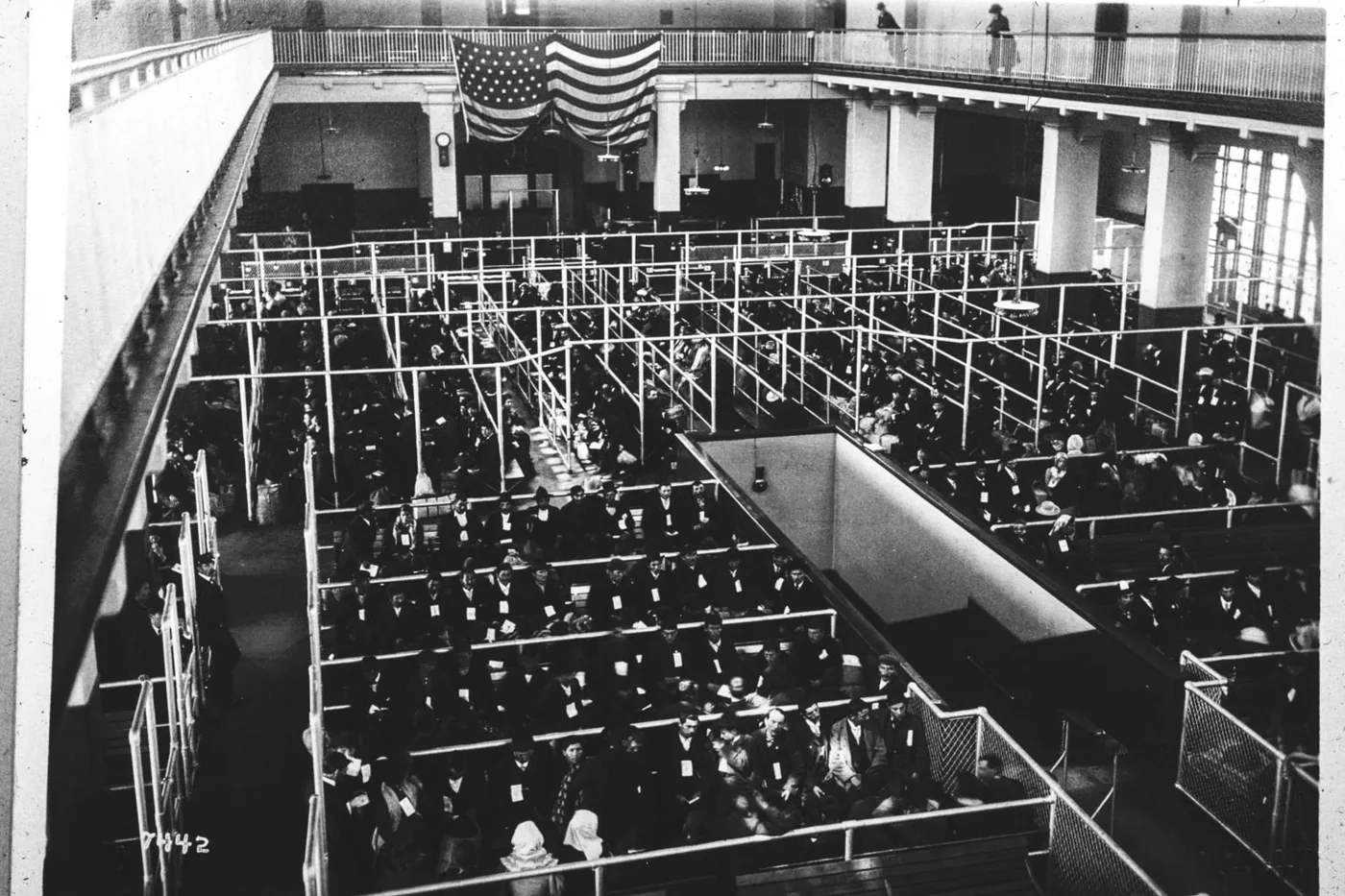
Ellis Island was the immigration station in New York Harbor where the United States decided, one person at a time, who could enter the country. It began operating on January 1, 1892, and handled more than 12 million people before it shut down in 1954. The first person through was Annie Moore, a 17-year-old from County Cork, Ireland, who had crossed the Atlantic in steerage with her two younger brothers on the steamship Nevada. Roughly four in ten Americans alive now have at least one ancestor who came through Ellis Island.
Not everyone who arrived in New York was sent there. Wealthier travelers in first or second class were examined on board the ship and stepped off directly at the docks. Steerage passengers, the ones who could afford only the cheapest tickets, were ferried to the island for a full inspection.
How inspection worked at Ellis Island
Arrivals walked up a long staircase to the Registry Room, a cavernous hall on the second floor. Doctors stood at the top and watched them as they came up. The staircase itself was a screening tool: anyone who limped, wheezed, or struggled with a bag was pulled aside.
The medical exam that followed took only seconds. Doctors used chalk to mark anyone they wanted to examine further. Each letter stood for something: L meant a limp, H meant possible heart trouble, X meant possible mental illness, E meant an eye problem needed checking. The eye exam was the part most arrivals dreaded. A doctor would use a small metal hook to turn back the eyelid, checking for trachoma. Trachoma was an eye infection, contagious and at the time largely untreatable. Anyone found to have it was turned away.
After the medical exam came a legal interview. An inspector asked roughly thirty questions and compared the answers to the ship's passenger list: what was the person's name, their trade, where were they headed, how much cash did they have. One question asked whether someone was already waiting to employ them. Under the contract-labor laws, having a job lined up actually counted against you, so the smart answer was no, even when it was not true.
Most people got through. About 98 percent were admitted, usually within a few hours. The other 2 percent, roughly 250,000 people over the station's lifetime, were turned away. Families were sometimes broken apart by a single rejection: one child kept back for running a temperature while the others continued to Manhattan. Among immigrants, the station earned the nickname "island of tears."
The peak years at Ellis Island
The year 1907 was the station's busiest. More than 1 million people passed through, and on April 17, the single busiest day, inspectors handled 11,747 arrivals. Most people arriving during this period came from Italy, Poland, Slovakia, Greece, and the Jewish communities of the Russian Empire.
Their sheer numbers provoked a backlash. Critics said the new arrivals could not be absorbed, that they were too different in religion, too many in number, and too poor to contribute. In 1924, Congress passed the Johnson-Reed Act. The law set national-origin quotas based on the 1890 census, a date chosen because it predated most southern and eastern European immigration. It reduced immigration from Italy and Poland to a small fraction of what it had been, and it barred most Asian immigrants entirely. Within five years, annual arrivals fell from about 700,000 to roughly 280,000.
Why did Ellis Island close?
The Johnson-Reed Act did more than cap numbers. It shifted immigration screening overseas, to American consulates, where people now applied for visas before boarding a ship. The inspection halls on Ellis Island lost their purpose almost overnight.
For its last three decades, from the mid-1920s to 1954, the station served mainly as a holding facility for deportees. It housed enemy nationals in wartime and people accused of radical politics during the postwar scares over communism. It closed for good in 1954.
Immigrants arriving on the West Coast never set foot on Ellis Island. Many went through Angel Island, a station in San Francisco Bay. There, laws restricting Chinese immigration led to harsh interrogations that could drag on for weeks or months. A few detainees scratched poems into the wooden walls of the barracks.
Were names changed at Ellis Island?
A popular family story holds that inspectors at Ellis Island garbled immigrants' surnames, either by accident or by simplifying names they could not spell. The historical record shows otherwise. Inspectors on the island never wrote down names themselves. The only list of passengers came from the ship's manifest, filled out by clerks at the port of departure in Europe. Inspectors compared each person to that existing document.
Name changes did happen, but immigrants typically chose new names on their own after arriving, often to fit in.
Ellis Island today
The main building reopened in 1990 as the Ellis Island Immigration Museum. A $100 million renovation announced in 2024 is expanding the exhibits and adding digital access to over 150 million arrival records. The station closed seven decades ago, but its records connect millions of American families to the ships and ports their ancestors came from.