
Great Pyramid of Giza
The Great Pyramid of Giza is a 2560 BC tomb for the pharaoh Khufu and the only surviving wonder of the ancient world.
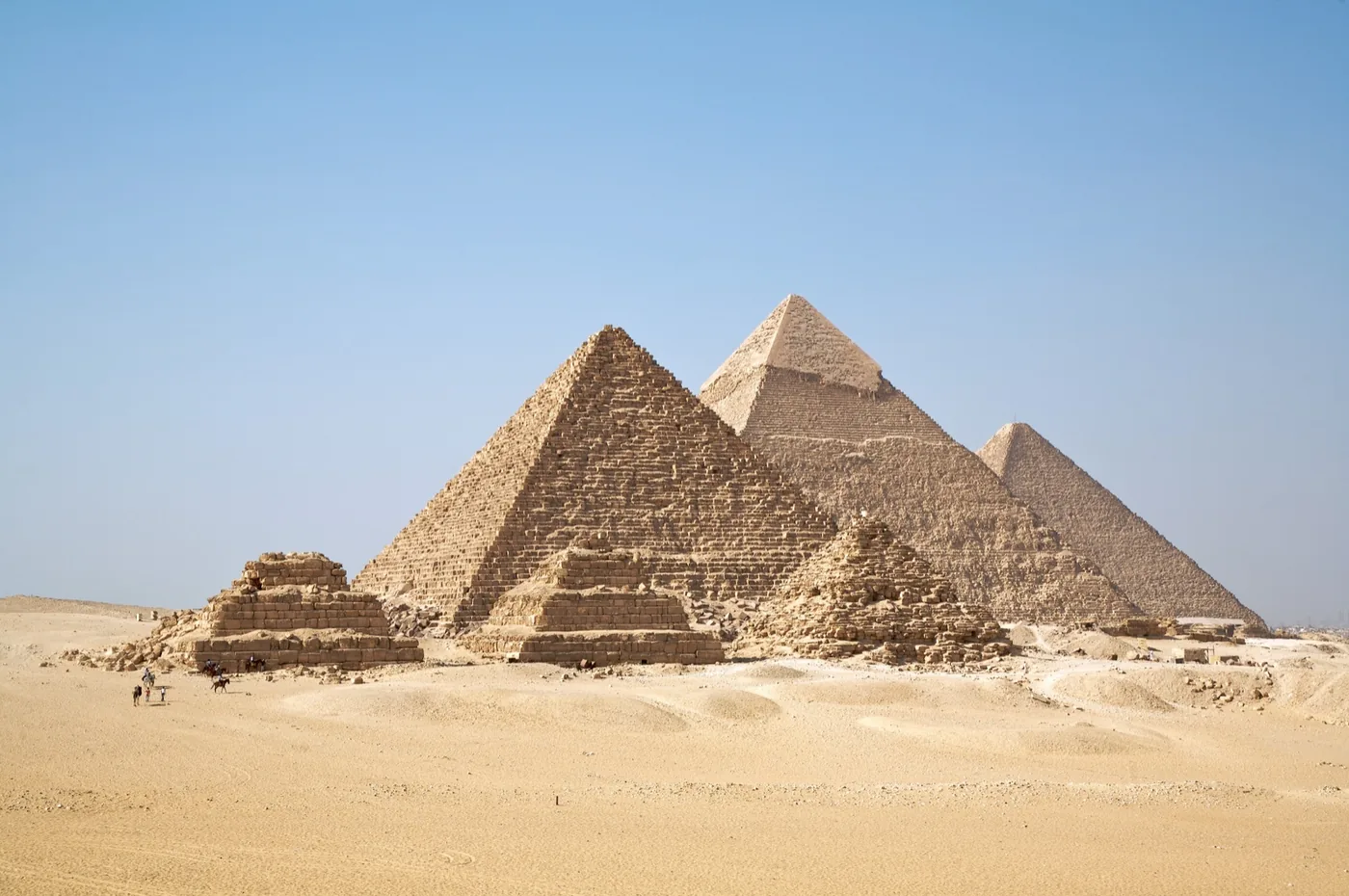
The Great Pyramid of Giza is a tomb built around 2560 BC for the Egyptian pharaoh Khufu, on the Giza plateau west of what is now Cairo. It is the oldest and only surviving member of the ancient world's seven wonders. Roughly 2.3 million limestone and granite blocks went into it, weighing a total of roughly six million tons. When finished, it rose to about 146 meters, and for the next 3,800 years nothing taller was built on Earth. The only complete statue of Khufu is a small ivory statuette, about 7.5 centimeters tall, found at a site called Abydos, hundreds of kilometers from Giza. The man who built the largest monument in the ancient world left one of the smallest known royal portraits.
How Khufu built the Great Pyramid
Khufu was the second pharaoh of Egypt's Fourth Dynasty and the son of Sneferu, who had already built two large pyramids at Dahshur, about 20 kilometers south of Giza. Sneferu's projects were experiments. His first attempt at Dahshur, now called the Bent Pyramid, had to change its angle partway up because the original slope was too steep. His second, the Red Pyramid, got the engineering right. Khufu inherited those lessons and a workforce that already knew how to build on a massive scale.
The Great Pyramid took roughly twenty years to complete. Most of the limestone came from quarries on the Giza plateau itself. The fine white casing stones came from Tura, across the Nile. The heaviest pieces, granite blocks weighing up to about 80 tons for the King's Chamber, were quarried at Aswan, roughly 900 kilometers upriver, and shipped north by barge during the annual flood.
The four sides of the base are aligned to the cardinal directions with less than a twelfth of a degree of error. The base covers thirteen acres and is level across its entire footprint to within a few centimeters. The builders achieved this without a compass or any modern surveying instrument.
In the Old Kingdom, the pharaoh was considered a living god whose survival after death was thought to keep the cosmic order intact. The pyramid was designed to preserve him for eternity. Its interior contains three chambers. The highest, the King's Chamber, holds a granite sarcophagus that had to be placed during construction because it is too large to fit through the passages. The sarcophagus was found empty. The pyramid was probably robbed within a few centuries of Khufu's burial.
Were the pyramids built by slaves?
For most of Western history, people assumed the answer was yes. Herodotus, a Greek historian who visited Egypt around 450 BC, roughly 2,000 years after the pyramid was built, wrote that 100,000 men were forced to work on it. Hollywood repeated the image for decades.
Archaeological work starting in the late 1980s told a different story. Egyptologists Mark Lehner and Zahi Hawass uncovered a workers' town beside the Giza plateau with bakeries, breweries, and graves of workers whose broken bones had been set. The workers ate bread, drank beer, and were given beef, a luxury in ancient Egypt. When they died, they were buried in small tombs near the pyramid, an honor that would not have been given to slaves.
The pyramid was built by Egyptian laborers, conscripted in rotating shifts, with perhaps 20,000 to 30,000 on site at once. They were organized into crews with their own names. Graffiti left by workers inside the pyramid include the crew name "Friends of Khufu." The crews served in shifts tied to the agricultural calendar, coming to Giza when the Nile's annual flood covered the fields and made farming impossible.
Building the Great Pyramid required a bureaucracy that could feed and house thousands of workers for twenty years, an agricultural surplus large enough to support them, and a state organized enough to coordinate the whole effort. It was a feat of administration as much as engineering.
How tall is the Great Pyramid of Giza?
The Great Pyramid originally stood about 146 meters (481 feet) tall. Erosion and the loss of the upper courses have brought it down to about 138 meters (455 feet) today.
For roughly 3,800 years it was the tallest structure humans had ever built. The pyramid was not surpassed until Lincoln Cathedral in England completed a central spire around 1311, reaching about 160 meters. That spire collapsed in a storm in 1548, but by then other European churches had passed the pyramid's height.
When new, the pyramid looked very different from the stepped stone visible today. Its outer surface was covered in smooth, polished white limestone from the Tura quarries. In the Middle Ages, most of that casing was stripped away to build mosques and fortresses in Cairo. A few casing stones survive at the base, and the joints between them are about half a millimeter wide.
The Great Pyramid is the largest of three main pyramids on the Giza plateau. The other two were built for Khufu's son Khafre and his grandson Menkaure. Khafre's pyramid appears taller from some angles because it sits on higher ground, but it is actually a few meters shorter. No later pharaoh matched the scale of Khufu's pyramid, and 4,500 years later it is still standing.