
HIMARS
HIMARS is a truck-mounted rocket launcher that fires GPS-guided munitions at ranges up to about 500 km, known for its role in Ukraine's war against Russia.
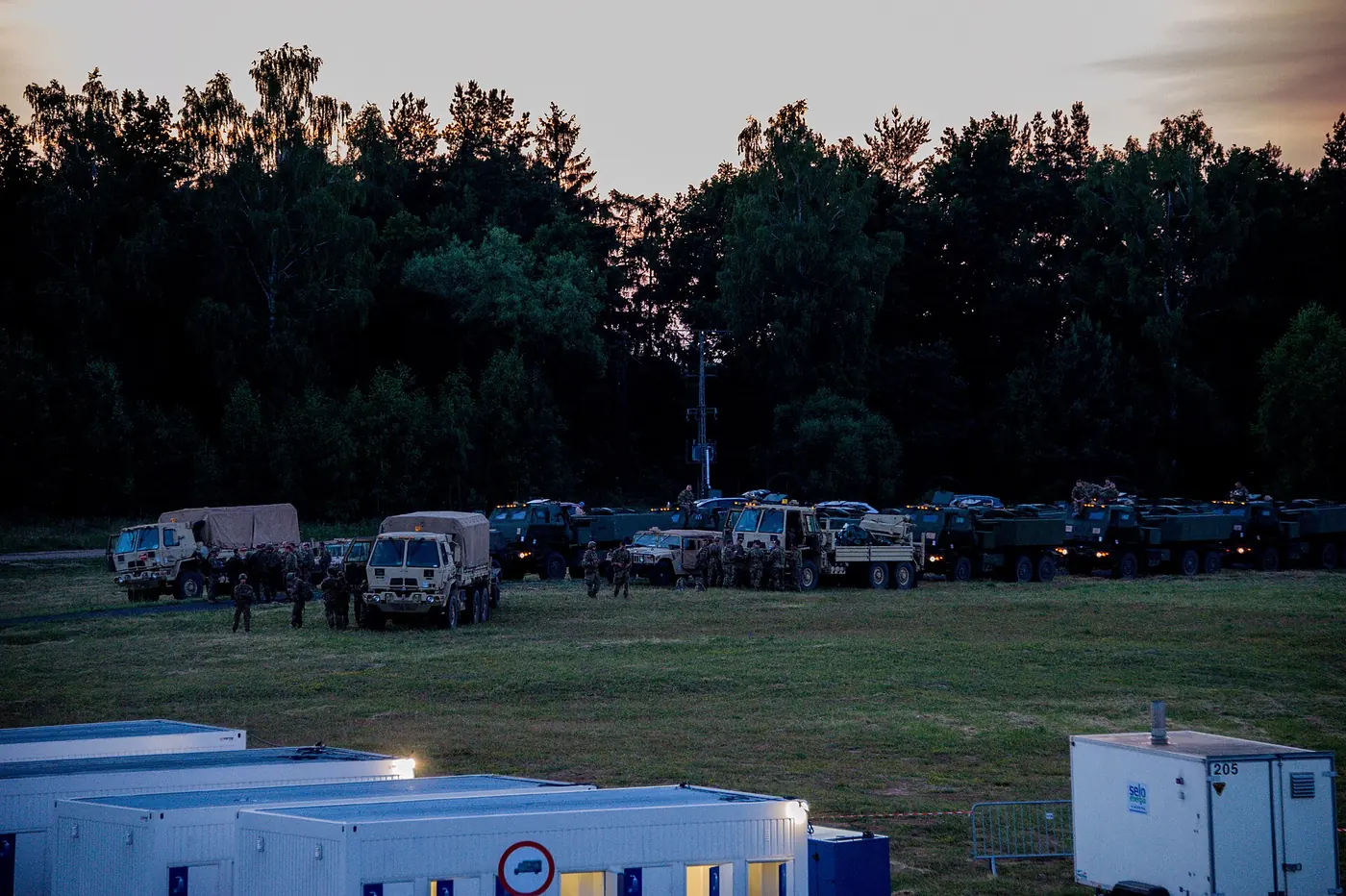
The M142 High Mobility Artillery Rocket System, or HIMARS, is a truck-mounted rocket launcher built by Lockheed Martin for the US Army. It sits on the back of a standard five-ton army truck, carries a pod of six GPS-guided rockets, and weighs about 16 tons loaded. A crew of three operates it. The Army first deployed HIMARS in 2005, but the system became widely known in 2022 when Ukraine used a small number of launchers to destroy dozens of Russian ammunition depots, command posts and bridges during Russia's full-scale invasion. Each rocket strikes within meters of a set of coordinates, and the launcher can be driving away within about a minute of firing, before the enemy can shoot back.
How Ukraine used HIMARS to change the war
Ukraine received its first four HIMARS in late June 2022, four months after the invasion began. By autumn, about twenty were in the country. They were few, but they hit a weakness in how the Russian army fought.
The Russian army ran on artillery, and artillery ran on shells. Millions of rounds moved forward by rail and piled up in big depots near the front lines. Command posts sat in the same area. For months, these targets had been out of reach of Ukraine's conventional artillery. HIMARS changed that. Each GMLRS rocket, guided by GPS, could strike a target up to about 80 kilometers away with precision measured in meters, not hundreds of meters.
Within weeks, Ukraine destroyed dozens of ammunition depots and struck headquarters, rail junctions and bridges. Russia had to pull its supply lines back past the 80-kilometer reach of HIMARS. That meant longer truck runs to the front, fewer shells reaching forward positions, and a measurable drop in Russian fire volume.
The clearest case was Kherson. Through the summer and into autumn of 2022, Ukrainian HIMARS struck the Antonivka Bridge and other crossings over the Dnipro River, cutting supply lines to Russian forces on the western bank. By September the main bridge was impassable. Russian troops on the far side, supplied only by pontoon and barge, could not hold. Russia withdrew from Kherson in November 2022. It was the only regional capital Russia had captured during the invasion and then gave up. HIMARS became a folk hero in Ukraine, with songs and T-shirts.
How Russia adapted to HIMARS
Russia adapted quickly. Russian forces dispersed their ammunition into many smaller dumps further from the front. Commanders moved their headquarters back. Russia also hunted the launchers with drones and ballistic missiles, but Ukraine used decoys, some of them made of wood, which absorbed expensive Russian missiles aimed at cheap targets.
The most effective counter was electronic warfare. GMLRS rockets navigate by GPS, which relies on a faint satellite signal that ground-based jammers can disrupt. By 2023, Russian jamming had degraded GMLRS accuracy enough that officials in both Kyiv and Washington confirmed the problem. The Washington Post reported in 2024 that jamming had made HIMARS significantly less effective in some areas of the front. The US Army began purchasing anti-jamming GPS kits in response.
The pattern repeated something seen throughout the history of warfare. A weapon works well when it first appears, the enemy studies it, and a contest begins between the weapon and its countermeasure. In Ukraine, the race between GPS-guided munitions and the electronic warfare designed to blind them became one of the defining technical struggles of the conflict.
How far can HIMARS shoot?
The range depends on which munition the launcher fires. A standard GMLRS rocket, the type Ukraine used most, reaches up to about 80 kilometers (50 miles). A single pod holds six of them.
The launcher can also carry one ATACMS missile in place of the six-rocket pod. ATACMS is a heavier ballistic missile with a range of up to 300 kilometers (190 miles). The US first sent ATACMS to Ukraine in October 2023, starting with older models that reached about 165 kilometers, allowing strikes deeper behind Russian lines.
A newer missile, the Precision Strike Missile (PrSM), is entering service as a replacement for ATACMS. It can reach more than 499 kilometers (310 miles).
How does HIMARS work?
The crew enters target coordinates, and the GMLRS rocket uses GPS and an inertial navigation system to guide itself to the point. Because each rocket is individually guided, one launcher firing six rockets can hit six separate targets in a single salvo. Older rocket artillery sprayed unguided rockets across a wide area. HIMARS puts one rocket on one point.
After firing, the crew drives the truck to a new position before the enemy can trace the rockets back to their origin and return fire. Reloading takes minutes: the launcher's own crane lifts a fresh pod off a supply truck, replacing the empty one. These features, precision at long range, fast relocation, and quick reload, made a small number of HIMARS more effective in Ukraine than far larger numbers of conventional guns.
As of late 2025, Lockheed Martin had built more than 750 HIMARS launchers, and more than a dozen countries operated or had ordered the system.