
Disputed territory · Eastern Europe
Crimea
Under Ukrainian drone and missile strikesUpdated October 12, 2026
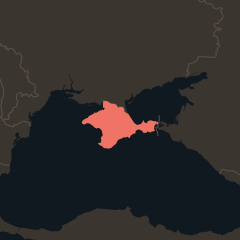
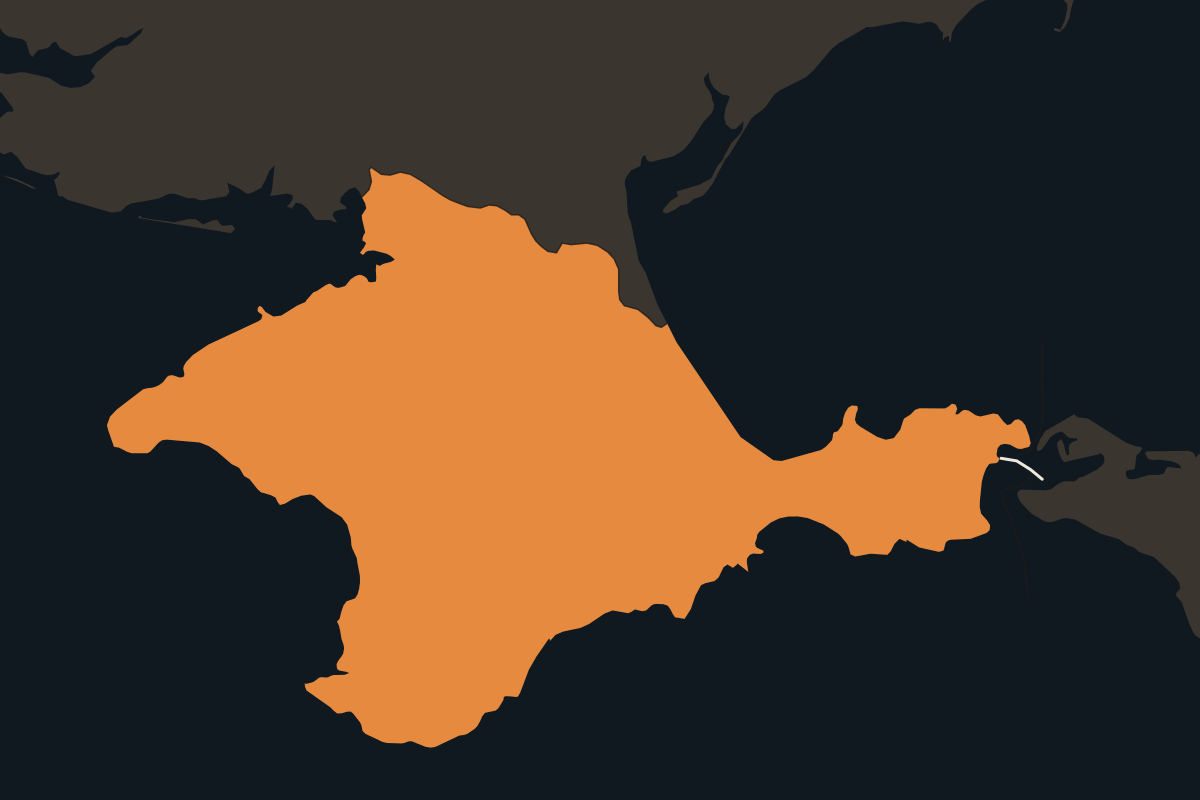
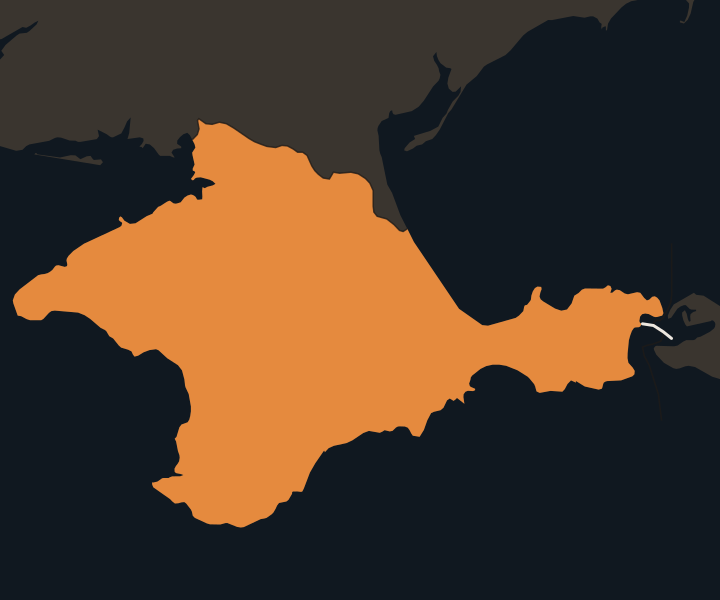
Crimea is a peninsula on the Black Sea that Russia has held since 2014. Russia annexed it in March 2014 after a referendum that Ukraine and most of the world reject. Ukraine still claims Crimea, and the UN, the EU and the United States treat it as part of Ukraine. Since 2022 Russia has used Crimea as a base and supply hub for its war, and Ukraine strikes it with drones and missiles.
- Held by Russia since
- 2014
- annexed on March 18, 2014
- Area
- 27,000 km²
- including Sevastopol
- People
- 2.3 million
- Russia's 2014 census, which Ukraine rejects
- Crimean Bridge
- 19 km
- opened in 2018, hit in 2022, 2023 and 2025
Crimea in 30 seconds
- Armed men without insignia seized Crimea's parliament in February 2014. Russia annexed the peninsula on March 18 after a referendum Ukraine and most countries reject.
- The Soviet leadership moved Crimea from the Russian republic to the Ukrainian republic in 1954. Crimea stayed part of Ukraine when the Soviet Union broke up in 1991.
- Russia's Black Sea Fleet has been based at Sevastopol since 1783. Since 2022 Crimea has been Russia's base and supply hub for the war.
- In 2026 Ukrainian strikes on fuel depots, bridges and power plants brought fuel rationing and a Crimea-wide blackout. Peace talks have stalled.
Who controls Crimea?
Russia controls Crimea and has since 2014. Ukraine still claims it, and Ukraine's constitution says Crimea cannot be separated from Ukraine. On March 27, 2014 the UN General Assembly affirmed Ukraine's borders in Resolution 68/262, by 100 votes to 11, with 58 abstentions. Only a handful of Russia's allies, such as Nicaragua and Belarus, accept the annexation.
Crimea is part of a larger occupation. As of late September 2026 Russia holds about 19% of Ukraine, including Crimea, about 117,000 km². That includes a land corridor through southern Donetsk, Zaporizhzhia and Kherson that links Crimea to Russia. Crimea itself is not on the ground front line. The nearest ground fighting is across the Dnipro river in Kherson and in Zaporizhzhia.
 CRIMEA
UKRAINE
RUSSIA
Black Sea
Sea of Azov
Sevastopol
Simferopol
Yalta
Kerch
Dzhankoi
Yevpatoria
Feodosia
Kherson
Crimean Bridge
CRIMEA
UKRAINE
RUSSIA
Black Sea
Sea of Azov
Sevastopol
Simferopol
Yalta
Kerch
Dzhankoi
Yevpatoria
Feodosia
Kherson
Crimean Bridge
 CRIMEA
UKRAINE
Black Sea
Sea of Azov
Sevastopol
Simferopol
Kerch
Dzhankoi
Kherson
Crimean Bridge
CRIMEA
UKRAINE
Black Sea
Sea of Azov
Sevastopol
Simferopol
Kerch
Dzhankoi
Kherson
Crimean Bridge
Why does Russia want Crimea?
Russia has ruled Crimea for most of the past 240 years. The Russian Empire annexed the Crimean Khanate in April 1783 and founded Sevastopol, the home of its Black Sea Fleet, the same year.
On February 19, 1954 the Soviet leadership transferred Crimea from the Russian republic to the Ukrainian republic. Nikita Khrushchev, the Communist Party leader, is widely seen as the driving force. The transfer marked the 300th anniversary of the 1654 Pereiaslav agreement, which Soviet propaganda celebrated as Ukraine's union with Russia. Inside one Soviet state the change seemed to matter little. When Ukraine voted for independence on December 1, 1991, 54% of voters in Crimea said yes, the lowest share in Ukraine.
In 2001 about 60% of Crimea's people were ethnic Russians. A 2010 deal extended Russia's lease of the fleet's base at Sevastopol to 2042. Russia scrapped it after the annexation.
Who has ruled Crimea
- 1783The Russian Empire annexes the Crimean Khanate
- 1854Britain, France and the Ottomans fight Russia in the Crimean War
- 1944Stalin deports the Crimean Tatars
- 1954Moscow moves Crimea from Soviet Russia to Soviet Ukraine
- 1991Ukraine becomes independent, with 54% of Crimean voters in favor
- 2014Russian troops seize Crimea and Russia annexes it
- 2018The Crimean Bridge links the peninsula to Russia
- 2022Russia invades Ukraine, partly from Crimea
- 2026Ukrainian strikes bring fuel rationing and blackouts
How did Russia take Crimea in 2014?
Russia took Crimea in less than a month. In February 2014 Ukraine's pro-Russian president, Viktor Yanukovych, fled Kyiv after months of protests. On February 27 armed men without insignia seized Crimea's parliament. In a referendum on March 16, which Ukraine and most of the world reject, Russia said 96.77% of voters in the Republic of Crimea and about 95.6% in Sevastopol chose to join Russia. Vladimir Putin signed the annexation treaty on March 18.
On March 4 Putin had denied that Russian troops were involved. On April 17, in his televised "Direct Line" call-in show, he admitted that Russian servicemen had stood behind the Crimean "self-defense" forces, the armed men without insignia.
Ukraine had given up the nuclear weapons it inherited from the Soviet Union. In return, in the Budapest Memorandum of 1994, the United States, Britain and Russia promised to respect Ukraine's borders and not to use force against it.
The UN vote on Crimea, March 27, 2014
Who are the Crimean Tatars?
The Crimean Tatars are a Muslim, Turkic-speaking people who ruled the Crimean Khanate before 1783. Starting on May 18, 1944, Stalin deported the whole community, mostly to Central Asia, accusing it of collaborating with Nazi Germany. Records of the NKVD, the Soviet secret police, give about 191,000 people deported. Many died on the way or in the first years of exile. Mass return began only after 1989. In 2001 Crimean Tatars were about 12% of the Autonomous Republic of Crimea (the peninsula without Sevastopol).
Most Crimean Tatars opposed the annexation. In 2016 Russian-installed courts banned their assembly, the Mejlis, as "extremist", and Russia's Supreme Court upheld the ban. In January 2024 the International Court of Justice found that Russia had broken the court's 2017 order to lift those restrictions.
Eurovision 2016
1944
The song that won Eurovision
Jamala, a Crimean Tatar singer, won Eurovision in Stockholm on May 14, 2016 with a song called "1944". It is about her great-grandmother Nazylhan, who was put on a cattle train in May 1944 and lost her daughter on the journey.
What has the war done to Crimea?
Since 2022 Ukraine has struck Crimea as Russia's base for the war. Ukrainian attacks hit Saky air base on August 9, 2022 and the Black Sea Fleet's headquarters in Sevastopol on September 22, 2023. From late 2023 much of the fleet's active strength moved to Novorossiysk in Russia. The Crimean Bridge was hit on October 8, 2022 by a truck bomb, on July 17, 2023 by sea drones and on June 3, 2025 by underwater explosives.
In 2026 Ukraine set out to cut Crimea off. Strikes on depots and on the road from Russia through occupied southern Ukraine led to fuel rationing from May 31, and civilian fuel sales stopped on June 21. On June 26 the Russian-appointed head of Crimea, Sergei Aksyonov, declared a region-wide emergency, and Sevastopol's Russian-installed authorities did the same. Strikes on the grid blacked out all of Crimea on July 5-6.
Water is a weak point too. Ukraine dammed the North Crimean Canal in 2014, which had supplied about 85% of Crimea's fresh water. Russian forces reopened it in 2022, but the destruction of the Kakhovka dam on June 6, 2023 drained the reservoir that feeds it.
Ukraine's campaign against Crimea, 2026
- Jan 8Drones hit the Hvardiiske fuel depot
- May 31Fuel rationing begins in Crimea
- Jun 18A rail bridge on the Kerch-Dzhankoi line is hit
- Jun 21Strikes hit both ends of the Crimean Bridge and a Kerch oil terminal
- Jun 26Russia's appointed head of Crimea declares an emergency
- Jul 5Strikes on the grid black out the whole peninsula
Could Crimea go back to Ukraine?
Not soon. In April 2025 a US peace proposal reportedly offered legal recognition of Crimea as Russian, and President Trump said "Crimea will stay with Russia." A November 2025 draft offered only de facto recognition, accepting Russian control in practice but not in law. The United States has not recognized Crimea as Russian.
Three rounds of talks between the United States, Russia and Ukraine in Abu Dhabi and Geneva in January and February 2026 stalled over territory, mostly Russia's demand for all of the Donbas, the Donetsk and Luhansk regions. Ukraine will not legally recognize the occupation, but it would freeze the war on the current front line. Russia wants Crimea and four other Ukrainian regions recognized as Russian. On October 8, 2026 Russia's deputy foreign minister said there were "no plans" for three-way talks. In September 2026 Russia held State Duma elections in Crimea, and the EU said it did not recognize them.
Where each side stands
 UkraineWill not recognize the occupation, but would freeze the war on the current line
 RussiaWants Crimea and four other regions recognized as Russian
 United StatesFloated recognizing Crimea as Russian in 2025, but has not done so
What is at stake in Crimea?
The Black Sea Fleet
Sevastopol has been the fleet's home since 1783, and whoever holds Crimea can project power across the Black Sea. Ukrainian strikes since 2022 have pushed much of the fleet's active strength east to Novorossiysk.
The land bridge
Since 2022 Russia's occupied corridor through southern Ukraine has linked Crimea to Russia by road and rail. With the Crimean Bridge, it is how Russia supplies the peninsula, and both are Ukrainian targets.
Water
Crimea has little fresh water of its own. Before 2014 the North Crimean Canal supplied about 85% of it, and the loss of the Kakhovka reservoir in 2023 left the canal without its source.
Questions about Crimea
Is Crimea part of Russia or Ukraine?
Russia controls Crimea and calls it part of Russia. Ukraine, the UN, the European Union and the United States treat it as part of Ukraine. Only a handful of Russia's allies, such as Nicaragua and Belarus, accept the annexation.
Why did the Soviet Union give Crimea to Ukraine?
On February 19, 1954 the Soviet leadership transferred Crimea from the Russian republic to the Ukrainian republic. Nikita Khrushchev is widely seen as the driving force. The official reasons were economic ties and geography, since Crimea is joined to the Ukrainian mainland. The transfer also marked the 300th anniversary of the 1654 Pereiaslav agreement. Inside one Soviet state, the change seemed to matter little.
What was the Budapest Memorandum?
A set of promises signed on December 5, 1994. Ukraine gave up the nuclear weapons it inherited from the Soviet Union and joined the Non-Proliferation Treaty. In return the United States, Britain and Russia pledged to respect its independence and borders and not to threaten or use force against it. These were political assurances, not a promise to defend Ukraine.
How long is the Crimean Bridge?
About 19 km. It opened to cars in May 2018 and to passenger trains in December 2019. Putin opened it on May 15, 2018 by driving a KamAZ truck across at the head of a convoy. Ukraine attacked the bridge in October 2022, July 2023 and June 2025, and struck targets at both ends of it in June 2026.