
Disputed territory · East Asia
Dokdo / Takeshima
Quiet: yearly claims and protests, no clashesUpdated October 12, 2026
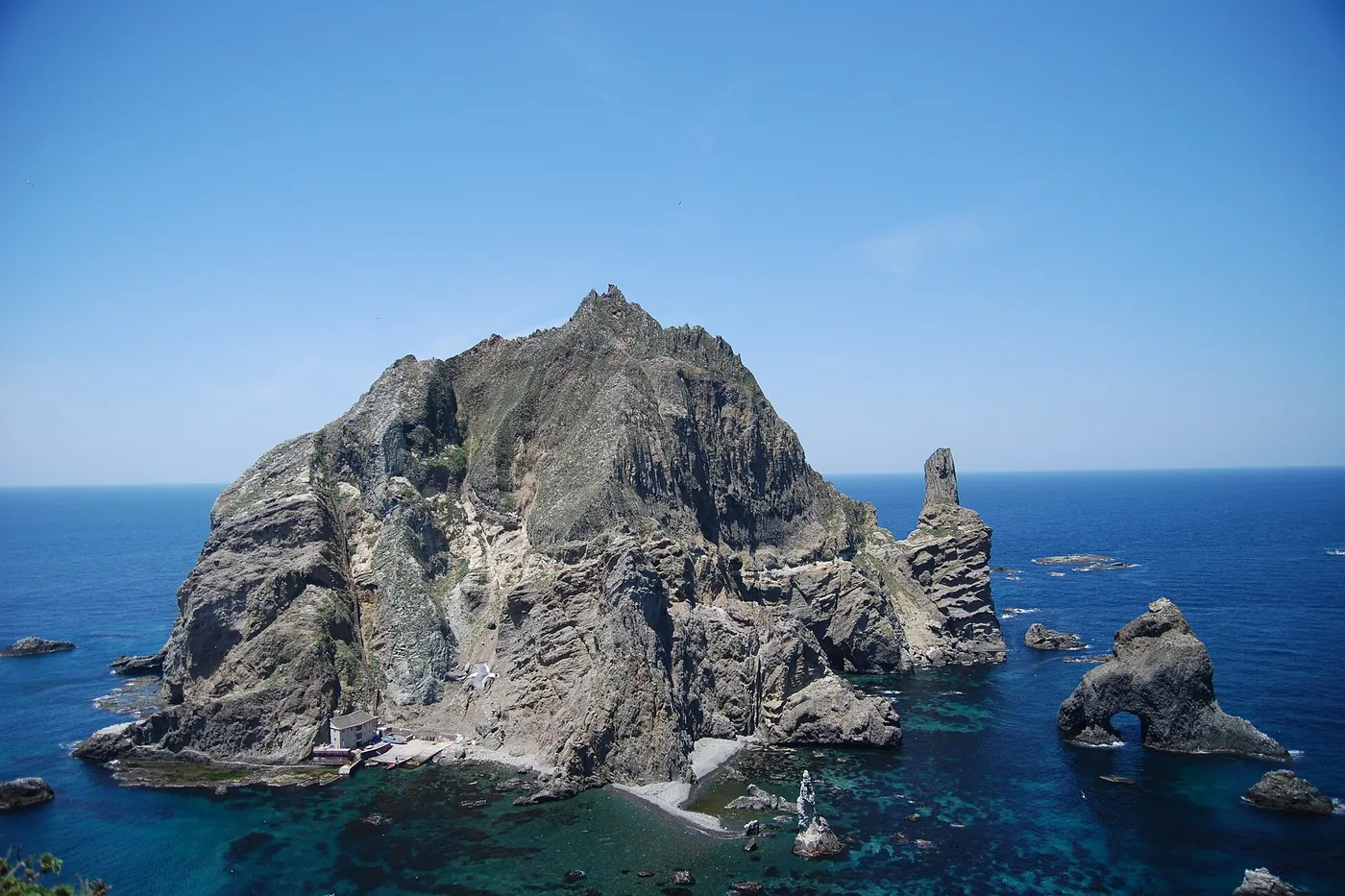
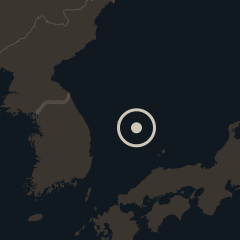
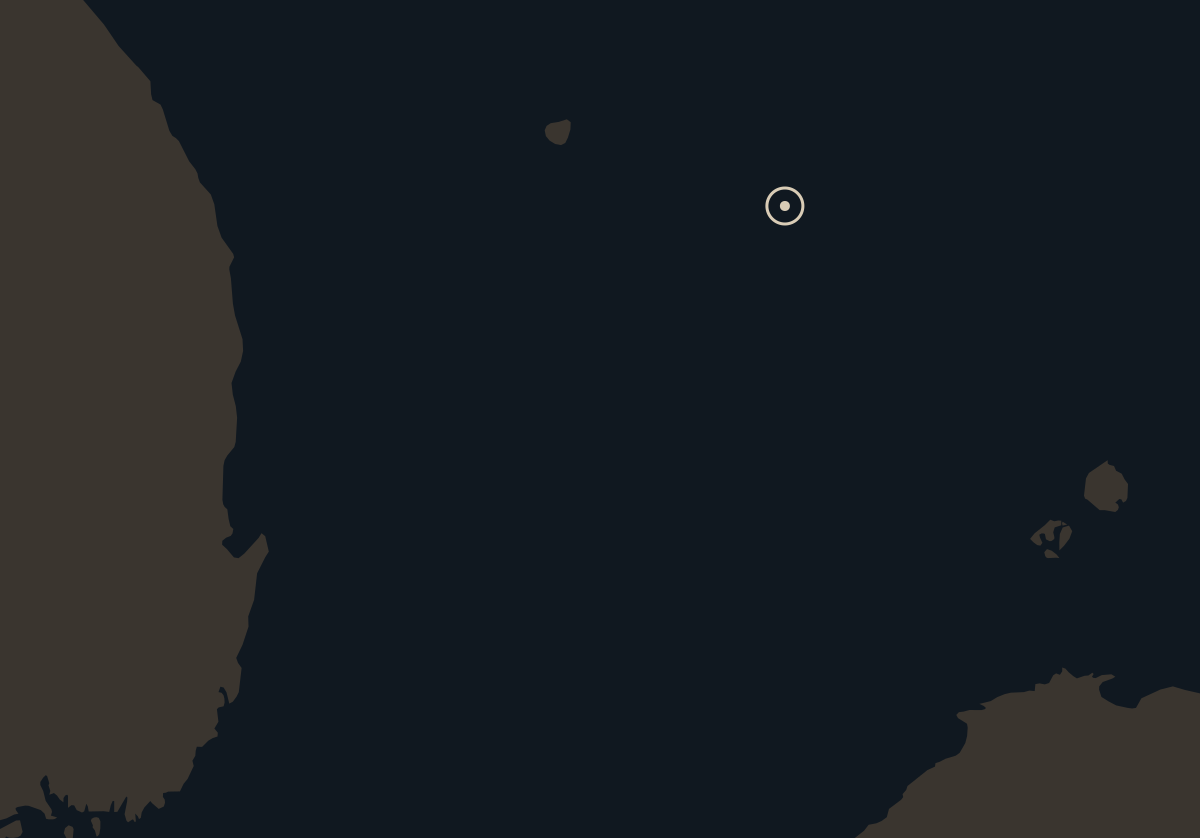
Dokdo is a group of two main islets and 89 smaller rocks between South Korea and Japan that South Korea holds and Japan claims as Takeshima. They lie about 87 km from South Korea's Ulleungdo and about 158 km from Japan's Oki Islands, each distance by its own government's figure. South Korea says Dokdo is Korean territory historically, geographically and under international law, and that there is no dispute. Japan says the islets are Japanese and that South Korea occupies them with no basis in international law. Korean police have guarded them since the 1950s.
- Area
- 0.19 km²
- South Korea's figure. Japan gives 0.20 km²
- Distance
- 87 km and 158 km
- from Ulleungdo (South Korea's figure) and the Oki Islands (Japan's figure)
- People on the islets
- About 26
- police, lighthouse keepers and officials, by South Korea's count, July 2026
- Visitors since 2005
- 3.7 million
- by South Korea's count
Dokdo / Takeshima in 30 seconds
- South Korea holds Dokdo, two islets and 89 rocks between South Korea and Japan. Japan claims them as Takeshima. Each side says history and international law support its case.
- Japan incorporated the islets into Shimane Prefecture in 1905. Japan says this lawfully reaffirmed sovereignty it already held. South Korea says the islets were already Korean and were the first Korean territory to fall victim to Japan's aggression.
- South Korea has held the islets since the 1950s. It has refused Japan's proposals to take the dispute to the International Court of Justice, saying there is no dispute.
- Every year Japan restates its claim in official papers and South Korea protests, and South Korea holds drills around the islets and Japan protests. Relations warmed in 2025-26, and both governments kept the islets out of their summits.
Who controls Dokdo?
South Korea controls Dokdo and administers it as part of Ulleung County, in North Gyeongsang Province. Japan counts the islets as part of the town of Okinoshima, in Shimane Prefecture. About 26 people are on the islets at any time, by the count of South Korea's foreign ministry in July 2026: officers of a South Korean police unit, two lighthouse keepers and two county officials. Nearly 3.7 million people have visited since 2005, about 500 a day, by the same count.
South Korea's navy holds drills around the islets, which it calls defense drills, about twice a year, closed to the press since 2019. There have been three under President Lee Jae-myung: in July 2025, December 2025 and August 2026. Japan protested each time.
Dokdo's residents
0
Registered residents since March 2026
The fisherman Kim Sung-do and his wife, Kim Shin-yeol, moved to the islets in the late 1960s. Kim Sung-do died in 2018. Kim Shin-yeol left in 2020 after a typhoon damaged their house and died at 88 on March 2, 2026. Their daughters and those of Choi Jong-deok, who lived on the islets from 1965 as their first resident, now dispute who should live there next.
 Dokdo
Dokdo(Takeshima) SOUTH
KOREA JAPAN Sea of Japan
(East Sea) Ulleungdo Oki Islands Pohang Matsue
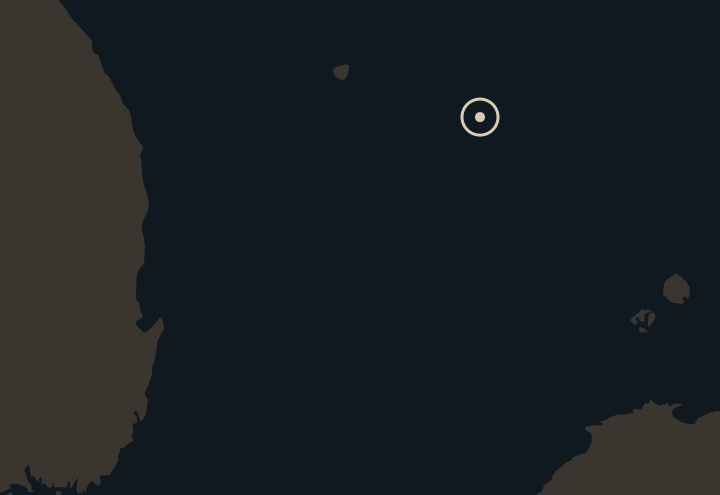 Dokdo
Dokdo(Takeshima) SOUTH
KOREA JAPAN Sea of Japan
(East Sea) Ulleungdo Oki Islands Pohang Matsue
Why do South Korea and Japan both claim the islets?
The dispute turns on who held the islets before 1905, whether Japan's incorporation that year was valid, and what the post-war settlement decided. On January 28, 1905 Japan's cabinet decided to place the islets, which it named Takeshima, under Shimane Prefecture. South Korea links this to what followed: later that year Japan made Korea a protectorate, and in 1910 it annexed Korea. In 1946, after Japan's defeat, an Allied order, SCAPIN 677, excluded the islets from Japan's administration, while stating that this was not a decision on their final status.
Old names add to the confusion. In the Edo period (1603-1868) the Japanese called today's islets Matsushima and called Ulleungdo Takeshima. In 1693 Japanese fishermen took a Korean fisherman, An Yong-bok, from Ulleungdo to Japan, and in 1696 he returned to Japan of his own accord. South Korea says his trips led Japan to admit that Ulleungdo and Usan, which South Korea says is Dokdo, were Korean. Japan says his statements have "numerous inconsistencies with the facts."
The documents each side cites
- 512The Korean kingdom of Silla conquers Usan-guk, a state South Korea says included Dokdo
- 1454A Korean record describes two islands visible from each other. South Korea says one is Dokdo
- 1618Japan says the shogunate let two families sail to Ulleungdo, using the islets as a stopover
- 1877A Japanese order says "Takeshima" (then Ulleungdo) "and one other island" have nothing to do with Japan
- 1900A Korean decree places "Seokdo", which South Korea reads as Dokdo, under Ulleungdo's new county
- 1905Japan incorporates the islets as Takeshima
- 1946An Allied order excludes the islets from Japan's administration, not as a final decision
- 1951The peace treaty does not name the islets. A US letter says they were never treated as Korean
- 1952South Korea declares the Peace Line, which Japan calls the Syngman Rhee Line
What does each side say?
South Korea cites the Sejong Sillok Jiriji of 1454, which describes two islands, Usan and Mureung (Ulleungdo), visible from each other on a clear day, and identifies Usan as Dokdo. It cites the Korean Empire's Imperial Ordinance No. 41 of October 25, 1900, which placed "Seokdo" under Uldo County, the new county for Ulleungdo, and reads "Seokdo" as Dokdo. It also cites a Japanese order of 1877 that said "Takeshima and one other island" had nothing to do with Japan, and reads these as Ulleungdo and Dokdo. South Korea says Dokdo was the first Korean territory to fall victim to Japan's aggression against Korea.
Japan says it established sovereignty by the mid-17th century at the latest. It says the Edo shogunate allowed two merchant families of Yonago to sail to Ulleungdo, and that they used the islets as a stopover and fishing ground. It says its 1905 cabinet decision lawfully reaffirmed that sovereignty, and that Usan is another island, not Dokdo. Japan also says the 1951 peace treaty did not list Takeshima among the islands Japan gave up.
Each side in its own words
 South Korea"Dokdo is an integral part of Korean territory, historically, geographically and under international law" (Ministry of Foreign Affairs)
 Japan"Takeshima is indisputably an inherent part of the territory of Japan, in light of historical facts and based upon international law" (Cabinet Secretariat)
What did the 1951 peace treaty say?
The 1951 San Francisco peace treaty did not mention the islets, and each side reads the silence its own way. In Article 2(a) of the treaty, signed on September 8, 1951, Japan renounced all claims to Korea, "including the islands of Quelpart, Port Hamilton and Dagelet" (Jeju, Geomundo and Ulleungdo). In a letter of August 10, 1951, Dean Rusk, a US assistant secretary of state, told Yang You-chan, South Korea's ambassador to the US, that "according to our information" the islets were "never treated as part of Korea." Japan cites the letter. South Korea says it was one country's view, not a decision of the treaty, and that SCAPIN 677 had already excluded the islets from Japan. Japan replies that SCAPIN 677 itself said it was not a final decision on sovereignty.
On January 18, 1952 President Syngman Rhee declared a sea boundary that South Korea calls the Peace Line and Japan calls the Syngman Rhee Line. It put the islets on Korea's side. Japan says South Korea seized Japanese fishing boats and detained their crews under the line, which ended in 1965. South Korea says a civilian volunteer group held the islets from 1953 to 1956 and then handed them to the police. Japan dates what it calls South Korea's occupation to the stationing of police there in June 1954.
Japan's offers to go to the world court
- September 1954South Korea refused in October 1954
- March 1962South Korea did not agree
- August 2012After President Lee Myung-bak visited the islets. South Korea refused
How do the islets affect relations today?
Relations between South Korea and Japan have warmed since 2025, and both governments keep the islets out of their summits. President Lee Jae-myung, in office since June 2025, and Prime Minister Sanae Takaichi, in office since October 2025, have met four times, most recently in May 2026. Even so, the yearly round of claims and protests goes on. In 2026 South Korea protested new Japanese textbooks in March, Japan's diplomatic bluebook in April and its defense white paper in August, the 22nd white paper in a row to state the claim. In August Japan protested a South Korean navy drill and a South Korean survey ship working west of the islets, in waters Japan calls its exclusive economic zone.
Before taking office, Takaichi had called for a cabinet minister to attend Takeshima Day, a ceremony Shimane Prefecture holds each February 22 to mark its 1905 notice placing the islets under the prefecture. In 2026 Japan sent a parliamentary vice minister instead, as in each of the 13 years before. In March 2026 Takaichi said Japan would "clearly let the international community know that Takeshima is Japanese territory." South Korea's presidential office replied: "There is no territorial dispute over Dokdo."
The islets in 2026
- Feb 20Japan's foreign minister restates the claim in parliament
- Feb 22Japan sends a parliamentary vice minister to Takeshima Day
- Mar 12Takaichi says Japan will tell the world Takeshima is Japanese
- Apr 10South Korea protests Japan's diplomatic bluebook
- Aug 4South Korea protests Japan's defense white paper
- Early AugSouth Korea's navy holds a drill around the islets, and Japan protests
- Aug 7Japan protests a Korean survey ship west of the islets
- Oct 9Dokdo is dropped from the Korean edition of the Equal Earth world map. South Korea denies agreeing to it
What is at stake in Dokdo / Takeshima?
Fishing
A fisheries agreement in force since 1999 set up shared provisional waters in which the islets sit and left the boundary and sovereignty questions aside. Talks on fishing in each other's waters broke down in 2014, when both countries shut out each other's boats.
Sea zones
Neither country has fixed a sea boundary in the area. Japan uses the islets as a base point for its exclusive economic zone, the waters where a country controls fishing and seabed resources, and since 2006 South Korea has too, after earlier using Ulleungdo. A South Korean program found methane hydrate, a frozen gas, in the nearby Ulleung Basin in 2007.
National identity
In 2025, 4,668 Koreans had Dokdo listed as their registered domicile, an address on paper,, by a Korean regional newspaper's count, and 112 Japanese had Takeshima listed as theirs, by Okinoshima town's. A Dokdo Museum stands on Ulleungdo, and Japan opened a National Museum of Territory and Sovereignty in Tokyo in 2018. Japanese schools teach Takeshima as Japanese territory, and many Koreans know the 1982 song "Dokdo Is Our Land."
Questions about Dokdo / Takeshima
Who owns Dokdo / Takeshima?
South Korea holds and governs the islets, and Japan claims them. No court has ruled. The International Court of Justice can hear the case only if both countries agree, and South Korea has refused Japan's proposals, saying there is no dispute to settle.
Dokdo, Takeshima or Liancourt Rocks?
Dokdo, the Korean name, is usually read as "solitary island", and some Korean sources link "dok" to a dialect word for stone, which ties it to the "Seokdo" ("stone island") of the 1900 decree. Takeshima, the Japanese name, means "bamboo island". Japan gave it to the islets in 1905 after earlier using it for Ulleungdo. Liancourt Rocks, the name the US government uses, comes from the French whaler Le Liancourt, which nearly ran onto them in 1849. This page uses Dokdo, the name used by the country that holds the islets, as it does for other territories. It calls the sea the Sea of Japan, the name most international charts use, which South Korea calls the East Sea.
What happened to the islets' sea lions?
Japanese sea lions, called gangchi in Korean, once bred on the islets. Commercial hunting in the early 1900s cut their numbers sharply. The last colony on the islets, about 50 to 60 animals, was seen in the early 1950s. The species is now listed as extinct. South Korea cites the hunting as Japanese exploitation. Japan cites its hunting licenses as proof that it governed the islets.
Has a South Korean president visited Dokdo?
Yes, once. Lee Myung-bak became the first sitting South Korean president to visit, on August 10, 2012. Japan recalled its ambassador the same day and soon proposed taking the dispute to the International Court of Justice.