
Disputed territory · Balkans
Kosovo
Frozen: talks with Serbia stalledUpdated October 12, 2026
Kosovo, in the Balkans, has been outside Serbia's control since 1999 and declared independence from Serbia on February 17, 2008. More than 100 of the 193 UN member states recognize Kosovo, including the United States and most of the EU. Serbia says Kosovo is still its province. Russia, China and five EU members do not recognize Kosovo either. About 92% of Kosovo's 1.6 million people are ethnic Albanians, according to a 2024 census that many Serbs boycotted. NATO troops have kept the peace since the 1999 war, and talks between Kosovo and Serbia have stalled.
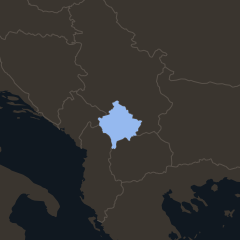
- Independence declared
- 2008
- on February 17, from Serbia
- Area
- 10,887 km²
- a little smaller than Jamaica
- People
- 1.6 million
- 2024 census, which many Serbs boycotted
- Recognized by
- 100+
- of the 193 UN members, by most counts
- Held by
 Kosovo
- Claimed by
 Serbia
Kosovo in 30 seconds
- Kosovo has been outside Serbia's control since 1999 and declared independence in 2008. More than 100 UN members recognize it. Serbia, Russia, China and five EU members do not.
- About 92% of the people are ethnic Albanians. About half of Kosovo's Serbs live in four municipalities in the north, next to Serbia. Most of the rest live in enclaves in the south.
- Serbia sees Kosovo as the cradle of its state and its Orthodox Church. The Battle of Kosovo of 1389 and medieval monasteries are central to that claim.
- NATO bombed Yugoslavia in 1999, saying it was stopping a Serbian crackdown on Albanians, and NATO troops still keep the peace. Deals reached in EU-led talks in 2013 and 2023 were never fully carried out.
Is Kosovo a country?
It depends on who you ask. Kosovo functions as a state, but many of the world's governments do not recognize it. Kosovo has its own government, parliament, police and passports, and it uses the euro. More than 100 of the 193 UN member states recognize Kosovo. Kosovo gives a higher count and Serbia gives a lower one. Kosovo is not a UN member because joining requires the Security Council, where Russia and China can veto. Kosovo joined the IMF and the World Bank in 2009 and FIFA and UEFA in 2016.
On July 22, 2010, the International Court of Justice said in an advisory opinion that Kosovo's declaration of independence did not violate international law. The vote was 10 to 4. Serbia's constitution calls Kosovo "an integral part" of Serbia. UN Security Council Resolution 1244 of 1999, which Serbia cites, is still in force.
Some countries that do not recognize Kosovo
- SerbiaCalls Kosovo its southern province, Kosovo and Metohija
 RussiaCan veto Kosovo's UN membership
 ChinaCan also veto Kosovo's UN membership
 SpainOne of five EU members, with Greece, Romania, Slovakia and Cyprus
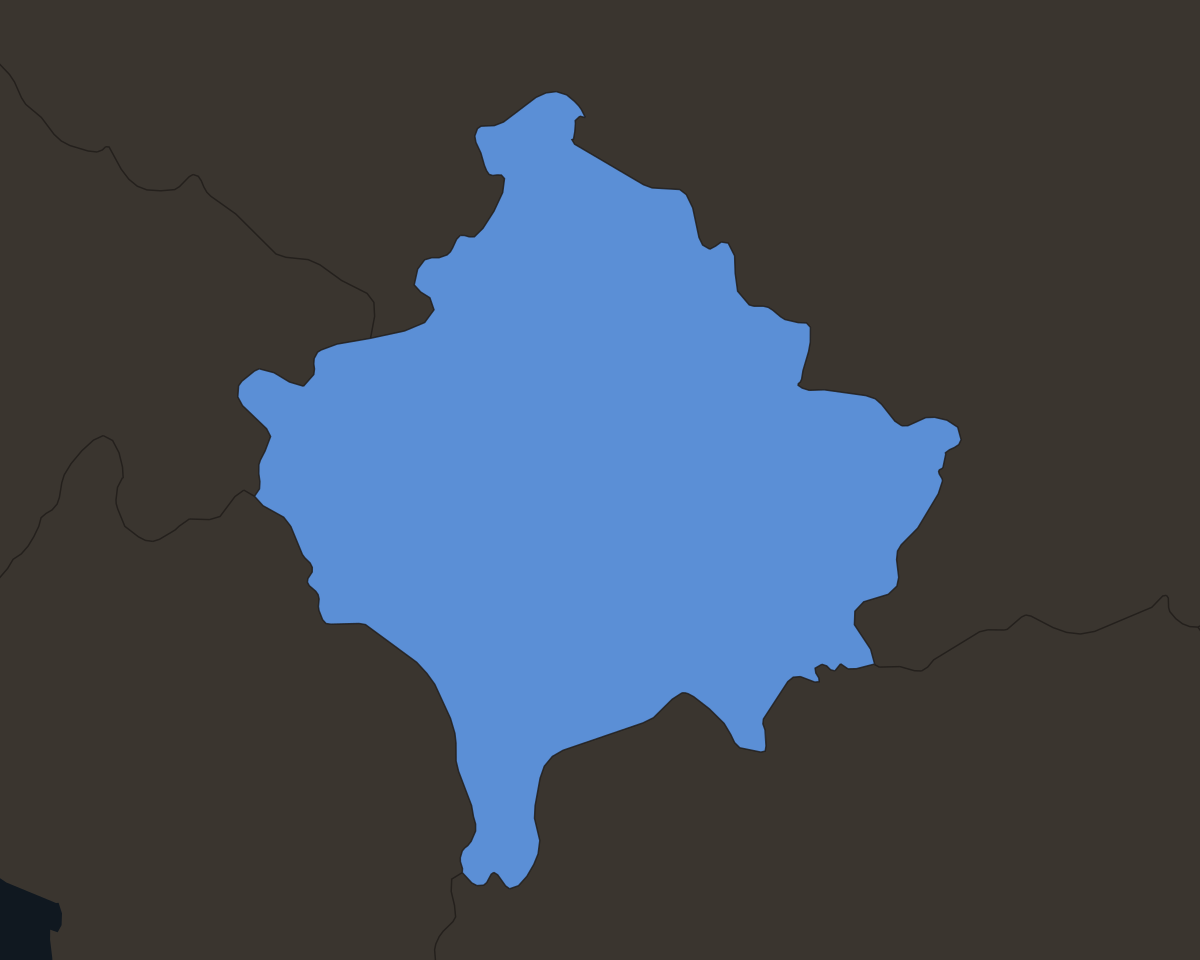 KOSOVO
SERB-MAJORITY
KOSOVO
SERB-MAJORITYNORTH SERBIA MONTENEGRO ALBANIA NORTH MACEDONIA Pristina Mitrovica Prizren Peja (Peć) Gračanica Niš Skopje
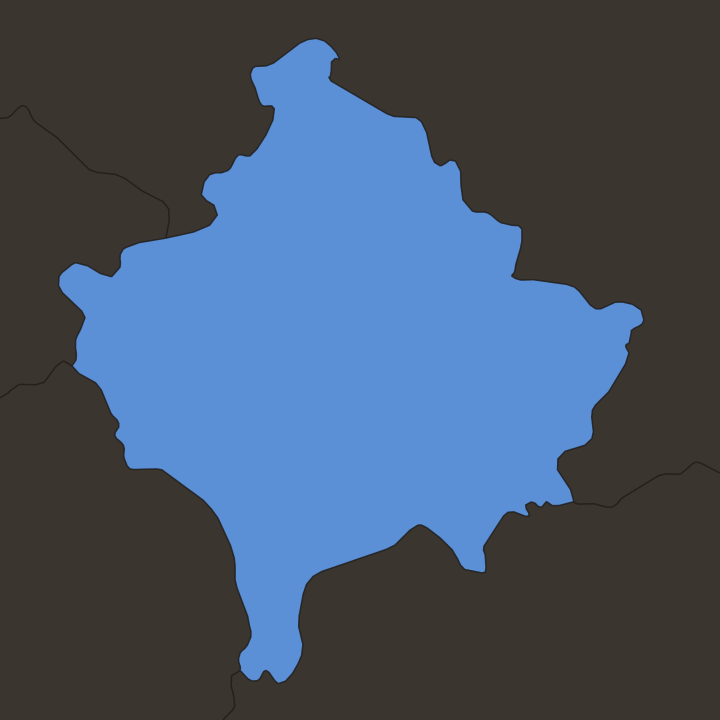 KOSOVO
SERBIA
ALBANIA
Pristina
Mitrovica
Prizren
Peja (Peć)
Skopje
KOSOVO
SERBIA
ALBANIA
Pristina
Mitrovica
Prizren
Peja (Peć)
Skopje
Why does Serbia claim Kosovo?
Serbia says Kosovo was the heart of medieval Serbia. The Battle of Kosovo, fought in 1389 against the Ottoman Turks, is central to Serbian national identity. Serbs mark it on Vidovdan, June 28. Both Prince Lazar and Sultan Murad I died in the battle. Four Serbian Orthodox sites in Kosovo, including the monastery of Visoki Dečani and the Patriarchate of Peć, are on UNESCO's list of World Heritage in Danger. Serbia and Montenegro took Kosovo from the Ottoman Empire in 1912.
Serbia also points to UN Resolution 1244 and says Kosovo's 2008 declaration broke international law.
Kosovo's government says Albanians have been the large majority for generations. After the repression of the 1990s and the 1999 war, Kosovo says living under Serbia again is impossible. Kosovo says independence is final and that only mutual recognition can end the dispute.
How Kosovo left Serbia
- 1389The Battle of Kosovo against the Ottoman Turks
- 1912Serbia and Montenegro take Kosovo from the Ottoman Empire
- 1974Yugoslavia's constitution gives Kosovo wide self-rule
- 1989Milošević strips Kosovo of most of its self-rule
- 1998War between the Kosovo Liberation Army and Serbian forces
- 1999NATO bombs for 78 days, then the UN takes over
- 2008Kosovo declares independence. Serbia rejects it
- 2010The International Court of Justice says the declaration broke no international law
- 2013The Brussels Agreement, the first deal on normalizing relations
- 2023Armed Serbs attack Kosovo police at Banjska. Four die
What happened in the Kosovo War?
In March 1989 Serbia under Slobodan Milošević stripped Kosovo of most of its self-rule. On June 28, 1989, the 600th anniversary of the Battle of Kosovo, Milošević spoke to a huge crowd at Gazimestan near Pristina. Through the 1990s Ibrahim Rugova, a literary scholar, ran a parallel Albanian state of schools and clinics. His nonviolent campaign earned him the nickname "Gandhi of the Balkans", and he was known for his trademark scarf.
The Kosovo Liberation Army (KLA) began attacks in the mid-1990s. In 1998 its fight with Serbian forces turned into open war. On January 15, 1999, 45 Albanians were killed at Račak. NATO bombed Yugoslavia, then made up of Serbia and Montenegro, for 78 days, from March 24 to June 10, 1999. More than 850,000 Albanians fled or were expelled.
Serbian forces withdrew under Resolution 1244, and the UN ran Kosovo with NATO troops (KFOR) keeping the peace. The Humanitarian Law Center's Kosovo Memory Book counts 13,625 people killed or missing from 1998 to 2000. On September 16, 2026, a special court in The Hague convicted former president Hashim Thaçi and three other former Kosovo Liberation Army leaders of war crimes. Thaçi got 25 years. All four were acquitted of crimes against humanity, and the defense will appeal. On October 6, 2026, Kosovo's parliament voted to cap the court's sentences at 15 years. The effect of that vote on the court is disputed.
1998-2000
13,625
Killed or missing in the Kosovo War
The Humanitarian Law Center, a human rights group from Serbia, records 13,625 people killed or missing in Kosovo from 1998 to 2000. Of those, 1,636 are still missing.
More than 850,000 Albanians fled or were expelled in 1999, most of them during the NATO bombing. Most returned within weeks after Serbian forces left in June 1999. After the war many Serbs, Roma and others fled Kosovo. Serbia counts about 200,000 people displaced.
Why is northern Kosovo tense?
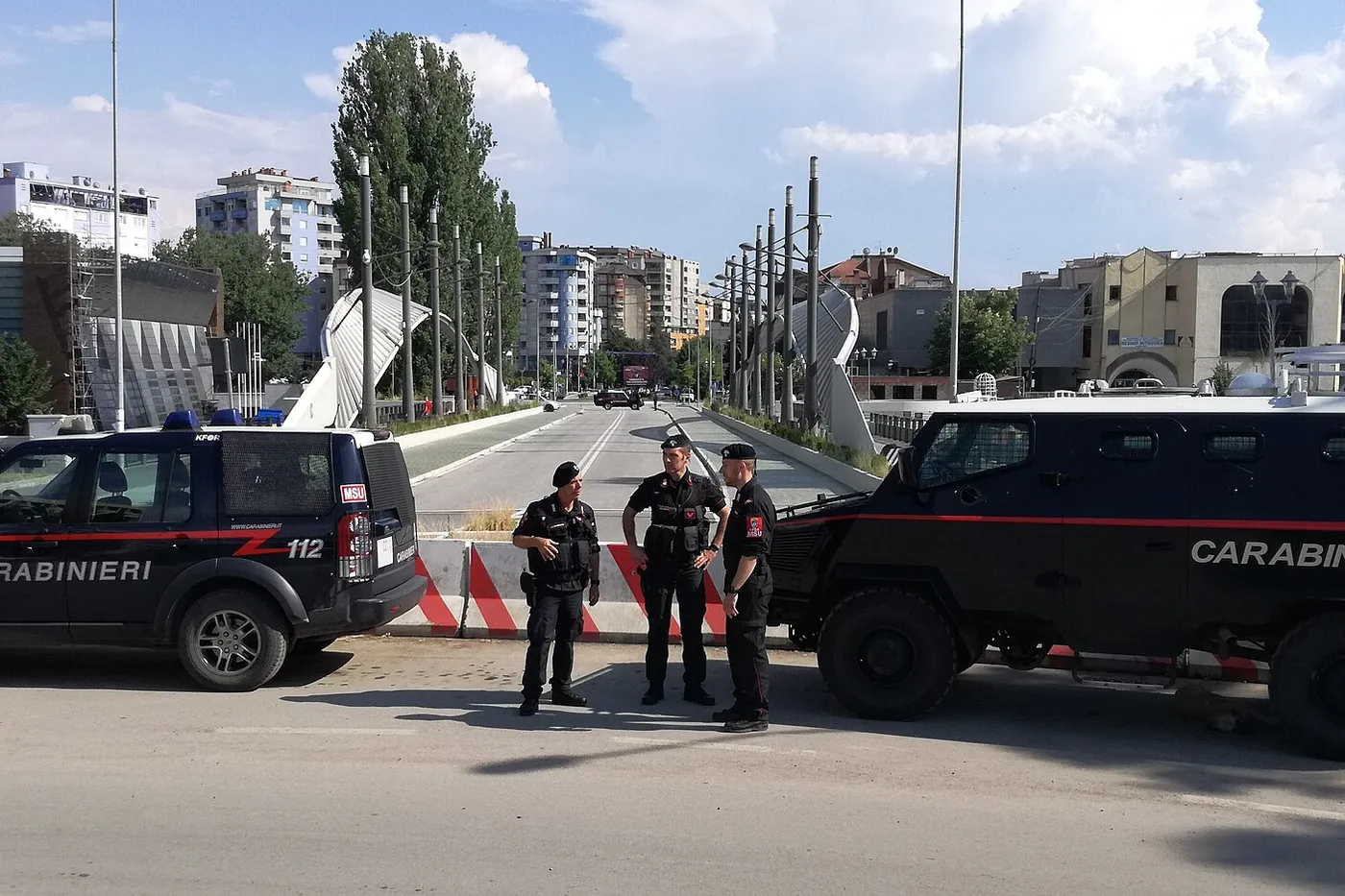
Four municipalities north of the Ibar river (North Mitrovica, Zvečan, Zubin Potok and Leposavić) have a Serb majority and lie between the Ibar and the border with Serbia. For years Serbs there used Serbian schools, hospitals, offices and money. In November 2022 Serbs quit Kosovo's police, courts and local governments over a license plate dispute. In April 2023 Serbs boycotted local elections, and Albanian mayors took office on tiny turnouts. On May 29, 2023, clashes with Serb protesters in Zvečan injured 93 NATO soldiers. On September 24, 2023, at least 30 armed Serbs led by Milan Radoičić, then a leader of the main Serb party Srpska Lista, attacked Kosovo police at Banjska. A Kosovo police sergeant and three attackers died. Radoičić admitted taking part and remains at large in Serbia. In April 2026 a Pristina court convicted three Kosovo Serbs of terrorism over the attack. Serbia rejected the verdict.
Kosovo banned the Serbian dinar for cash payments from February 2024 and closed Serbian-run offices in 2024 and 2025. In October 2025 Srpska Lista won back all four northern mayoralties. Kosovo opened a new road bridge in Mitrovica in August 2025, while the main bridge stays closed to cars.
The north since 2022
- 2022Serbs quit Kosovo's police, courts and town halls over license plates
- May 2023Clashes in Zvečan injure 93 NATO soldiers
- Sep 2023Armed Serbs attack police at Banjska. Four die
- 2024Kosovo makes the euro the only cash currency and shuts Serbian-run offices
- 2025Serb mayors return in the north after local elections
- 2026Kosovo takes over Serbia-run railway stations in the north
Will Serbia ever recognize Kosovo?
Talks led by the EU began in 2011. The Brussels Agreement of April 19, 2013 promised an Association of Serb-majority Municipalities, which has never been set up. In February and March 2023, at Brussels and Ohrid, both sides accepted an EU plan out loud, but neither signed it. Kosovo's prime minister Albin Kurti says the talks must end in mutual recognition. Serbia's foreign minister Marko Đurić says they "cannot be" about recognition. Serbia's president Aleksandar Vučić said on February 27, 2026: "Kosovo has been, is and will be Serbia."
Both governments want to join the EU, and the EU says normalizing relations is a condition for both. On September 27, 2026, Vučić resigned as president to run for prime minister in an election on October 25, 2026. In Kosovo, Kurti formed his fourth government on September 13, 2026, and parliament elected Justina Shiroka-Pula president late on October 6, 2026, with one vote more than needed, ending months of deadlock. The result was announced just after midnight, and some question whether the vote is valid.
Who leads now
- Albin KurtiKosovo's prime minister since 2021, fourth government in September 2026
- Justina Shiroka-PulaKosovo's president, elected by parliament on October 6-7, 2026
- Aleksandar VučićResigned as Serbia's president to run for prime minister
- Ana BrnabićSerbia's acting president, as speaker of parliament
What is at stake in Kosovo?
Kosovo's Serbs
Serbs made up about 2% of the population in the 2024 census, which many Serbs boycotted. Many still rely on schools and hospitals run and paid for by Serbia. Kosovo has closed other Serbian-run offices. Serbs fear a new law on foreigners could cut people without Kosovo papers off from Serbian-run schools and clinics.
NATO troops
KFOR had 4,636 troops from 33 countries in February 2026, including 907 from Italy and 590 from the United States. In June 2026 NATO said it would cut the force back to 3,000 to 3,500. In July, KFOR's commander said the cuts would be gradual, start in 2027 and could be reversed.
The road to the EU
Serbia has been an EU candidate since 2012. Kosovo applied in December 2022 and is the only country in the region without candidate status. The EU says normalizing relations with each other is a condition for both.
Questions about Kosovo
Is Kosovo part of Serbia?
Serbia says yes. Serbia's constitution calls Kosovo an integral part of Serbia, and Serbia calls the region Kosovo and Metohija. Kosovo says no. Kosovo declared independence in 2008, and more than 100 UN members recognize it. Serbia's government has had no authority over most of Kosovo since its forces left in June 1999, though it still runs schools and hospitals for Serbs. Kosovo runs its own government, police, courts and borders, and uses the euro.
Is Kosovo in the UN or the EU?
Neither. UN membership needs the Security Council's approval, where Russia and China can veto. Kosovo applied to join the EU in December 2022, but five EU members do not recognize Kosovo. Kosovo is a member of the IMF and the World Bank (2009) and FIFA and UEFA (2016). Its Olympic committee has been recognized by the International Olympic Committee since 2014. At the 2016 Olympics, Kosovo's first under its own flag, the judoka Majlinda Kelmendi won gold.
Why does Kosovo use the euro?
After the 1999 war the UN administration let Kosovo use the German mark. Kosovo switched to the euro in 2002 along with Germany. Kosovo has no say over the euro and is not part of the eurozone. From February 1, 2024, the euro became the only currency allowed for cash payments. That hit Serbs who are paid in Serbian dinars.
Why is there a Bill Clinton statue in Pristina?
Many Kosovo Albanians credit President Bill Clinton with the 1999 NATO bombing that forced Serbian forces out. Pristina named a main boulevard after Clinton. On November 1, 2009, Clinton came in person to unveil a statue of himself about 3.5 m tall. The United States recognized Kosovo the day after it declared independence.