
Why Egypt and Ethiopia are fighting over the Nile
Ethiopia finished Africa's largest dam on the river that gives Egypt 97% of its water. There is still no agreement on how to run it.
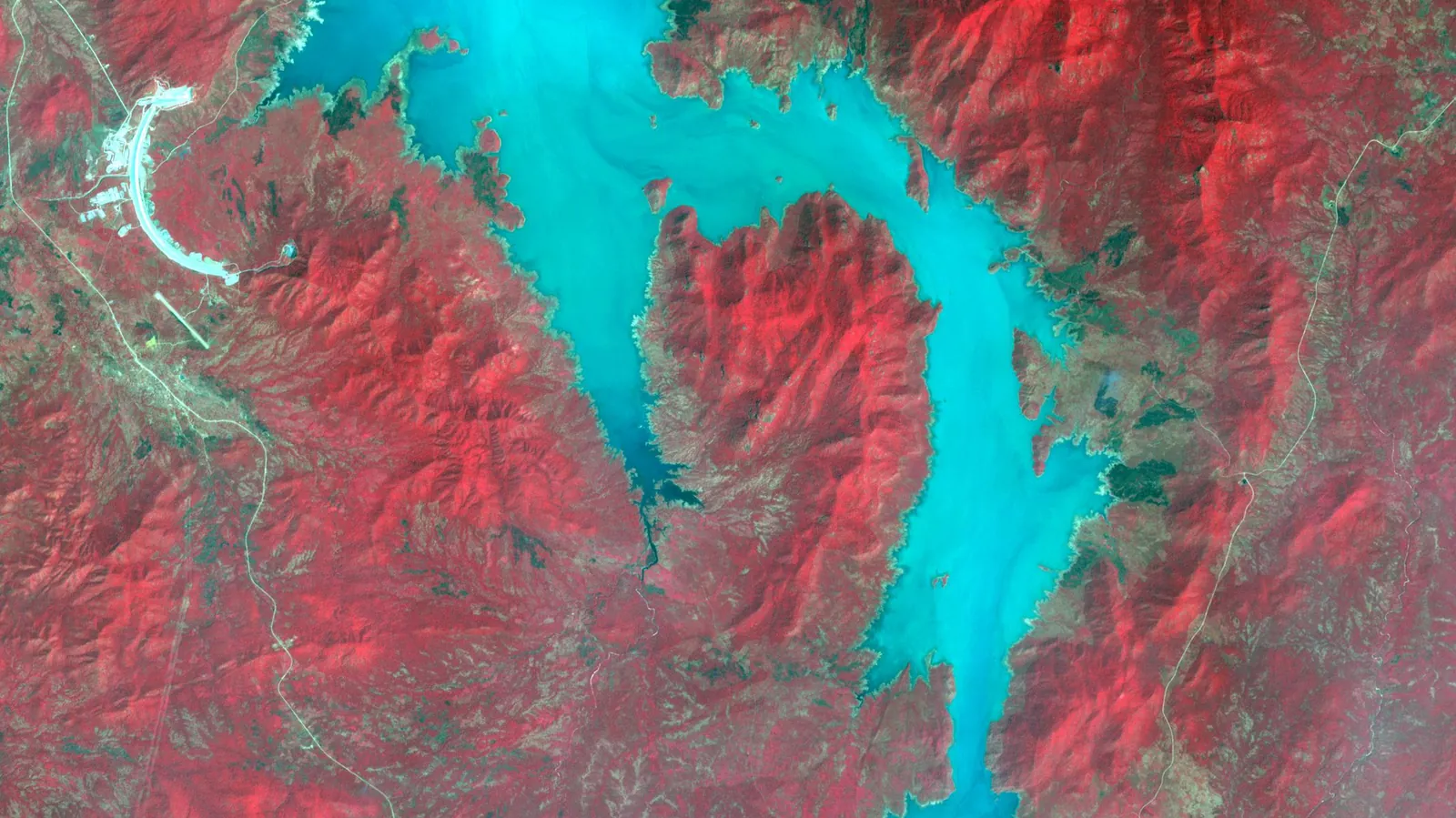
In October 2025, Egypt's president Abdel Fattah el-Sisi accused Ethiopia of a water crime. For fifteen years, Egyptian leaders had warned that Ethiopia's dam on the Blue Nile would dry their country out. The first real grievance was the opposite: water released upstream without warning had put roughly 1,300 acres of farmland in the Nile Delta under water. Ethiopia said the summer rains had been unusually heavy. Neither government could prove the other wrong, because no agreement requires Ethiopia to tell Egypt anything before it opens a gate.
The Grand Ethiopian Renaissance Dam, inaugurated in September 2025, is the largest hydroelectric dam in Africa. There is still no binding agreement on how it should be run.
Why the Nile is an existential question for Egypt
Look at Egypt from space at night and the problem is obvious. A thin line of light traces the Nile south to north, fanning into a bright triangle at the delta. Everything else is dark. That narrow strip is where roughly 120 million Egyptians live, on about 5 percent of their country's land. The rest is desert.
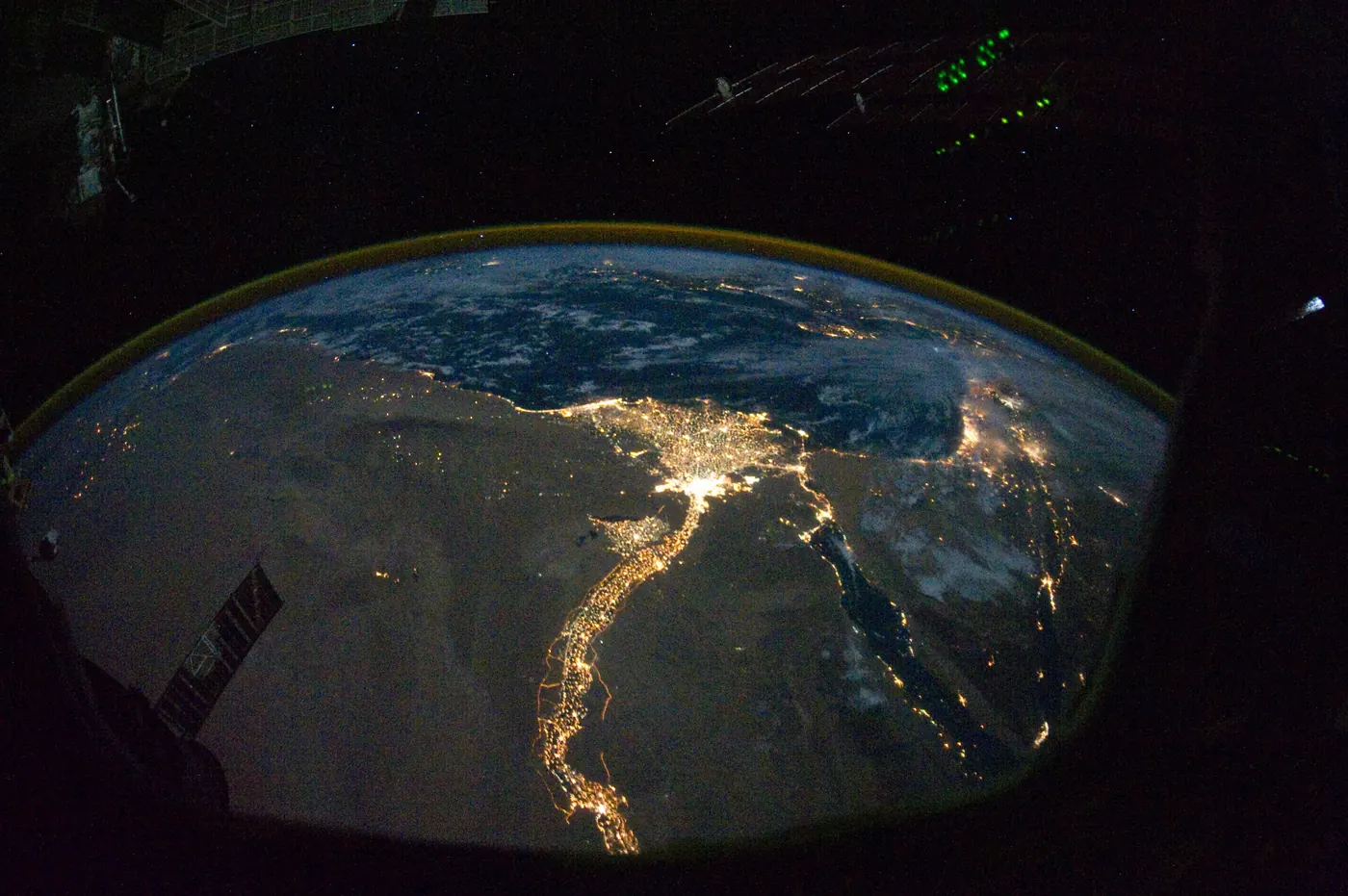
About 97 percent of Egypt's fresh water comes from the Nile. Egyptian agriculture, which employs a third of the workforce, uses more than 80 percent of it. Egypt built the Aswan High Dam between 1960 and 1970 to store the river's annual flood and release it on schedule. Its reservoir, Lake Nasser (named after President Gamal Abdel Nasser), holds over 130 billion cubic meters. But Egypt has been drawing more water than the river provides since the mid-1990s, and the population has nearly doubled since the dam was finished. There is no second river. There is no large aquifer. If the Nile's flow drops, Egypt has nowhere else to go.
The treaty Ethiopia never signed
In 1959, Egypt and Sudan signed a treaty dividing the entire Nile between themselves. Egypt took 55.5 billion cubic meters a year. Sudan took 18.5 billion. The remaining 10 billion was assigned to evaporation. That was the whole river, accounted for.
Ethiopia, the country where 85 percent of the Nile's water actually comes from, was not at the table. The agreement rested on a British colonial deal from 1929 that gave Egypt veto power over any upstream construction. Ethiopia had never been a British colony and had no say in either deal. For decades, this did not matter. Ethiopia was one of the poorest countries in the world, and building a major dam on the Blue Nile was beyond its capacity.
What changed was not Ethiopian wealth but Egyptian weakness. In April 2011, while Cairo was consumed by the revolution that toppled President Hosni Mubarak, Ethiopia broke ground on the dam. No international lender would finance it, because Egypt lobbied against it and the geopolitical risk scared off investors. So Ethiopians paid the $5 billion cost themselves: government bonds, payroll deductions from civil servants, and public donations. More than half of the country's 139 million people had no electricity. About 86 percent of Ethiopia's energy came from burning wood, charcoal, and animal dung. The dam became a rare point of national unity in a country deeply divided along ethnic lines.
Egypt's president Mohamed Morsi responded with open threats. At a televised meeting in 2013, participants proposed sending special forces to destroy the dam. Morsi declared that "all options are open." He was removed in a military coup weeks later, but the message had been delivered. Ethiopia kept building.
The dam does not drain the Nile
Here is the part most people get wrong about this dispute. A hydroelectric dam does not consume water. The Nile enters the reservoir, spins the turbines, and continues downstream. Filling the reservoir between 2020 and 2024 was the one real subtraction, and Egypt suffered no measurable shortage from it. The dam's reservoir actually loses far less water to evaporation than Egypt's own: about one billion cubic meters a year in its cool highland gorge, compared to ten to sixteen billion from Lake Nasser sitting in open desert.
What the dam takes is not volume but control over timing. The Blue Nile runs on the Ethiopian monsoon. Most of the year's water arrives in a few months. A reservoir holding 74 billion cubic meters decides when that water reaches Egypt and how fast. In a normal year, regulated flow is actually better for Egyptian farmers than the natural flood cycle. The danger is a drought year, when Ethiopia might hold water back to keep its turbines running. No agreement governs what happens then, and that is the scenario that keeps Egyptian planners awake.
What this means in 2026
Every attempt at a deal has failed, and the reason is straightforward: Egypt wants a binding commitment on how much water Ethiopia must release during a drought, and Ethiopia views any such commitment as giving away the sovereignty it just spent $5 billion to establish. The United States brokered talks in 2019 and 2020; Ethiopia rejected the terms. The African Union mediated through 2021 and produced nothing. In January 2026, the Trump administration offered to try again. Egypt accepted. Ethiopia did not respond.
Egypt is left with no good options. Its military is far stronger than Ethiopia's, but the dam sits over 1,500 kilometers from the Egyptian border, and destroying it would send a catastrophic flood into Sudan. In October 2026, Egypt signed the El Alamein Declaration with Eritrea, Sudan, and Somalia, a joint statement rejecting unilateral measures on the Nile. Ethiopia rejected it and accused Egypt of backing armed groups inside its borders. At home, Egypt is building desalination plants and has cut the area farmers can plant with rice by roughly a third. These are adaptations, not solutions.
For five thousand years, whoever held the Nile Delta controlled a river that no one upstream could challenge. That era ended in September 2025, when Ethiopia inaugurated a dam it paid for with its own citizens' salaries, on a river it was never given a share of.
Test what you learned
5 questions on this article. About two minutes, no signup.