
Gamal Abdel Nasser
Gamal Abdel Nasser was the president of Egypt who nationalized the Suez Canal in 1956 and led the pan-Arab movement until his death in 1970.
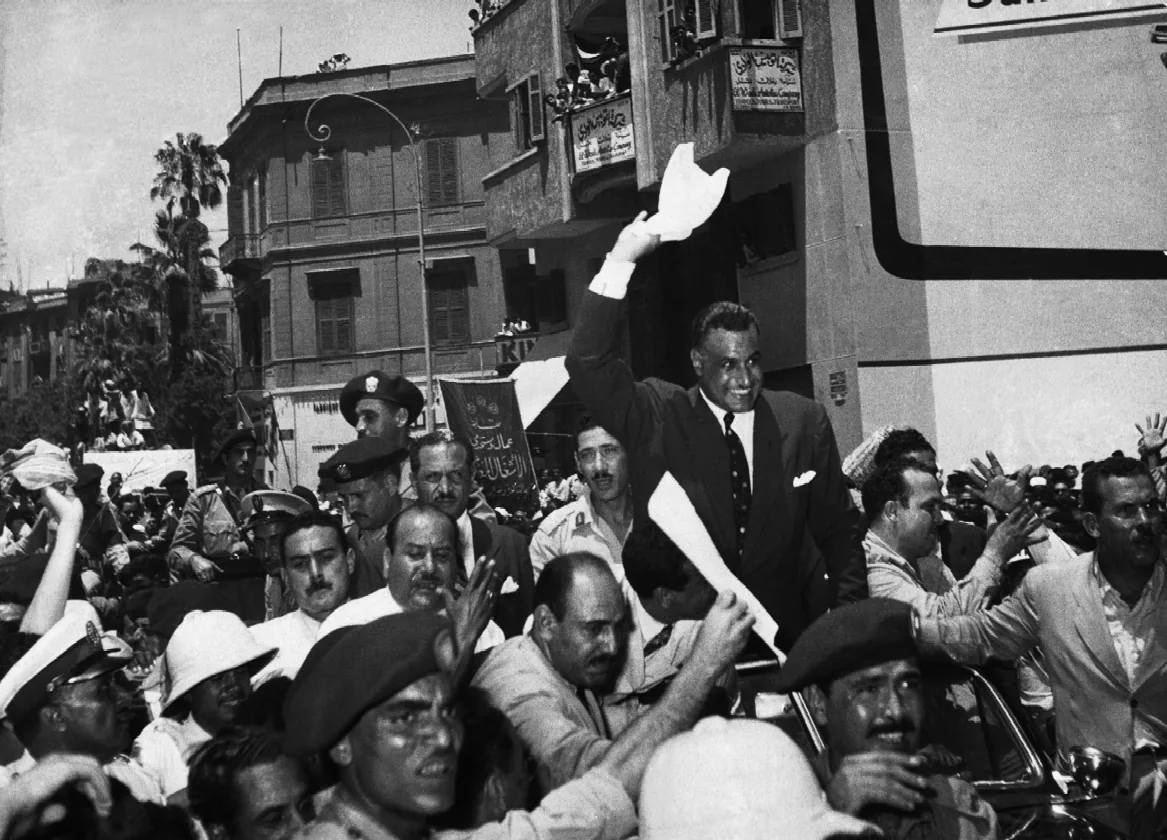
Gamal Abdel Nasser was the president of Egypt from 1956 to 1970 and the most influential Arab leader of his generation. He came to power through a military coup in 1952, forced out the last British troops, and in 1956 nationalized the Suez Canal. When Britain and France invaded to take it back, the United States forced them to withdraw, and Nasser became a symbol of Arab independence. Along with India's Jawaharlal Nehru and Yugoslavia's Tito, he helped create the Non-Aligned Movement. He built a pan-Arab movement that at its peak merged Egypt and Syria into a single state. In June 1967, Israel destroyed Egypt's air force in hours and took the Sinai Peninsula. Nasser's influence across the Arab world collapsed with the defeat. He died three years later of a heart attack at fifty-two.
How Nasser came to power
Nasser was born on January 15, 1918, in Alexandria. His father was a postal clerk from a village in Upper Egypt, and the family moved often. Nasser attended nine different schools as a child. As a teenager he joined anti-British demonstrations and was wounded by a bullet at seventeen. He entered the Royal Military Academy in 1937 and became an army officer.
The 1948 war against Israel changed him. Nasser fought in it and came back convinced that the real enemy was in Cairo too: a corrupt monarchy and political class that had sent soldiers to fight with defective weapons. He and a group of young officers, the Free Officers, began planning a coup.
On July 23, 1952, they seized power. King Farouk sailed into exile three days later. Nasser was the real leader, but for two years he governed behind a figurehead president, General Muhammad Naguib. In October 1954, a Muslim Brotherhood member fired eight shots at Nasser during a speech in Alexandria, and every one missed. Nasser barely paused. He told the crowd: "Let them kill me." The moment was broadcast by radio across the Arab world. The failed assassination gave Nasser the support to push Naguib aside and take control of the government. He then crushed the Muslim Brotherhood.
How Nasser nationalized the Suez Canal
In 1954, Nasser negotiated the withdrawal of the last British troops from the Suez Canal Zone, something Egyptian nationalists had demanded for seventy years. Two years later, the United States and Britain withdrew their offer to finance the Aswan High Dam, Egypt's largest development project.
On July 26, 1956, Nasser declared the Suez Canal Company the property of the Egyptian state. The tolls, he said, would pay for the dam. Britain, France, and Israel planned a joint attack in secret and launched it that October. Their armies won on the ground. But the United States refused to back what it saw as a colonial war, pressured the British pound, and forced London and Paris to pull their troops out.
Nasser lost the military fight and won the political one. Across the Arab world and the developing world, he became the leader who had stood up to two European empires and survived.
Nasser and pan-Arabism
Pan-Arabism held that the Arab peoples were a single nation, split into artificial states by European powers after World War I. Nasser turned this idea into a popular movement with himself at the center. From about 1958 to 1961, his influence reached its peak. In 1958, Syria dissolved its own government and merged with Egypt to form the United Arab Republic. That same year, officers inspired by Nasser overthrew the monarchy in Iraq.
At home, Nasser took banks and factories into state ownership, broke up large estates, and built schools across the country. His government was also authoritarian. Political opponents were jailed, and the Muslim Brotherhood was crushed, and its leading intellectual, Sayyid Qutb, was hanged in 1966. Qutb's execution helped produce a generation of Islamist militants who defined themselves against everything Nasser stood for.
The union with Syria collapsed in 1961 when Syrian officers pulled out. Starting in 1962, Egypt intervened in Yemen's civil war. The intervention dragged on for five years and cost Egypt thousands of soldiers with no clear result. By the mid-1960s, the pan-Arab project was losing ground, but Nasser remained the most recognized leader in the region.
The 1967 war and Nasser's death
In May 1967, Nasser ordered United Nations peacekeepers out of the Sinai, blocked Israeli ships from the Straits of Tiran, and moved his army to the border. He did not intend to start a war, but each step made it harder to step back.
On June 5, Israel attacked first. Its air force destroyed nearly all of Egypt's warplanes on the ground in a single morning. Within six days the fighting was over. Egypt had lost the entire Sinai Peninsula, Jordan had lost the West Bank, and Syria had lost the Golan Heights.
Nasser resigned on live television on June 9. Crowds filled the streets of Cairo and other Arab cities, demanding he stay. He withdrew his resignation but never recovered his authority. On September 28, 1970, Nasser died of a heart attack. He was fifty-two, and the Sinai was still under Israeli occupation. Five million people came to his funeral in Cairo.
After the 1967 defeat, three movements gained influence as Nasser's project collapsed. Political Islam, led by groups like the Muslim Brotherhood, argued that the defeat was God's punishment for abandoning faith. Palestinian armed organizations decided they could not rely on Arab governments to win their homeland back. Saudi Arabia's conservative monarchy, which Nasser had attacked for a decade, emerged from the defeat with its main competitor broken and an oil boom just ahead.
Nasser's successor, Anwar Sadat, reversed nearly everything Nasser had built. Sadat expelled Egypt's Soviet advisers, made peace with Israel on his own, and aligned Egypt with the United States. Within a decade of Nasser's death, every part of his project had been undone.