
Al-Khwarizmi
Al-Khwarizmi was a Baghdad mathematician whose book gave algebra its name and whose own name became the word algorithm.
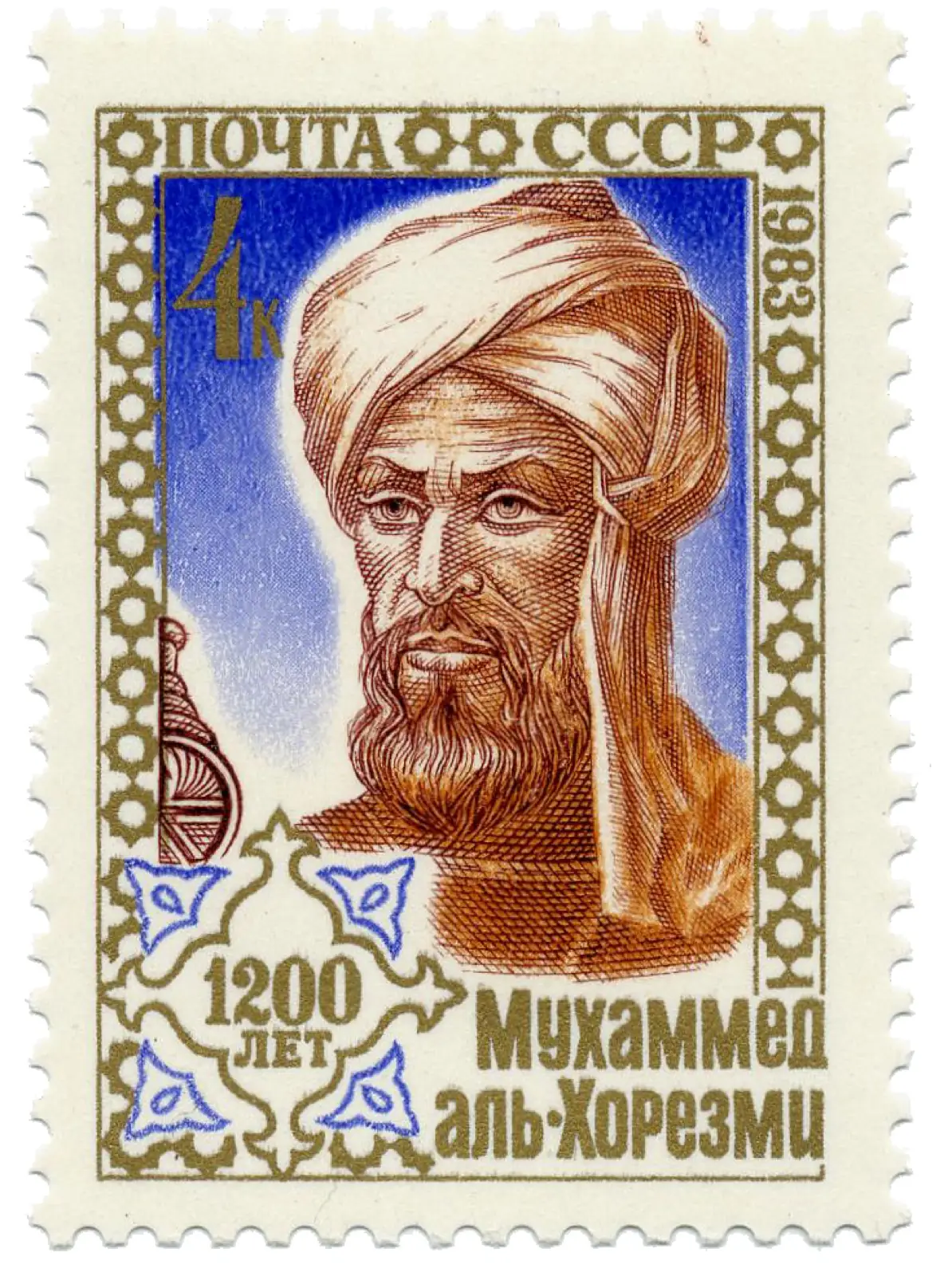
Muhammad ibn Musa al-Khwarizmi was a mathematician, astronomer, and geographer who worked in Baghdad in the early 800s. Around 820 he wrote a book on solving equations at a Baghdad research center called the House of Wisdom. Its title is the origin of the word "algebra." Al-Khwarizmi also wrote a treatise on the Indian number system, which was translated into Latin centuries later. That translation is the origin of the word "algorithm." Two of the most basic words in mathematics and computing come from this one person. Al-Khwarizmi took methods that other mathematicians had used before him and organized them into a general system, with classifications, rules, and proofs. The result was the first book that treated solving equations as its own discipline.
Al-Khwarizmi and the book that named algebra
Al-Khwarizmi worked at the House of Wisdom in Baghdad, a library and research center supported by the Abbasid Caliph al-Ma'mun. Al-Ma'mun, who ruled from 813 to 833, was devoted to learning. He reportedly paid translators the weight of each completed book in gold and sent agents to buy Greek, Persian, and Indian manuscripts from across the known world. The House of Wisdom brought together mathematicians, astronomers, translators, and scribes, and al-Khwarizmi was one of its leading scholars.
Al-Ma'mun encouraged al-Khwarizmi to write a practical book on calculation. In its preface, al-Khwarizmi explained that he meant it to be useful for "inheritance, legacies, partition, lawsuits, and trade." The book's title in Arabic was long, but two words in it changed history. Al-jabr meant "restoration": if a quantity was subtracted on one side, you moved it to the other. Al-muqabala meant "balancing": you reduced both sides by combining terms of the same kind. Latin scholars adopted the word al-jabr, which over the centuries turned into "algebra."
Al-Khwarizmi wrote the book entirely in words. He called the unknown quantity a "thing" (shay') and its square "property" (mal), and he showed how to manipulate them by fixed rules. He classified equations into six standard types, gave a procedure for solving each, and proved that the procedures for the three harder types worked for every equation in their class. The second half of the book applied these methods to real problems: dividing an inheritance among heirs under Islamic law, measuring plots of land, and working out prices in trade.
Babylonian scribes and Greek mathematicians had solved equations before al-Khwarizmi. His contribution was to treat equation-solving as a general discipline with its own rules, not a collection of techniques for individual problems. That shift, from solving one problem to writing down a method that solves every problem of the same kind, is the core idea of algebra.
Where was al-Khwarizmi from?
His name means "from Khwarezm," a region in Central Asia that is now split between Uzbekistan and Turkmenistan. Khwarezm sat along the Silk Road, and most historians take the name to mean that al-Khwarizmi or his family originally came from there. But the 9th-century historian al-Tabari recorded that al-Khwarizmi was also called "al-Qutrubbulli," linking him to a district between the Tigris and Euphrates not far from Baghdad. He may have been born near Baghdad to a family that had migrated from Khwarezm. No surviving record settles the question. What is certain is that he spent his career in Baghdad, at the House of Wisdom.
How al-Khwarizmi's name became "algorithm"
Al-Khwarizmi wrote a treatise on the decimal number system that had come from India, explaining the digits one through nine and the concept of zero, and showing how to add, subtract, multiply, and divide with them. The original Arabic text has been lost. It survives only in a 12th-century Latin translation, Algoritmi de numero Indorum. Europeans at the time still calculated with Roman numerals. They learned place-value notation from al-Khwarizmi's translated text. The number system al-Khwarizmi described is the one the world uses today.
European scholars Latinized his name as "Algoritmi." Over time the word came to mean the kind of step-by-step method al-Khwarizmi had taught, and by the 20th century "algorithm" meant any finite sequence of instructions a machine can follow.
His algebra book reached Europe through a separate translation. The English scholar Robert of Chester translated it into Latin in 1145, and it served as a standard textbook at European universities for centuries. Between the two translations, al-Khwarizmi's work reshaped European mathematics from its foundations.
Al-Khwarizmi also produced an astronomical work called the Zij al-Sindhind, a collection of tables drawn from Indian and Persian sources. The tables tracked the movements of the sun, the moon, and the five planets known at the time, and Muslim and later European astronomers relied on them for centuries. He wrote a geography called Kitab Surat al-Ard ("The Shape of the Earth"), which updated Ptolemy's positions for hundreds of places across the known world.
The words "algebra" and "algorithm" are so common today that most people do not think about where they came from. They came from a mathematician working in Baghdad twelve centuries ago, whose books shaped how the world does arithmetic, solves equations, and writes instructions for machines.