
Silk Road
The Silk Road was a network of overland trade routes that connected China to the Mediterranean for over 1,500 years.
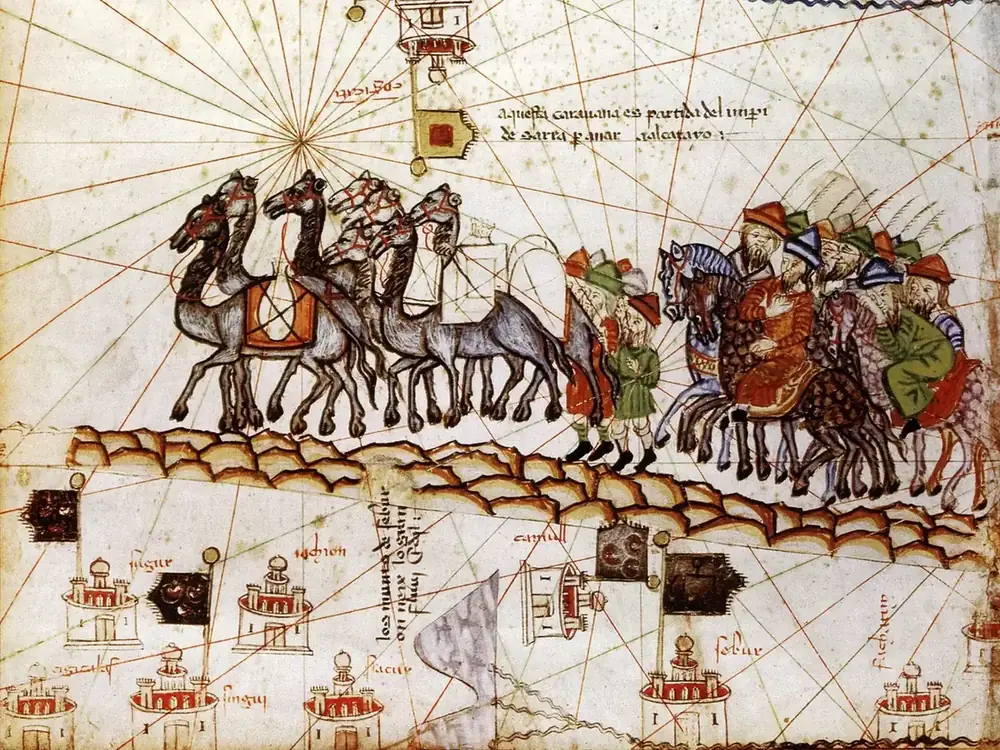
The Silk Road was a network of overland trade routes that connected China to the Mediterranean world for roughly 1,500 years, from about 130 BC to the 1500s. The main routes stretched about 4,000 miles from the Chinese capital Chang'an (modern Xi'an) through Central Asia to the eastern Mediterranean. They crossed the Gobi Desert, skirted the Taklamakan Desert, and crossed the Pamir Mountains. The name is misleading in almost every way. There was no single road. Silk was only one of many goods that traveled the routes. And almost nobody made the full journey. Goods moved stage by stage between market towns, changing hands as many as a dozen times between China and the Mediterranean. Each merchant knew his own stretch and little beyond it.
How Zhang Qian opened the Silk Road
The routes opened in 138 BC, when Emperor Wu of the Han dynasty dispatched Zhang Qian, a minor court official, into Central Asia to seek allies against the Xiongnu, a nomadic people who raided China's northern frontier. Zhang Qian was captured within months. The Xiongnu held him for about ten years. During his captivity he married a Xiongnu wife and had a son. He eventually escaped with his family, continued west, and reached the kingdoms of Central Asia. When he returned to China around 125 BC, he had failed to find allies. But he brought back a detailed report on wealthy, settled kingdoms that the Han court had not known existed, some of which raised horses far better than any in China.
Zhang Qian's report led Emperor Wu to send more envoys and military expeditions into Central Asia, and regular trade followed. Chinese silk, which no one outside China could produce, flowed west through a chain of middlemen. The Sogdians, merchants based around the cities of Samarkand and Bukhara in modern Uzbekistan, became the most important intermediaries on the routes, carrying goods and languages across Central Asia for centuries.
How the Silk Road worked
Goods moved as a relay. A bolt of silk that left Chang'an passed through Sogdian, Persian, and Syrian hands before it reached the Mediterranean, and its price rose at each transfer. Because the system was a relay, it was durable. It did not need any single empire to control the full route.
Goods that moved west included silk, and later paper, gunpowder, and the compass. Going east came glass, wool, horses, and above all silver. The trade was lopsided. China made things the West wanted and could not produce. The West had little that China needed. The difference was paid in precious metal. The Roman writer Pliny the Elder complained in the first century AD that Rome was sending 100 million sesterces a year to India, China, and Arabia combined, mostly for silk and spices.
But goods were not the most important things the routes carried. Religions traveled with merchants. Buddhism spread from India through the oasis towns of the Tarim Basin into China, and the Dunhuang caves in western China are filled with Buddhist paintings left by travelers and monks over centuries. Nestorian Christians and Manichaeans carried their faiths along the same paths, and Muslim merchants later did the same. Disease traveled the routes too. The plague that struck Constantinople in 542 likely reached the Byzantine Empire through the trade network. The Black Death of 1347 arrived in Europe along the same network.
The routes worked best when a large power kept the middle safe. Trade peaked under the Han and Tang dynasties in China and again during the Mongol century that followed Genghis Khan's conquests in the 1200s. During the Pax Mongolica, the Mongols secured the routes so effectively that a Venetian merchant like Marco Polo could travel from Europe to the court of Kublai Khan and back.
Who named the Silk Road?
The German geographer Ferdinand von Richthofen is usually credited with coining the name in 1877 while mapping the overland routes across Central Asia. Nobody who actually used the routes had called them that. Von Richthofen named them the Seidenstraße, "Silk Road" in German, and the term stuck, even though it describes neither a single road nor a trade that was mainly about silk.
In 2013 China's president Xi Jinping chose the name deliberately when he launched the Belt and Road Initiative, a trillion-dollar infrastructure program to build ports, railways, and highways across Asia, Africa, and Europe. The name points to a real period of history when trade across Eurasia ran through China without European colonial powers involved.
Why did the Silk Road decline?
The Silk Road declined in the 1400s and 1500s for two reasons. The Mongol khanates broke apart in the mid-1300s, and the wars and banditry that followed made overland travel dangerous and expensive again. At the same time, sea transport became cheaper. A single ship could carry more cargo than a large caravan and did not need to pay tolls to a dozen different rulers along the way. When Portuguese ships rounded the Cape of Good Hope in 1488 and reached India by sea in 1498, European traders could bypass the overland routes entirely. The middlemen who had profited from the transit trade lost their business, among them the Central Asian khanates, Mamluk Egypt, and Venice.
The overland routes declined five centuries ago, but the religions, technologies, and diseases they spread had already reshaped every civilization they connected.