
Berlin Airlift
The Berlin Airlift was the 1948–1949 operation in which the United States, Britain, and France supplied blockaded West Berlin entirely by air.
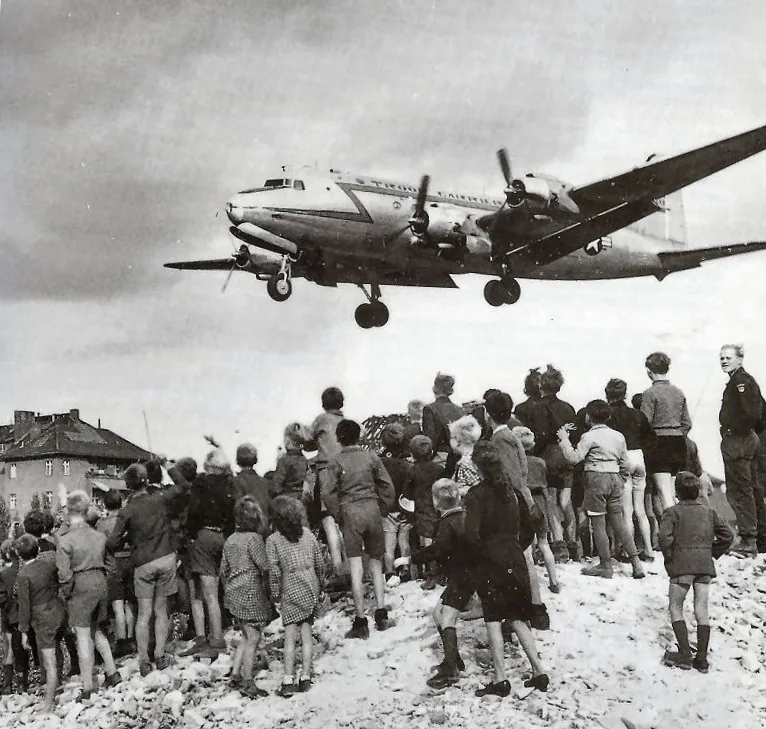
The Berlin Airlift was a fifteen-month operation in which the United States, Britain, and France supplied the western sectors of Berlin entirely by air after the Soviet Union sealed off all ground access to the city. It lasted from June 1948 to September 1949 and was one of the first major crises of the Cold War. The city lay roughly 160 kilometers inside Soviet-controlled territory, and around 2.5 million residents lived in its western sectors. When Soviet forces shut down every highway, railroad, and waterway leading into the city, President Harry Truman chose to supply it by air rather than risk a war by sending a ground convoy. By the time the operation ended, it had logged 278,228 flights and carried roughly 2.3 million tons of food, coal, and medicine into the city.
Why the Soviet Union blockaded Berlin
After World War II, the four allied powers divided Germany into occupation zones and Berlin into four sectors. By 1948, the three Western occupying powers had combined their zones into a single economic unit. They were also working toward establishing an independent government in western Germany. On June 20, 1948, they replaced the worthless reichsmark with the Deutsche Mark across their occupation zones and soon brought the new currency into their sectors of Berlin as well.
The new currency threatened Moscow in two ways. It stabilized the Western economy, which made recovery possible. And it undermined the value of the Soviet zone's own inflated currency. A prosperous Western Germany ended any realistic chance of reunifying the country on Soviet terms.
The western sectors of Berlin were the weak spot: surrounded on all sides by Soviet-controlled territory, they could not be defended on the ground. On the night of June 24, 1948, Soviet forces closed every ground route into the city. The Soviet leadership calculated that no air force could feed 2.5 million people indefinitely, that the Western allies could not send a ground convoy through without triggering a shooting war, and that they would eventually have to withdraw. At the start of the blockade, the western sectors had enough food for roughly thirty days and coal for about forty-five.
How the Berlin Airlift worked
Two days after the blockade began, American C-47 cargo planes started flying flour into the city. The operation was improvised at first. The Americans called their part Operation Vittles, and the British called theirs Operation Plainfare.
In late July 1948, General William Tunner took charge. Tunner had managed the wartime supply flights across the Himalayas, known as "the Hump," delivering cargo into China during World War II. He reorganized the Berlin operation around a fixed set of rules. Aircraft flew at assigned altitudes in stacked corridors, with one plane landing every few minutes. Crews were forbidden to leave their aircraft while cargo was unloaded. If a pilot missed an approach, the plane had to fly back to base rather than circle for a second try, because one late arrival would delay every plane behind it.
The French built an entirely new airfield at Tegel in roughly ninety days. A Soviet-operated radio mast blocked the approach path, so French engineers demolished it. Planners estimated the city needed about 4,500 tons of food, coal, and medicine each day. During Easter weekend in April 1949, the operation set a record: 1,383 flights delivered 12,941 tons of coal over a single day, averaging about one plane touching down per minute.
An American pilot named Gail Halvorsen began dropping candy attached to handkerchief parachutes to children watching the planes from behind a fence at Tempelhof airfield. The practice spread through the fleet and became known as Operation Little Vittles. Over the full airlift, 101 people died, most in crashes: 40 Britons, 31 Americans, and German ground crew.
Why was the Berlin Airlift significant?
The Soviet government ended the blockade just after midnight on May 12, 1949. Flights kept running until September 30 to accumulate a stockpile in case the blockade returned. By then, the blockade had produced the opposite of everything Moscow wanted.
Instead of pushing the Western allies out of Berlin, it pulled them into a permanent military alliance. The North Atlantic Treaty, the founding agreement of NATO, was signed in April 1949 while planes were still landing in Berlin. The airlift gave senators who had been skeptical of a peacetime alliance with Europe a concrete reason to vote yes. American forces stayed in Europe permanently, something that had not been certain before the crisis.
Instead of preventing a West German state, the blockade accelerated its creation. The Federal Republic of Germany was established on May 23, 1949, before the airlift had even ended.
The crisis also changed how Americans and Britons saw the people they were feeding. In 1945, Berliners were enemy civilians living in a ruined city. By 1949, they were people whom allied airmen had spent a winter keeping alive. That shift happened faster than anyone expected, and the airlift was the reason.
Neither side fired a shot during the entire crisis. The Soviets never physically closed the air corridors, and the United States never forced a ground convoy through to the city. Each side left the other a way out rather than forcing a direct confrontation. That restraint became the rule for the decades of Cold War that followed.