
Harry Truman
Harry S. Truman was the 33rd U.S. president, who authorized the atomic bomb and built the alliances and institutions of the Cold War.
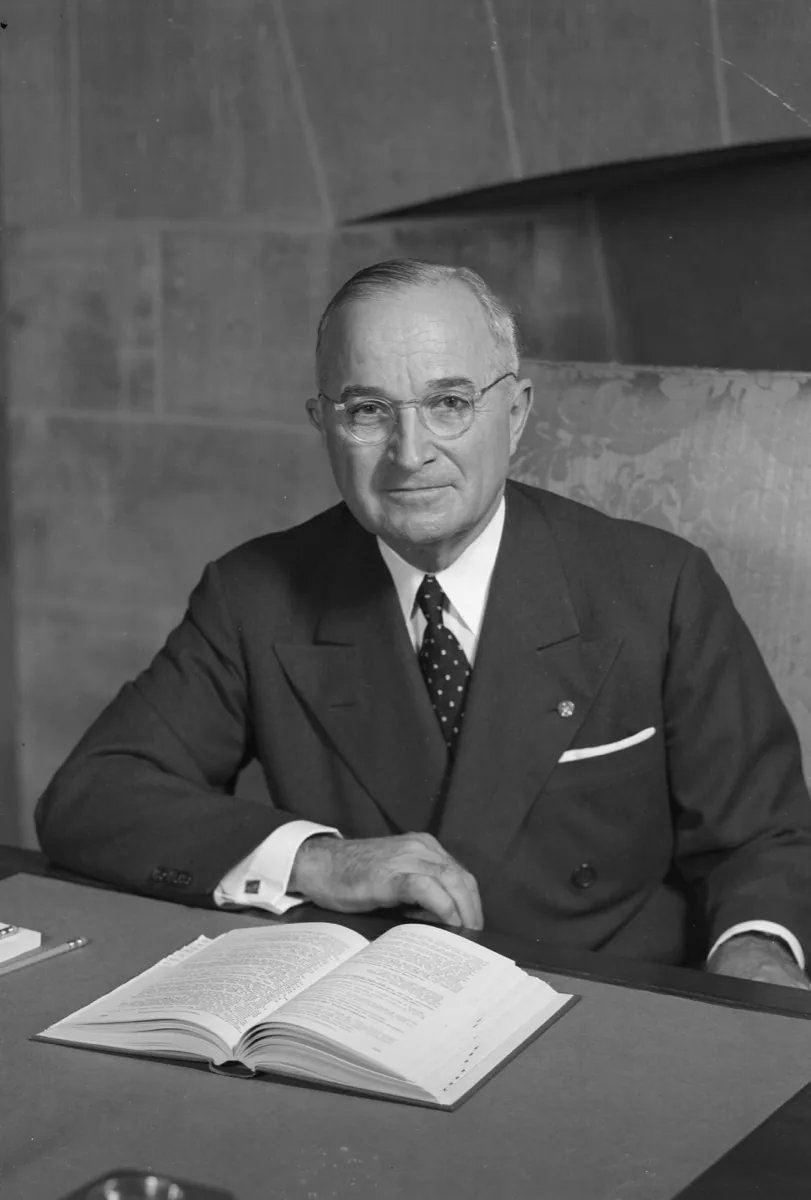
Harry S. Truman was the 33rd president of the United States, serving from 1945 to 1953. He took office when Franklin Roosevelt died on April 12, 1945, after just eighty-two days as vice president. No one had told Truman that the country was developing a nuclear weapon. Less than four months later, he authorized its use against Japan. Within four years he committed the United States to defending Europe permanently, a break from every president before him. He entered the presidency less prepared than almost any modern president and left it having built the alliances and institutions that shaped American foreign policy for the rest of the century.
How an unknown senator became president
Truman was born in Lamar, Missouri, in 1884 and grew up in Independence. He had poor eyesight and wore thick glasses from childhood. He never earned a college degree. During World War I he led an artillery unit in France, where his soldiers respected him for keeping steady under fire. After the war he and a friend opened a men's clothing store in Kansas City. The store failed, and Truman spent years paying off the debt.
He got into politics with the help of Tom Pendergast's Kansas City organization, a connection opponents held against him for the rest of his career. In 1934 he won a U.S. Senate seat in Missouri as a little-known candidate. During World War II he chaired a Senate committee that investigated waste and fraud in defense contracts. The Truman Committee held over 400 hearings and saved the government an estimated $10 to $15 billion in wartime spending while costing less than $1 million to run.
Roosevelt's advisers chose Truman as the vice-presidential candidate in 1944 largely because he offended fewer factions in the Democratic Party than the alternatives. He had only a few private conversations with Roosevelt before taking office.
How Truman shaped the Cold War
Truman became president in April 1945. The war in Europe was nearly over, but the war in the Pacific was expected to cost enormous casualties. In July 1945 he traveled to the Potsdam Conference, where he met Soviet leader Joseph Stalin and British Prime Minister Winston Churchill. While there, he learned that the first atomic bomb test had succeeded. He authorized its use, and in August 1945 the United States dropped atomic bombs on Hiroshima and Nagasaki. Japan surrendered days later.
As relations with the Soviet Union worsened, Truman acted sooner than most in Washington. In February 1947 Britain said it could no longer afford to support Greece against a communist insurgency. Truman went to Congress and pledged that the United States would support free peoples resisting outside pressure. That pledge became the Truman Doctrine, and Truman followed it with the Marshall Plan, which spent about $13 billion, over $130 billion in today's dollars, to rebuild Western Europe. When the Soviet Union blockaded West Berlin in 1948, Truman ordered the Berlin airlift, which flew food and fuel into the city for more than a year. In 1949 the United States joined NATO, its first peacetime military alliance outside the Western Hemisphere.
In 1947 Truman signed the National Security Act, which established three new bodies: the Defense Department, a National Security Council, and the Central Intelligence Agency. All three still operate today.
Truman also took steps at home that carried political risk. On July 26, 1948, he signed Executive Order 9981, desegregating the armed forces over the objections of southern Democrats in his own party. He recognized Israel eleven minutes after it came into existence on May 14, 1948, despite the objections of George Marshall, his Secretary of State.
In November 1948, Truman won the presidential election that nearly every poll and newspaper had predicted he would lose to Thomas Dewey. The Chicago Daily Tribune printed "Dewey Defeats Truman" on its front page before the results came in. Truman posed with the paper two days later.
His second term was harder. In June 1950, after North Korea invaded South Korea, Truman sent American forces to fight without a congressional declaration of war, calling the conflict a "police action." That decision set a precedent that every president since has followed. The war reached a stalemate, and after General Douglas MacArthur openly defied Truman's strategy, Truman fired him. The firing was constitutionally correct but deeply unpopular. By February 1952, Truman's approval rating had fallen to 22%, the lowest Gallup had ever recorded for a sitting president. He chose not to run for reelection.
Why did Truman drop the atomic bomb?
Truman authorized the bombings because American military planners expected that invading Japan would cost hundreds of thousands of American and Japanese lives. The bomb offered a way to end the war without an invasion. The United States dropped the first bomb on Hiroshima on August 6, 1945, and a second on Nagasaki three days later. Japan surrendered on August 15. Truman defended the decision for the rest of his life and never said he regretted it.
Historians have debated it ever since. Some argue that Japan was already close to surrendering, or that demonstrating the bomb on an uninhabited target could have achieved the same result. Others point out that Japan's military leaders resisted surrender even after both bombings. No consensus has emerged, and the debate continues.
Was Harry Truman a good president?
Most historians today consider Truman one of the best presidents in American history. That was not the view when he left office in January 1953. His approval rating was among the lowest ever recorded. The Korean War had no clear end, corruption scandals had embarrassed his administration, and many Americans saw him as a small-town politician who had been out of his depth.
That view did not last. Over the following decades, historians moved Truman steadily up in their rankings. In the 2024 Presidential Greatness Project survey, political scientists ranked Truman sixth among all U.S. presidents, behind only Abraham Lincoln, Franklin Roosevelt, George Washington, Theodore Roosevelt, and Thomas Jefferson. The containment strategy, the alliances, and the institutions he built lasted through the entire Cold War and, for the most part, remain in place. His willingness to make unpopular decisions, from desegregating the military to firing MacArthur, looks stronger with time. Truman displayed a sign on his desk that read "The buck stops here." He set the direction of American foreign policy for the rest of the twentieth century, and much of that direction still holds.