
Bill of Rights
The Bill of Rights is the first ten amendments to the US Constitution, ratified in 1791 to protect individual liberties.
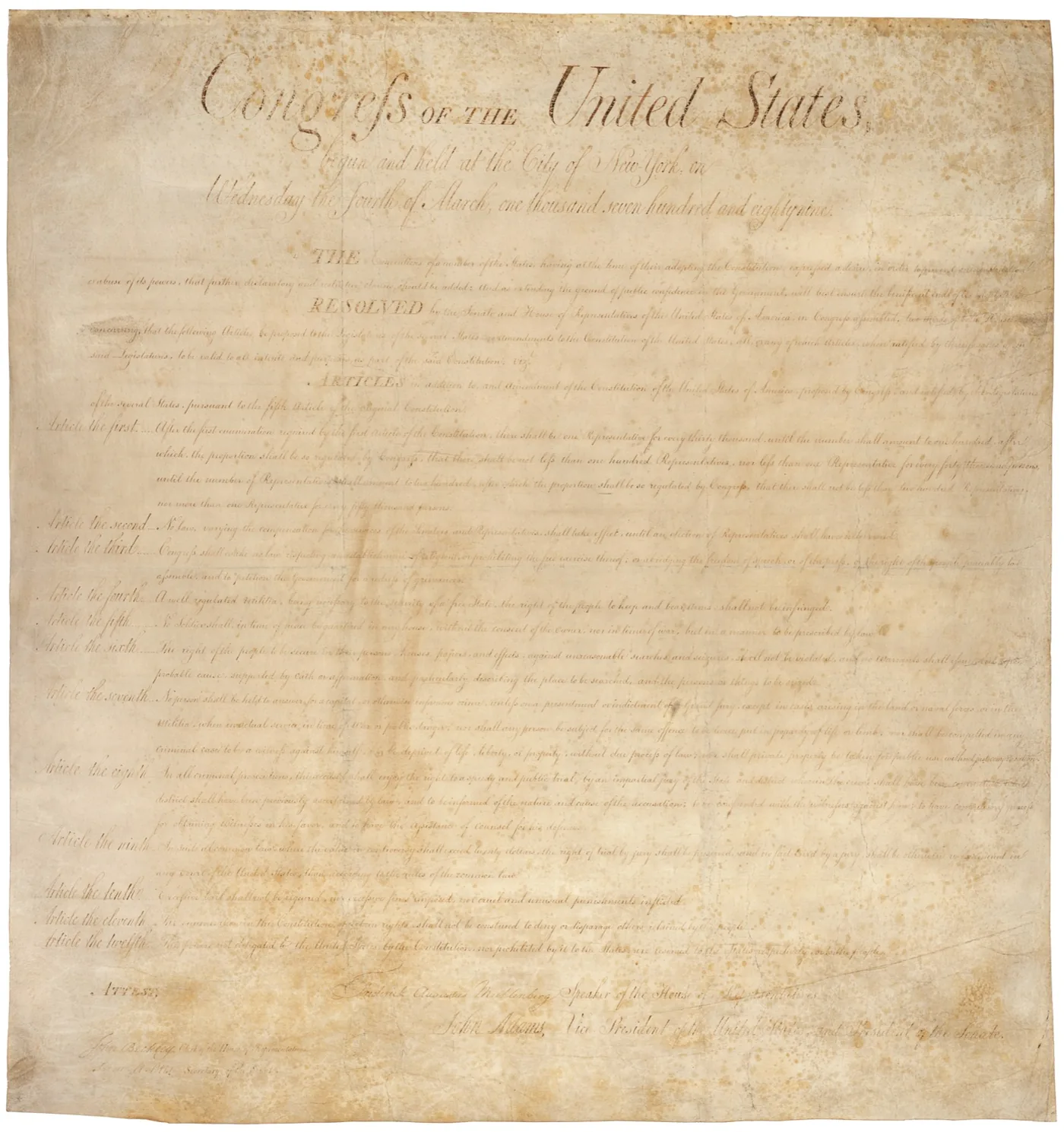
The Bill of Rights is the first ten amendments to the United States Constitution. James Madison drafted them, Congress approved them in 1789, and the states ratified them on December 15, 1791. The amendments list the individual liberties that the federal government cannot take away, from freedom of speech and religion to the right to a jury trial. They exist because the Constitution almost failed without them. The document that came out of the Philadelphia Convention in 1787 spelled out the powers of the new federal government but said almost nothing about what that government could not do to individuals. Several states refused to ratify unless guarantees of individual rights were written into the text. The Bill of Rights was the bargain that made the Constitution possible.
How the Bill of Rights was written
The Constitution's silence on individual rights was deliberate. Alexander Hamilton and other Federalists argued that a list was unnecessary because the new government only had the powers the Constitution gave it. Anti-Federalists saw this as dangerous. George Mason, who had written Virginia's Declaration of Rights in 1776, refused to sign the Constitution because it lacked one of its own. Several state ratifying conventions approved the Constitution with the expectation that amendments would follow.
James Madison, a Virginia congressman who had helped write the Constitution and defended it in the Federalist Papers, was initially skeptical that a bill of rights was needed. His friend Thomas Jefferson, then serving as minister to France, argued in a letter that "a bill of rights is what the people are entitled to against every government on earth, general or particular, and what no just government should refuse." Madison came around. In June 1789 he introduced a list of proposed amendments in the First Congress, drawing on Virginia's Declaration of Rights, English common law, and the demands of the state ratifying conventions. Congress debated his proposals, revised them, and approved twelve amendments on September 25, 1789. The states ratified ten of them. Virginia, the last state needed, voted yes on December 15, 1791. One of the two rejected amendments, which limited when Congress could raise its own pay, was eventually ratified as the Twenty-Seventh Amendment in 1992.
What the ten amendments protect
The First Amendment covers the most ground in a single sentence. It forbids Congress from setting up an official religion or interfering with religious practice, and it guarantees freedom of speech, of the press, of assembly, and of petition.
The Second Amendment guarantees the right to own and carry weapons. Its full text is one sentence, and its opening clause about "a well regulated Militia" has generated more than two centuries of argument about what the amendment actually means.
The Third Amendment bars the government from quartering soldiers in private homes in peacetime without the owner's consent. The Fourth Amendment guards against unreasonable searches and requires that any warrant be supported by probable cause.
The Fifth through Eighth Amendments mostly govern criminal justice. They require grand jury indictments for serious crimes, forbid trying someone twice for the same offense, guarantee due process, and give defendants the right to a public jury trial and to a lawyer. The Eighth Amendment forbids excessive bail and punishments that are cruel and unusual.
The Ninth Amendment says that the rights listed in the Constitution are not the only rights people have. The Tenth Amendment reserves to the states and the people any powers the Constitution does not grant to the federal government.
Does the Bill of Rights apply to state governments?
For most of American history, it did not. The Supreme Court settled the question early: in Barron v. Baltimore in 1833, it held that the first ten amendments limited only the federal government. Under that ruling, a state could censor its residents or search without a warrant as long as its own constitution allowed it.
The Fourteenth Amendment, ratified in 1868 after the Civil War, changed the legal basis. It says that no state may deprive any person of life, liberty, or property without due process of law. Beginning in the 1920s, the Supreme Court used that clause to apply the Bill of Rights to the states one guarantee at a time, in a process called incorporation. The Court incorporated free speech in 1925, the right to a lawyer in 1963, and the right to bear arms in 2010. Today nearly every protection in the Bill of Rights applies to state and local governments, not just the federal government.
Why is the Second Amendment so controversial?
The Second Amendment reads: "A well regulated Militia, being necessary to the security of a free State, the right of the people to keep and bear Arms, shall not be infringed." For decades, many courts read the amendment as protecting a right tied to state militias, not an individual right to own a gun.
In District of Columbia v. Heller (2008), the Supreme Court ruled 5 to 4 that the Second Amendment protects an individual's right to keep a firearm at home for self-defense, regardless of militia service. Two years later, in McDonald v. City of Chicago (2010), the Court applied that right to the states. Those decisions settled that the right is individual, but they left open which weapons are covered and what regulations are allowed. The Court continues to hear cases on those questions.
The Bill of Rights today
The text of the Bill of Rights is short, and the framers wrote it in broad terms. "The freedom of speech" and "unreasonable searches" meant something specific in 1791, but the words do not say whether free speech covers campaign spending or a social media platform's algorithm, or whether a search of someone's smartphone needs a warrant. Those questions go to the Supreme Court, and the Court's answers keep changing as technology and society change. The Bill of Rights is still debated every term because Madison and his colleagues wrote principles, not instructions, and left future generations to work out what those principles require.