
Federalist Papers
The Federalist Papers are 85 essays Hamilton, Madison, and Jay wrote to persuade New York to ratify the Constitution in 1787 and 1788.
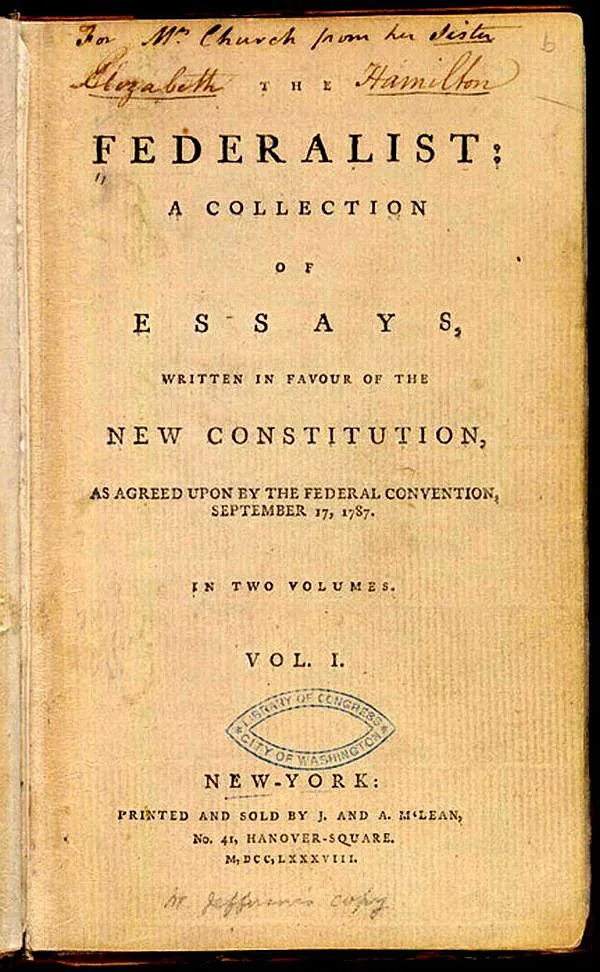
The Federalist Papers are 85 essays written between October 1787 and May 1788 to persuade New York to ratify the United States Constitution. Alexander Hamilton, James Madison, and John Jay wrote them under the shared pen name Publius and published them in New York newspapers. The target audience was the people of New York and the few dozen delegates at the state's ratifying convention, where the outcome was genuinely uncertain. The essays were campaign material, written fast and under deadline. They became the most-cited interpretation of the Constitution in American law, quoted by the Supreme Court more often than any historical source besides the Constitution itself.
How Hamilton, Madison, and Jay wrote the Federalist Papers
Hamilton came up with the project. He was about 30, born out of wedlock on the Caribbean island of Nevis and orphaned as a teenager. He had come to New York as a scholarship student, served as George Washington's aide during the Revolutionary War, and built a law practice in Manhattan. At the Constitutional Convention in Philadelphia he had argued for an executive with near-monarchical power. The Convention rejected the idea. Hamilton set out to defend the Constitution anyway, because he believed even an imperfect union was better than none.
He recruited two allies. James Madison, a Virginia delegate, had shaped more of the Constitution's structure than anyone else at the Convention. John Jay was the country's Secretary of Foreign Affairs and one of the most respected lawyers in New York. Jay wrote four essays on foreign policy, then fell seriously ill in late 1787 and contributed only one more, on the Senate's treaty power. That left Hamilton and Madison to produce the remaining 80 essays between them.
They wrote at remarkable speed. Madison later recalled that the authors were often still writing the next section of an essay while the printer was setting the previous one in type. The two men disagreed about nearly everything except the need for ratification. Hamilton wanted a powerful central government. Madison spent the 1790s fighting Hamilton's broad reading of the very clauses they had defended together as Publius.
New York ratified on July 26, 1788, by a vote of 30 to 27, along with a list of proposed amendments that helped lead to the Bill of Rights. But the essays probably did not decide the outcome. By the time New York voted, ten other states had already ratified, enough for the Constitution to take effect without New York. Hamilton announced that news at the convention in Poughkeepsie, and it likely mattered more than anything Publius had written.
What the most famous Federalist Papers argued
Federalist No. 10 is the best-known essay in the collection. Madison took on the oldest objection to a large republic. Since the days of the Roman Senate, political thinkers had insisted that a republic could survive only if it was small and homogeneous. A large one would split into factions and collapse. Enlightenment philosophers repeated the warning. Madison did not deny that factions exist. He argued they grow from human nature and from unequal distributions of property. Trying to suppress them, he wrote, is worse than the factions themselves. His answer was to make the republic larger. In a big country with many competing interests, no single group could easily form a permanent majority.
In Federalist No. 51, Madison argued that the structure of government itself had to keep power in check. People are not angels, he wrote, and a government cannot run on good intentions. Each branch needs both the legal authority and the personal motivation to resist the others.
In Federalist No. 78, Hamilton defended giving federal judges lifetime appointments. He called the judiciary the least dangerous branch because it controls neither the military nor the budget. He also laid out the case for judicial review, the idea that courts can strike down laws that violate the Constitution. The Supreme Court did not formally claim that power until Marbury v. Madison in 1803, about fifteen years later.
Who wrote the Federalist Papers?
Hamilton wrote the largest share, about 51 of the 85 essays. Madison wrote about 29. Jay wrote five. But the exact count has been disputed since both Hamilton and Madison claimed authorship of about a dozen of the same essays. Hamilton was killed in a duel with Aaron Burr in 1804. Madison died in 1836. Neither settled the question in his lifetime.
In the 1960s, statisticians used word-frequency analysis to study the disputed essays and concluded that Madison wrote all of them. Later studies using different methods reached the same result. The modern consensus gives Madison essays 49 through 58, plus 62 and 63, with essays 18 through 20 written jointly.
Why the Federalist Papers are still cited today
The Constitution is a short document, about 4,500 words in its original form, and it leaves many questions unanswered. The detailed records of the Constitutional Convention stayed secret for decades. James Madison's notes, the most complete account of what happened in Philadelphia, were not published until 1840, more than fifty years after the Convention and four years after Madison's death. In the meantime, the Federalist Papers were the most detailed public explanation of what the Constitution was supposed to do, and courts treated them that way.
The Supreme Court cited the essays occasionally in the 1800s. The rate climbed through the twentieth century, reaching more than fifty citations per decade by the 1980s. Justices on both the left and the right quote the same passages to support opposing conclusions. The Federalist Papers began as campaign material for a ratification fight in one state, and people still reach for them whenever the Constitution's meaning is at stake.