
Blitzkrieg
Blitzkrieg was Germany's method of fast combined-arms warfare that used massed tanks, dive-bombers, and radios to overrun Poland and France in weeks.
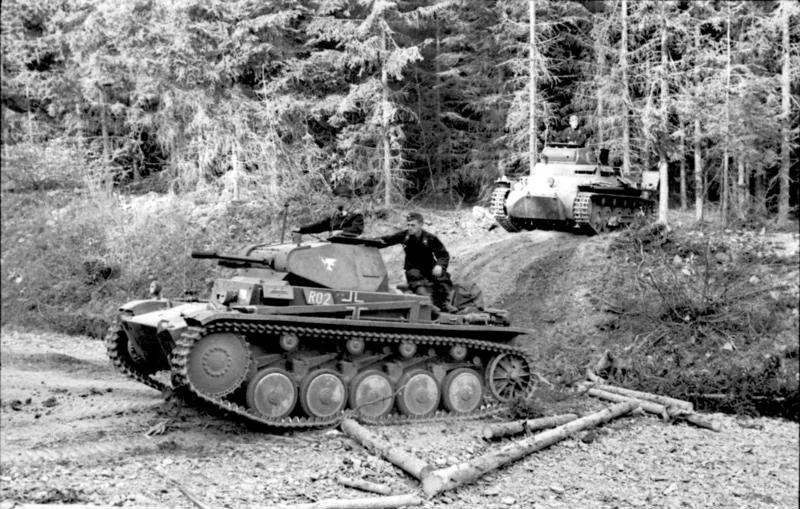
Blitzkrieg is German for "lightning war." It was a way of fighting that combined tanks, dive-bombers, and motorized infantry, all linked by radio, to break through enemy lines and advance so fast that the other side could not respond. In September 1939, Germany used it to defeat Poland in about five weeks. In May and June 1940, Germany overran France, then the strongest military power in continental Europe, in six weeks. Both victories came against large modern armies that expected the next war to look like the last one, with fixed lines and slow advances. The word "blitzkrieg" was not an official German military term. Western journalists popularized it after watching the results.
How Heinz Guderian built a new way of fighting
The idea came from a problem. In World War I, machine guns and trench lines produced four years of stalemate on the Western Front. Millions of soldiers died and the front barely moved. In the 1920s, British writers on military strategy proposed that tanks grouped into their own formations could break the deadlock. J.F.C. Fuller, who had helped plan the British tank attack at Cambrai in 1917, was among the first to argue for independent armored units. Basil Liddell Hart went further, calling for combined forces of tanks, mobile infantry, and artillery working together. If armor could punch through a defensive line and keep moving, wars could be decided by speed instead of attrition.
A German officer named Heinz Guderian took up these ideas. Guderian was born in 1888 in Kulm (now Chełmno, Poland), the son of a career officer. He served in World War I and spent the 1920s reading what Fuller and Liddell Hart wrote about armored warfare. In 1937 he published Achtung, Panzer!, a book that laid out his case for a new kind of war. Tanks should not be scattered among infantry units as support weapons. They should be massed together and aimed at a single narrow point in the enemy line, called the Schwerpunkt. The tanks would punch through and keep driving deep into the enemy's rear, cutting off supply lines and headquarters. Motorized infantry would follow through the gap. Junkers Ju 87 Stuka dive-bombers, fitted with wind-driven sirens that screamed during a dive, would serve as airborne artillery. Every tank would carry a radio, so armored columns could coordinate and change plans on the move.
Guderian had to fight for this system against traditionalists in the Wehrmacht who wanted to keep tanks tied to infantry. He won, and by 1939 Germany had armored divisions built around his design.
How blitzkrieg conquered France
The invasion of Poland in September 1939 showed the system worked, but the fall of France in 1940 made blitzkrieg famous.
The French army had more tanks than Germany's. It sat behind the Maginot Line, a belt of fortifications along the French-German border. The Allied plan assumed Germany would attack through Belgium, as it had in 1914, and the best French and British units moved north to meet that attack. The main German blow came instead through the Ardennes forest in southern Belgium and Luxembourg. The French high command considered the Ardennes impassable for tanks.
On May 10, 1940, German armored columns entered the Ardennes. By May 13, they had crossed the Meuse River at Sedan. The French expected a river crossing to take days of preparation. The Germans did it in hours, with Stuka dive-bombers keeping French defenders pinned while infantry crossed in rubber boats. From Sedan, the panzer divisions turned west and drove for the English Channel. They reached it near Abbeville on May 20, ten days after the invasion started. That advance trapped the main Allied force in Belgium. France signed an armistice on June 22.
Speed made the difference. German tanks had radios and could coordinate on the move. French and British commanders relied on telephone lines and couriers. By the time a French commander issued an order, the German tanks had already moved past the position it was about.
Why did blitzkrieg fail?
Blitzkrieg was designed to win fast. Germany did not have the oil, manpower, or industrial capacity to fight a long war, and its leaders knew it. The method worked against Poland and France, countries close to Germany with short distances to cover. The Soviet Union was different.
Germany invaded the Soviet Union on June 22, 1941, in an operation called Barbarossa. In the opening months, blitzkrieg produced familiar results. German panzer groups encircled entire Soviet armies and captured hundreds of thousands of soldiers. But Soviet territory was too vast. German supply lines stretched across hundreds of miles of bad roads and could not keep pace with the tanks. The Red Army lost battle after battle but kept fighting, retreating deeper into Russia and trading space for time. American Lend-Lease shipments of trucks, food, and machine tools helped keep the Soviet war effort supplied. The full story of why the invasion failed is covered in this article on Operation Barbarossa.
Once the war settled into a grinding struggle over factories, raw materials, and manpower, exactly the kind of long war Germany could not win, Germany lost.
Is blitzkrieg still used today?
No country calls its doctrine blitzkrieg, but the tactical ideas became standard in modern warfare. Concentrated armor, air support working alongside ground forces, radio-linked coordination, and deep advances past the front line are now taught at military colleges worldwide under the name maneuver warfare.
Israel used blitzkrieg-style armored drives in the Six-Day War of 1967, breaking through Egyptian defenses in the Sinai Peninsula and reaching the Suez Canal in three days. In 2003, American forces advanced from Kuwait to Baghdad in 21 days, combining armored speed and air power.
The core idea is that speed and concentration can defeat a larger force by moving faster than it can react. That idea remains central to how armies plan offensive operations today.