
Late Bronze Age Collapse
The Late Bronze Age Collapse was the destruction of the major connected civilizations of the eastern Mediterranean around 1200 BC.
The Late Bronze Age Collapse was the rapid destruction of the major civilizations of the eastern Mediterranean over a few decades around 1200 BC. The Hittite Empire in Anatolia fell. The Mycenaean kingdoms of Greece were wiped out. Several wealthy port cities of the Levant burned, including Ugarit in what is now Syria, which was never rebuilt. Egypt survived, but only barely, and entered a long decline. Within a single lifetime, the trade network and diplomatic system that had connected these kingdoms for centuries was gone. What followed was centuries of poverty and isolation across the eastern Mediterranean.
The trade network that held the Bronze Age together
Bronze is an alloy of copper and tin. Copper was common enough in the eastern Mediterranean, but tin was rare. Some of it came from Central Asia and possibly Cornwall, thousands of kilometers from the kingdoms that needed the metal. A single Mycenaean sword might contain tin that had changed hands many times across many kingdoms before it reached a Greek smith.
That need for tin created a trade network that linked the entire region. Rulers sent each other diplomatic letters, gifts, and royal brides. Copper, tin, gold, grain, ivory, and glass moved by ship and caravan across the eastern Mediterranean and beyond. The Uluburun shipwreck, a trading vessel that went down off the Turkish coast around 1300 BC, held goods originating in at least seven separate societies, from Mycenaean Greece to Nubia to Mesopotamia. It shows how tightly connected these kingdoms were.
The connection made them rich, but it also made them dependent on each other. Every kingdom depended on trade for something it could not produce at home. If the trade routes broke, all of them were exposed.
How the Bronze Age world fell apart
Starting around 1200 BC, several disasters hit the eastern Mediterranean at roughly the same time.
A decades-long drought struck the region. Pollen records and lake sediment cores show that rainfall dropped sharply across Anatolia, the Levant, and parts of Greece, causing crop failures and famine. A cluster of major earthquakes damaged cities across the Aegean and the Levant. And groups of raiders and migrants, known from Egyptian records as the Sea Peoples, attacked by land and sea across the region. Historians still debate where the Sea Peoples came from. They may have been displaced peoples from the Aegean and western Mediterranean, driven east by the same drought.
The Sea Peoples destroyed Ugarit around 1190 BC. A letter from Ugarit's last king, Ammurapi, was found in the ruins. In it he wrote that enemy ships had arrived, that his cities were burning, and that his own troops and ships were far away in Hittite territory. The Hittite capital of Hattusa was abandoned and burned. The Mycenaean palaces at Pylos, Mycenae, and Tiryns were destroyed. Each kingdom that fell removed a trading partner and a supplier for the kingdoms that remained, and the losses compounded.
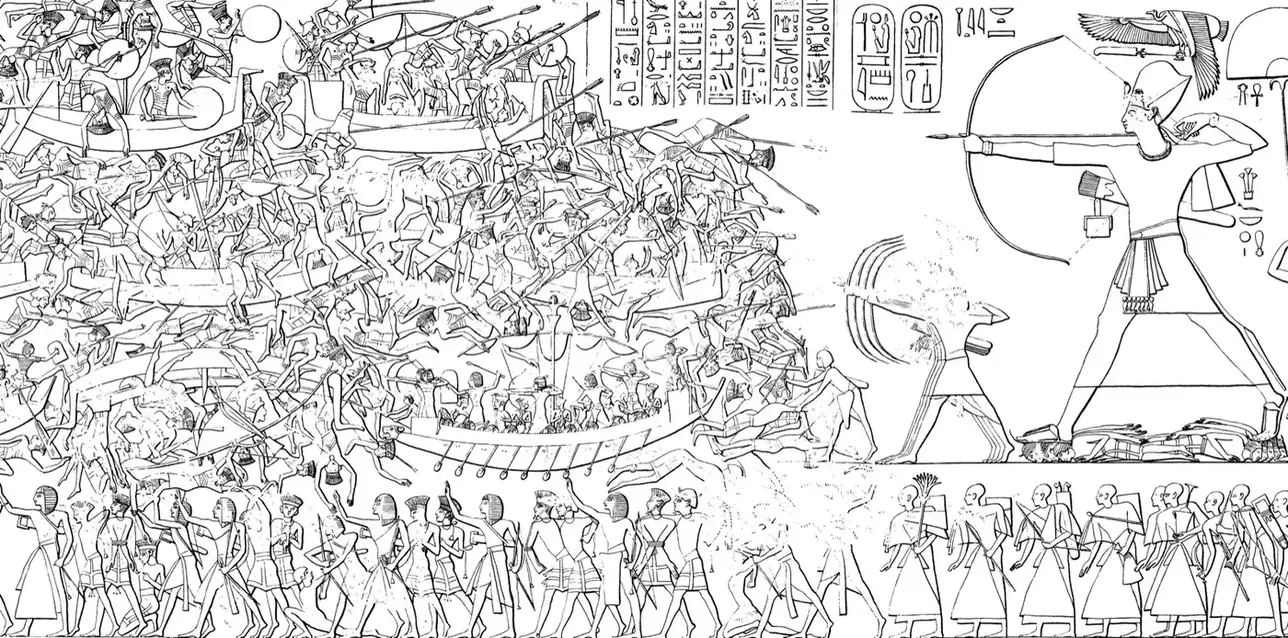
Egypt's pharaoh Ramesses III fought off the Sea Peoples in land and naval battles around 1177 BC and recorded his victory on the walls of his temple at Medinet Habu. Egypt held, but it was the last major power still standing in the region, and it never recovered its former strength.
What caused the Bronze Age Collapse?
No single cause was enough to bring down an entire civilization, let alone a dozen of them. The historian Eric Cline calls what happened a systems collapse in his study of the event, "1177 BC." The drought, the earthquakes, and the Sea Peoples each would have been survivable on their own. But they hit a network of kingdoms that depended on each other for food, metal, and trade, and they hit at the same time. The network was too tightly connected to absorb all of those shocks at once.
The comparison to modern supply chains is one that Cline and other historians draw deliberately. A disruption in one part of a tightly connected system can spread and damage parts of the system that were never directly hit.
What happened after the Bronze Age Collapse?
The centuries after the collapse are sometimes called the Greek Dark Ages, though the effects reached far beyond Greece. Populations dropped, monumental building stopped, and long-distance trade nearly disappeared.
In Greece, the collapse erased not just kingdoms but writing itself. The Mycenaean palaces had used a script called Linear B, but only palace scribes knew it, and they used it only for keeping administrative records. When the palaces fell, the script disappeared with them. Greece had no written language for about four centuries, ending only when the Greeks adopted the Phoenician alphabet around 800 BC.
The world that eventually emerged looked nothing like the one before. Iron replaced bronze, because iron ore could be found locally and did not require the long-distance tin trade that had collapsed. Other powers rose across the region, including the Phoenicians, who spread their alphabet around the Mediterranean, and the Assyrians, who built an empire larger than anything the Bronze Age had seen. The memory of the age before faded into legends that Homer later drew on for the Iliad and the Odyssey. It was not until modern archaeology that anyone understood how connected the Bronze Age world had been, or how quickly it had all come apart.