
Hittites
The Hittites were a Bronze Age empire in Anatolia that fought Egypt to a draw and produced the earliest surviving written peace treaty.
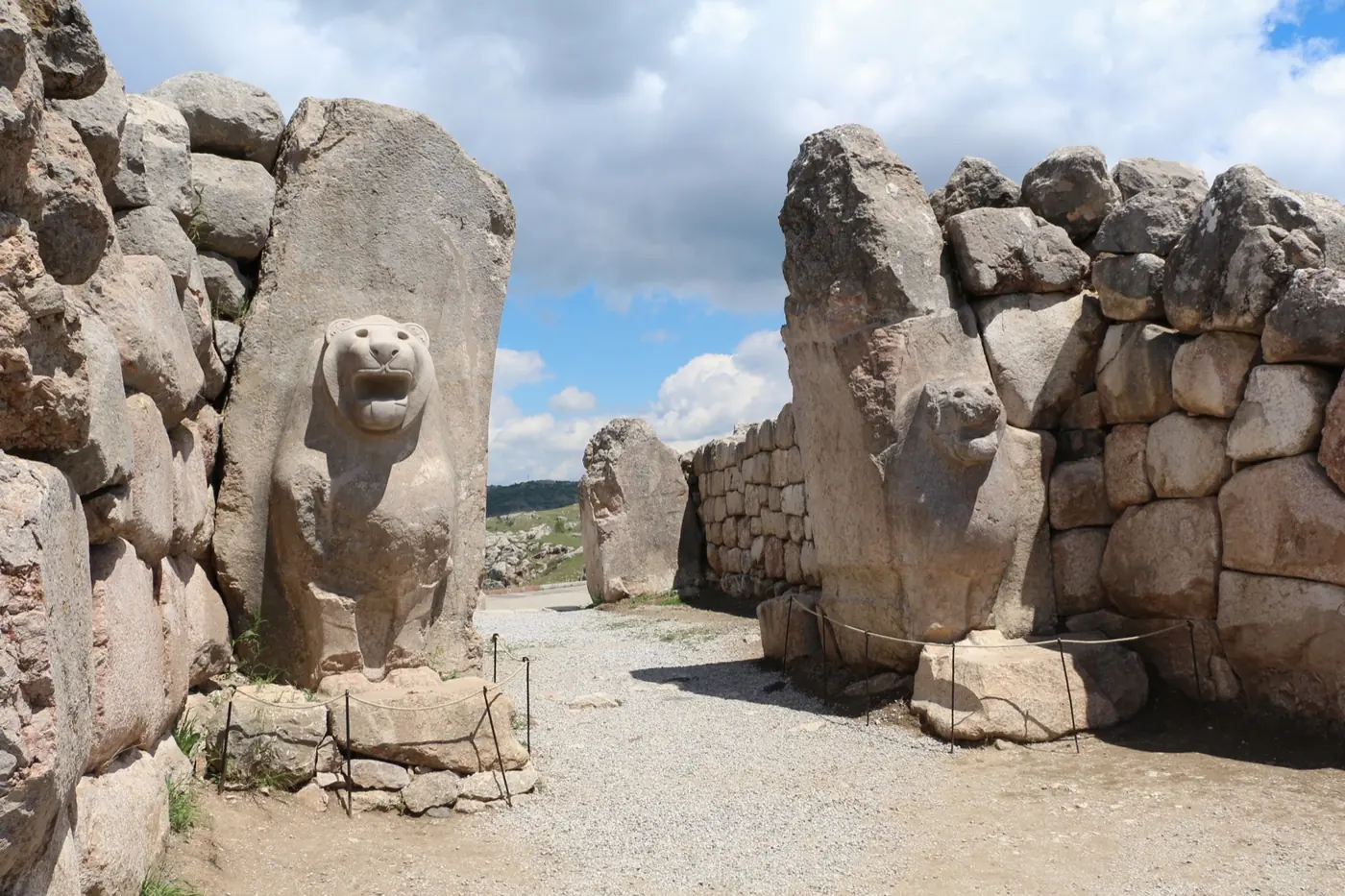
The Hittites were a Bronze Age people who built an empire across Anatolia, in modern Turkey, between about 1650 and 1180 BC. Their capital, Hattusa, occupied a high plateau in the interior of what is now Turkey. Its defensive walls ran for more than six kilometers, with monumental gates flanked by stone carvings of lions and sphinxes. From Hattusa, Hittite kings controlled dependent kingdoms across Anatolia and into northern Syria. Their army's main weapon was the war chariot, and they were among the first civilizations to produce iron objects. At their peak the Hittites rivaled Egypt as the strongest power in the ancient Near East. Then, around 1180 BC, the empire collapsed so thoroughly that it dropped out of the historical record for more than thirty centuries, surviving only as a name in a few passages of the Bible.
How the Hittites and Egypt divided the ancient Near East
During the Late Bronze Age, the major powers of the eastern Mediterranean formed a kind of diplomatic network. Egypt, Hatti (what the Hittites called their own land), Assyria, Babylon, and the Mycenaean world traded goods, arranged dynastic marriages, and exchanged letters written on clay tablets in cuneiform. Kings addressed each other as "brother." Nothing quite like this system of states had existed before, and it held together as long as every member remained strong enough to keep its commitments.
The great collision between the network's two strongest members happened near Kadesh, in present-day Syria, around 1274 BC. Ramesses II of Egypt marched north to take the city from the Hittite king Muwatalli II. Ramesses had advanced ahead of his main force, and the Hittite army was waiting out of sight behind the city. Hittite chariots struck the Egyptian column before reinforcements could arrive, and the battle turned into one of the largest chariot engagements on record, with thousands of chariots on both sides. Hittite chariots carried three men, a driver, a shield-bearer, and a spearman, which made them heavier and better suited for direct charges than the lighter two-man Egyptian ones. Neither side could break the other. Both kings claimed victory afterward. Ramesses, who went on to rule for 66 years and father more than a hundred children, spent much of that reign having his version of the battle carved across temple walls throughout Egypt. In fact, neither side won.
Roughly fifteen years after Kadesh, around 1259 BC, Ramesses and a later Hittite king, Hattusili III, agreed to a peace that covered mutual defense and the extradition of fugitives. The text of that agreement is the oldest known peace treaty to survive in writing. Both empires honored it for the rest of their existence. A copy hangs today at the United Nations headquarters in New York.
What happened to the Hittites?
Around 1180 BC, the system that held the Late Bronze Age together broke down violently. In a rapid series of destructions that historians call the Bronze Age collapse, major cities across the eastern Mediterranean fell within a few decades. The causes were probably several working together: a prolonged drought that ruined harvests, migrating raiders now called the Sea Peoples, and the collapse of trade networks on which every kingdom depended for tin, copper, and grain. When one part of the system broke, the rest could not absorb the shock.
The people of Hattusa left the city, and it burned. The Hittite state was finished. Small successor states in southeastern Turkey and northern Syria kept some Hittite traditions alive for a few centuries, but the central empire never recovered. Unlike Egypt, which survived the collapse in weakened form, the Hittites left behind no continuous tradition. Within a few centuries, no one in the region could say what empire had once ruled from Hattusa.
How were the Hittites rediscovered?
In the late nineteenth century, scholars noticed that the "Hittites" named in the Bible matched references in Egyptian and Assyrian records to a powerful kingdom called Hatti. But nobody knew where that kingdom had been or what its people had built. In 1906, the German archaeologist Hugo Winckler began digging at a site called Bogazkoy (now Bogazkale) in central Turkey. He found an archive of about ten thousand clay tablets. They were the official records of Hattusa, the lost Hittite capital. Winckler recognized one tablet as the Hittite version of a treaty already known from inscriptions in Egyptian temples, proof that the site had been the capital of the forgotten kingdom of Hatti.
The language on most of the tablets was unknown. In 1915, the Czech linguist Bedrich Hrozny deciphered it. The result surprised the scholarly world: Hittite belonged to the Indo-European language family, a distant relative of Greek, Latin, and English, and the oldest recorded member of that family. Winckler's excavation and Hrozny's decipherment turned the Hittites from a biblical footnote into one of the best-documented civilizations of the ancient Near East.