
Colosseum
The Colosseum is the largest amphitheater ever built, opened in Rome in 80 AD for gladiator fights, beast hunts, and public executions.
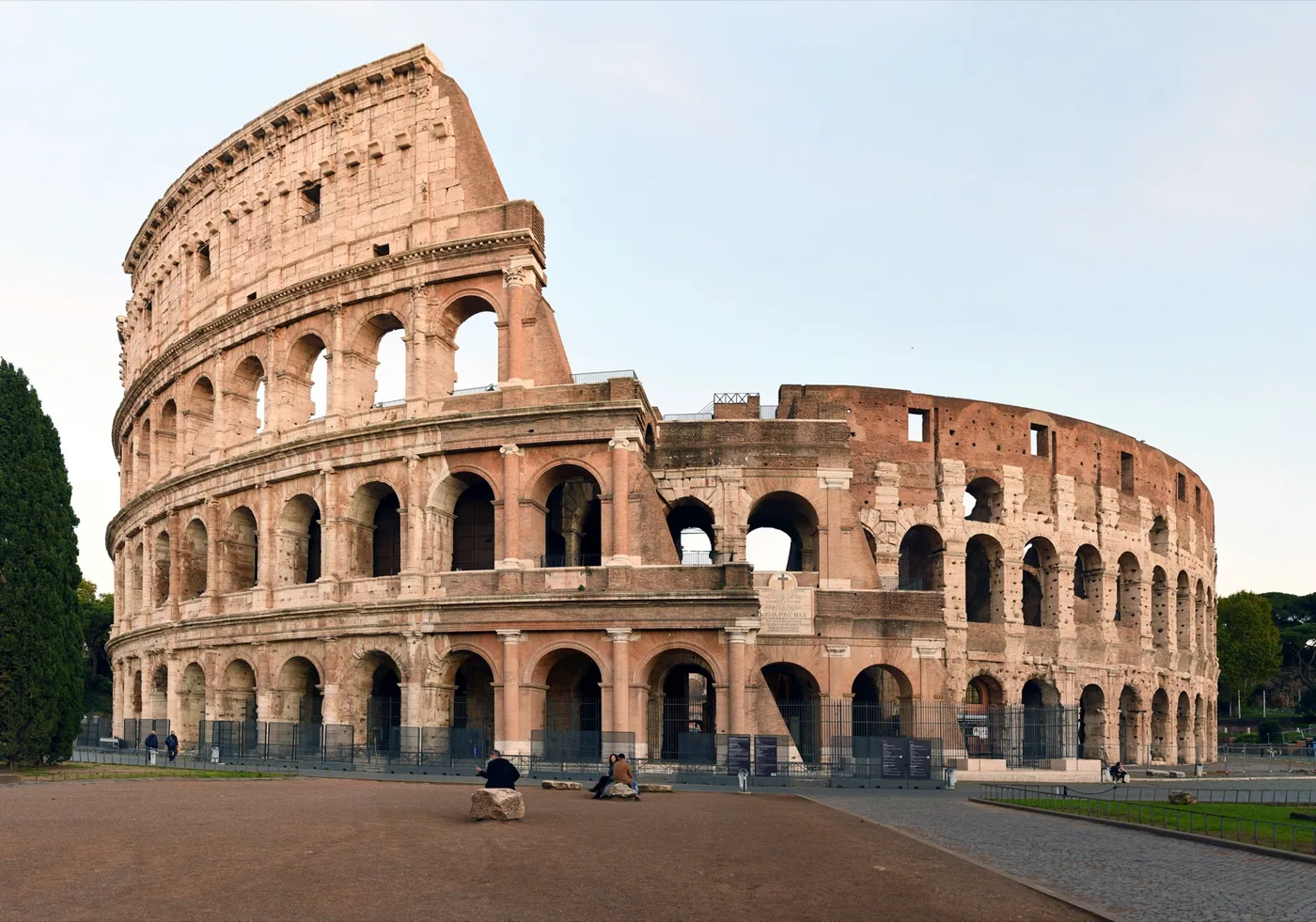
The Colosseum is the largest amphitheater ever built. It stands in the center of Rome, an oval building 48 meters tall and 189 meters long, built mainly from travertine stone. It is also known as the Flavian Amphitheatre, a name taken from the ruling family that built it. The name "Colosseum" probably came from a colossal bronze statue of Nero that once stood nearby. Construction began around 72 AD under the emperor Vespasian, on the site of a private lake that Nero had built for himself. The money came from the spoils of Rome's conquest of Jerusalem in 70 AD. The building could hold about 50,000 spectators, who came to watch gladiator fights, beast hunts, and public executions, all free of charge. Nearly two thousand years later, it is still standing, though more than half of its outer wall is gone.
How the Flavian emperors built the Colosseum
Vespasian took power in 69 AD after a civil war that followed Nero's suicide. Nero had seized a large area in the center of Rome for his private palace, the Domus Aurea, which included an artificial lake. Vespasian drained the lake and began building the amphitheater on the site. The choice was a political statement: land Nero had taken for himself was given back to the public.
The construction used about 100,000 cubic meters of travertine stone. Instead of mortar, the blocks were held together by an estimated 300 tons of iron clamps. Some of the labor probably came from Jewish captives taken during the siege of Jerusalem. The building took roughly eight years to complete.
Vespasian died in 79 AD, one year before the building was finished. His son Titus opened it in 80 AD and held games for a hundred consecutive days to celebrate. The ancient historian Cassius Dio wrote that about 9,000 animals were killed during those opening spectacles. Vespasian's younger son Domitian later finished the upper levels and added the underground chambers beneath the arena floor.
How the Colosseum's spectacles worked
The events followed a set pattern: animal hunts in the morning, public executions at midday, and gladiator fights in the afternoon. Admission was free. An emperor who sponsored a day of games was buying the goodwill of a city whose crowds could turn dangerous. Seating was arranged strictly by social rank. Senators sat at the front, closest to the arena. Ordinary citizens filled the middle tiers. Women and the poor stood or sat at the top.
Beneath the arena floor was a two-level underground structure called the hypogeum. It contained about 80 vertical shafts, a network of corridors and animal cages, and a system of lifts that workers operated by turning capstans. Animals and stage scenery could be raised through trapdoors and appear suddenly in the arena. In the building's earliest years, before Domitian dug out the hypogeum, the arena could be flooded with water from an aqueduct to stage mock naval battles.
Above the crowd, a massive canvas awning called the velarium could be stretched over the seating to block the sun. It was rigged to 240 wooden masts set into stone brackets around the top of the outer wall. The whole system weighed about 24 tons and was operated by roughly a thousand sailors from the imperial fleet at Misenum, near Naples. They were stationed in barracks near the Colosseum because they were the only people in Rome with the skills to handle that much rigging.
Why is the Colosseum broken?
The emperor Honorius banned gladiator fights around 404 AD. Animal hunts continued for another century, but as Rome's population shrank, the games stopped entirely.
Over the centuries that followed, Romans treated the Colosseum as a quarry. Workers pulled out the 300 tons of iron clamps that held the stone together, leaving the rows of holes still visible in the walls today. Travertine blocks and marble were hauled away to build palaces and churches across the city, including parts of St. Peter's Basilica. In the twelfth century, the Frangipane family built a fortress inside the structure, walling off sections of its arches. Then, in 1349, a powerful earthquake brought down most of the outer wall on the south side, which sat on softer ground than the rest of the building. The fallen stone was itself quarried for decades.
Popes began protecting what remained in the eighteenth century, and restoration has continued since then. What survives is less than half the original outer wall and much of the interior structure.
The Colosseum today
The Colosseum became a UNESCO World Heritage Site in 1980 as part of the Historic Centre of Rome. In 2024, it was the most visited archaeological site in Italy. Since 2021, visitors can walk through the hypogeum, the underground corridors where animals and gladiators once waited below the arena floor.
Nearly two thousand years after it was built, the Colosseum remains the most recognized symbol of ancient Rome.