
Gladiators
Gladiators were trained fighters in ancient Rome, mostly enslaved, who fought in arenas as public entertainment and political spectacle.
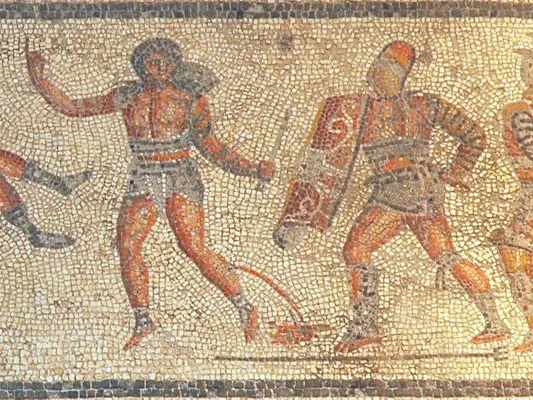
Gladiators were professional fighters in ancient Rome who fought in arenas for public entertainment. Most were enslaved war captives or condemned criminals. A smaller number were free volunteers who signed contracts giving up their legal rights in exchange for prize money and fame. Gladiators trained in specialized schools, fought in fixed combat styles with set weapons and armor, and became some of the most recognized figures in the Roman world. The games ran from at least 264 BC to 404 AD, and for most of that time they served as a tool of Roman politics as much as entertainment. In 73 BC, a gladiator named Spartacus escaped a training school at Capua with about 70 other fighters and gathered tens of thousands of enslaved people into a fighting force. Rome needed two years and several military campaigns to put the revolt down.
How gladiatorial combat began
The first recorded gladiatorial fight in Rome took place in 264 BC, when three pairs of fighters fought at a funeral. The contest was a munus, a duty owed to the dead. For the next two centuries the fights stayed connected to funerals, but they grew larger with each generation as wealthy Romans realized that sponsoring a spectacle was the fastest way to win popularity.
In 65 BC, Julius Caesar, then a junior magistrate called an aedile, staged a show with 320 pairs of gladiators in silvered armor to honor his father, who had died twenty years earlier. The Senate, still nervous about the Spartacus revolt less than a decade before, passed a law capping the number of fighters a sponsor could bring to Rome. Caesar used the games, along with banquets and parades, to build the public support that helped carry him to power.
By the imperial period, the games were a basic part of governing. Emperors provided free fights and free grain to the people of Rome. The poet Juvenal, writing in the early second century AD, complained that Romans had given up their political freedom and now cared only about "bread and circuses" (panem et circenses). The Colosseum, finished in 80 AD, could seat about 50,000 people and became the center of the spectacle. The games were not limited to Rome. Cities across the empire built their own arenas, and gladiatorial combat became a feature of public life from Britain to North Africa.
How gladiators trained and fought
Gladiators lived and trained in schools called ludi, each run by an owner-manager called a lanista. A lanista treated his fighters as expensive property worth keeping alive. Training a single gladiator cost years of feeding, housing, medical care, and coaching, and if one was killed in the arena, the sponsor of the games owed the lanista full compensation.
Fighters were sorted into distinct classes, each defined by its weapons and weaknesses. The murmillo carried a large rectangular shield, a short sword, and a helmet with a fish-shaped crest. His heavy armor gave him protection but tired him out. The retiarius wore almost no armor and fought bare-headed, carrying a net, a trident, and a dagger. He relied on speed. A standard matchup pitted these two types against each other, setting mobility against protection. The crowd bet on the outcome and cheered for their favorites.
A defeated gladiator signaled surrender by raising a finger. The editor, the person sponsoring the games, then decided whether the loser lived or died, taking the crowd's mood into account. A gesture called pollice verso, meaning "turned thumb" in Latin, was part of this decision. No surviving record says which direction the thumb pointed to mean what. The popular idea that thumbs down meant death comes from an 1872 painting by Jean-Léon Gérôme, not from ancient sources.
Did gladiator fights end in death?
Most did not. Historians studying ancient inscriptions and records estimate that roughly one in five fights ended with a fighter killed. The economics of the games pushed toward mercy. If the editor ordered a defeated gladiator killed, he owed the lanista the full replacement cost. That made death expensive for the person paying for the show, and mercy, called missio in Latin, was the cheaper and more common outcome.
The mass slaughter that people associate with the arena mostly came from a different kind of spectacle. Public executions of criminals were sometimes staged as fights with armed gladiators or wild animals, and these had a near-total death rate. They are often confused with gladiatorial matches in popular memory. Real gladiatorial bouts followed rules and were overseen by referees.
How gladiatorial combat ended
Gladiatorial combat declined as Christianity spread through the Roman Empire. Emperor Constantine, who legalized Christianity in 313 AD, issued an edict restricting the games, but it was not widely enforced. The fights continued through the fourth century, becoming less frequent.
The traditional date for the end is January 1, 404 AD. According to the church historian Theodoret, a monk named Telemachus jumped into the arena during a fight and was stoned to death by the crowd. Emperor Honorius, reportedly moved by the monk's death, issued a permanent ban on gladiatorial combat. Wild animal hunts continued in Roman arenas for another century, but the fights between people were over. The gladiatorial games had lasted more than six hundred years.