
Corn Laws
The Corn Laws were British tariffs on imported grain that kept bread expensive from 1815 until their repeal in 1846.
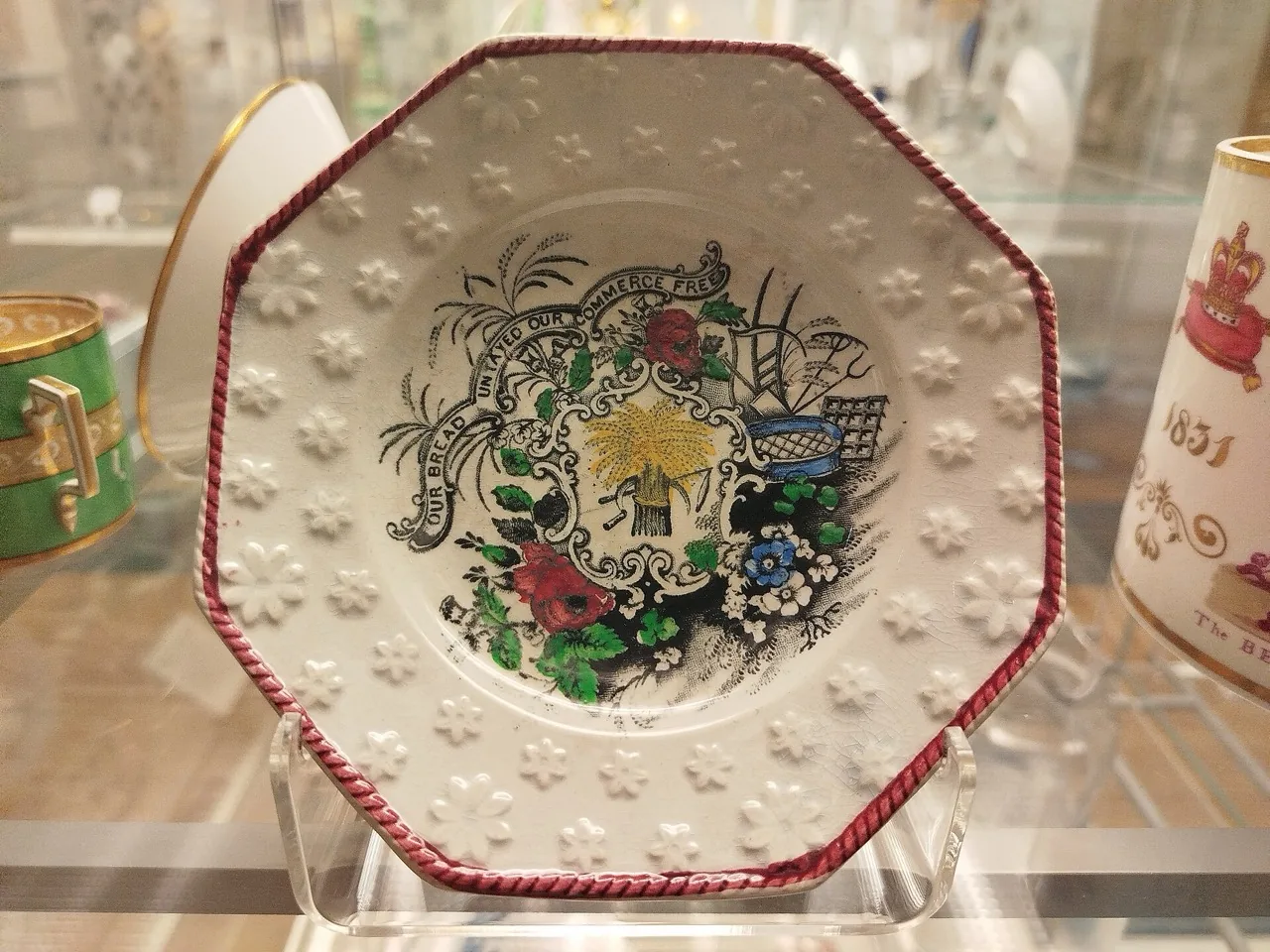
The Corn Laws were British tariffs on imported grain, in effect from 1815 to 1846. In British English, "corn" means grain, mostly wheat. Parliament passed the tariffs to protect landowners, and they kept the price of bread high for thirty years. The thirty-year campaign to end them turned into one of the first modern political movements in British history, led from Manchester by Richard Cobden and John Bright. When Robert Peel, who led the Conservative government, pushed repeal through Parliament in 1846, it split his own party and opened Britain to foreign trade more completely than any other major power.
How the Corn Laws kept bread expensive
When the Napoleonic Wars ended in 1815, cheap grain from the continent threatened to undercut British farmers. Parliament, dominated by landowners, passed the Importation Act. The Act banned imports of foreign wheat until the domestic price reached 80 shillings per quarter (a quarter was about 480 pounds of grain). That was an extremely high bar, and in practice foreign grain almost never entered the country.
The law did what it was designed to do. High grain prices kept rents up, enriched the landed class, and left workers paying more for every loaf of bread. The cost fell on ordinary families, who spent much of their wages on food, and on the factory owners in cities like Manchester and Birmingham.
Manufacturers had two arguments against the tariffs. Expensive bread forced them to raise wages, which made British goods more costly to sell abroad. And if foreign countries could not sell grain to Britain, they earned no British money to spend on British cloth and manufactured goods. Protection at home was hurting exports.
How the Anti-Corn Law League fought for repeal
In 1838, opponents of the tariffs organized the Anti-Corn Law League in Manchester. Its two leaders were Richard Cobden and John Bright. Cobden was born in Sussex, the fourth of eleven children of a struggling small farmer. After his father's farm was sold, Cobden worked as a traveling salesman, then built a calico printing business in Lancashire. Bright was a Quaker mill owner from Rochdale and one of the best-known orators in British public life. Cobden handled strategy. Bright gave the speeches.
The League ran a campaign more organized than anything Britain had seen. It employed paid lecturers to speak around the country. After the penny post was introduced in 1840, the League used it to send pamphlets directly to voters' homes. It published a weekly newspaper called The League. It even bought small freehold properties for supporters, because owning property worth 40 shillings a year gave a man the right to vote under the 1832 Reform Act.
The League framed the fight in moral terms: landowners were making workers pay more for bread so that rents could stay high. That argument put the landowners on the defensive, because there was no easy answer to it.
Why Robert Peel repealed the Corn Laws
Robert Peel, who led the Conservative government, pushed repeal through Parliament in 1846. Peel came from a cotton manufacturing family in Lancashire. His father, a wealthy mill owner, had bought him a seat in Parliament when he was 21. Peel had already cut tariffs on hundreds of other goods and was moving toward free trade, but grain was the hard case. The landowners who controlled his party depended on high grain prices for their income.
The Irish potato blight of 1845 forced the question. The potato crop failed across Ireland, and famine was coming. Peel argued that Britain could not justify keeping tariffs on food while people starved. He introduced a repeal bill in January 1846. It passed in June with the votes of Whigs and Radicals. Only about a third of the Conservatives in the House of Commons voted with Peel. Most of the others voted against their own prime minister.
Benjamin Disraeli, a backbencher who had spent months attacking Peel as a traitor to Conservative principles, built his political career on the split. Peel's government fell within days. The Conservative Party did not hold stable power again for roughly a generation. Peel himself died four years later, in 1850, thrown from his horse on Constitution Hill in London.
None of this helped Ireland. About a million people died in the famine, and more than a million emigrated. The causes of the death toll were British relief policy and Irish land tenure, not tariffs.
Britain after the Corn Laws
After 1846, Britain committed to free trade more fully than any other major country. It kept its markets open while Germany and the United States built their own industries behind high tariff walls. British consumers got cheaper food, British manufacturers got wider export markets, and the country became the world's leading banker and shipper.
The tradeoff was dependence on imports. By 1914, Britain imported about four-fifths of its wheat. A country that feeds itself on imported grain must protect its sea lanes. That dependence was one reason Britain maintained the world's largest navy. In both world wars, German submarines targeting merchant ships came closer to cutting off Britain's food supply than the German surface fleet ever did in open battle.
The debate over the Corn Laws has replayed with different products ever since, from the American Smoot-Hawley Tariff of 1930 to arguments over European farm subsidies and Chinese steel today. Every country that trades faces the same question: whether to protect the people who make things at home or to let consumers buy more cheaply from abroad. Britain chose consumers over producers in 1846, and that choice shaped its economy for the next century.