
Smoot-Hawley Tariff
The Smoot-Hawley Tariff was a 1930 US law that raised duties on about 890 kinds of goods, provoked worldwide retaliation, and reshaped American trade policy.
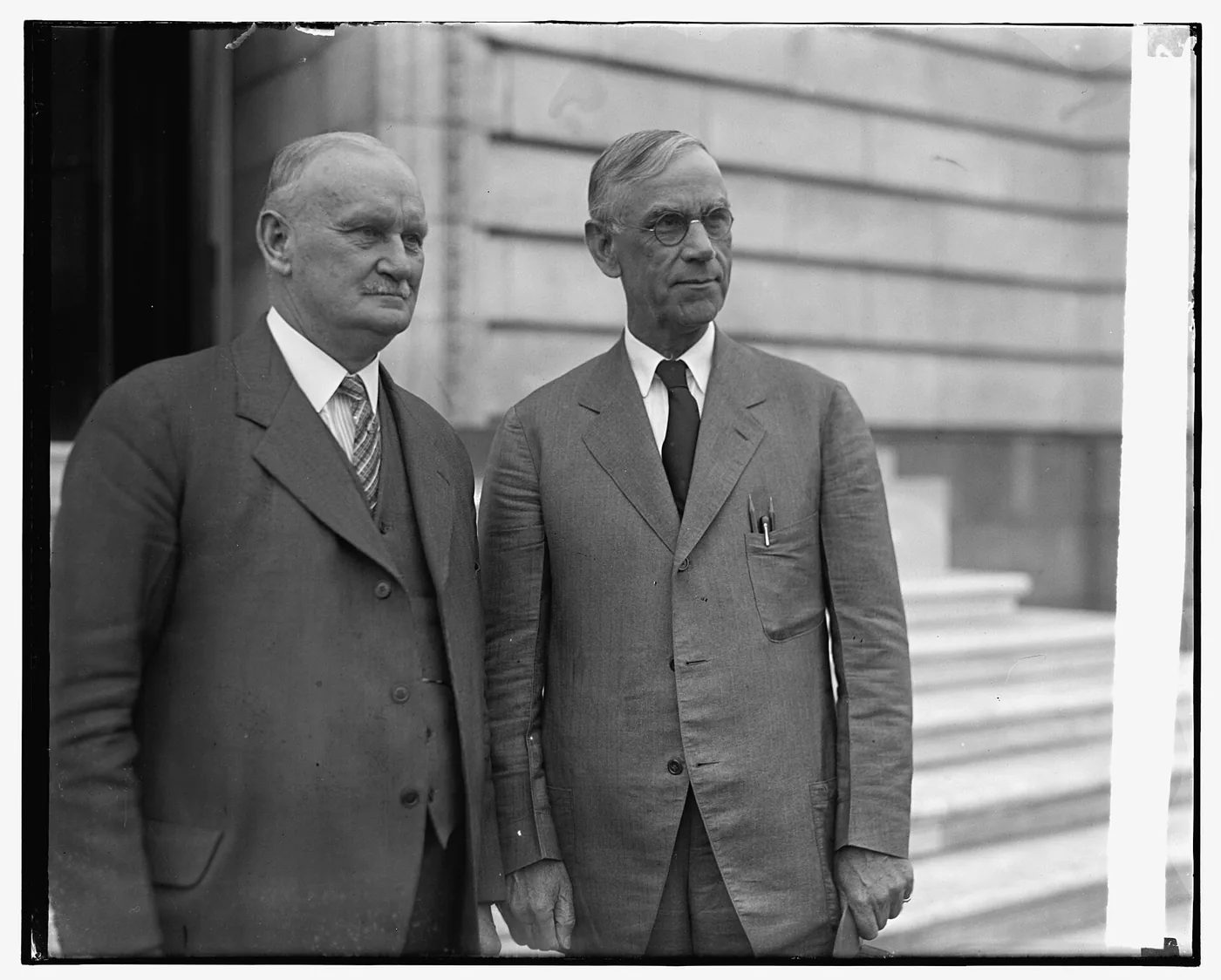
The Smoot-Hawley Tariff, formally the Tariff Act of 1930, increased US tariffs across about 890 product categories. President Herbert Hoover signed the bill into law on June 17, 1930. The stock market had crashed the previous October. Average tariff rates on dutiable imports rose to about 45 percent, among the highest the country had ever imposed. The law takes its name from the two legislators who steered it through Congress: Senator Reed Smoot, a Utah Republican, and Representative Willis Hawley, an Oregon Republican.
Trading partners around the world struck back. Canada imposed higher duties on American products and began buying more from Britain instead. Spain, Italy, and Switzerland raised their own tariffs on US goods. Within three years, American imports and exports had each fallen by roughly two-thirds. The name Smoot-Hawley has been shorthand for trade policy gone wrong ever since.
How a bill for farmers became the Smoot-Hawley Tariff
Farmers across the United States had spent the entire 1920s in a slump, even as the rest of the country boomed. During his 1928 presidential campaign, Hoover promised to raise duties and protect agriculture. The tariff revision he asked Congress for in 1929 focused on farm products.
It did not stay that way. Once Congress opened the full tariff schedule for revision, one industry after another showed up to request its own protections. A manufacturer whose raw materials were now taxed at a higher rate wanted a higher duty on its finished goods. Every new rate increase gave the next group a reason to demand its own. The bill that left Congress covered virtually every kind of imported good.
Opposition was loud. In the spring of 1930, 1,028 American economists, including Irving Fisher of Yale and Paul Douglas of the University of Chicago, published a joint letter urging Hoover to reject the legislation. They warned it would raise consumer prices, invite foreign retaliation, and make it harder for foreign borrowers to pay interest to American investors. Henry Ford visited Hoover at the White House and reportedly stayed overnight to press the case, calling the bill "economic stupidity." Hoover had doubts about the final bill, but vetoing his own party's biggest piece of legislation was politically impossible. He signed it.
How the world responded to Smoot-Hawley
Counter-tariffs came quickly. Canada, America's largest trading partner at the time, put new duties on US products and started buying more from Britain. Italy, Spain, Switzerland, and other countries imposed their own retaliatory tariffs. In 1932, Britain gave up its longstanding policy of open trade and switched to a system called imperial preference, which gave favorable terms to imports from the British Empire and penalized American goods.
Between 1929 and 1933, global trade fell by roughly two-thirds. The Great Depression and the monetary instability tied to the gold standard drove most of that decline, not the tariff on its own. But Smoot-Hawley and the counter-tariffs it provoked did help fragment global commerce into rival blocs, exactly when countries most needed to cooperate.
Who were Smoot and Hawley?
Reed Smoot was a Republican senator from Utah who served from 1903 to 1933. He was also an apostle of the Church of Jesus Christ of Latter-day Saints. After Smoot first took his seat in 1903, the Senate held two years of hearings on whether a church leader should serve in Congress. The full Senate voted to keep him in 1907, and Smoot served for another 26 years. He rose to chair the Senate Finance Committee, the committee that controls tariff legislation.
Willis Hawley was a Republican congressman from Oregon who served from 1907 to 1933. Before entering politics, Hawley had been president of Willamette University in Salem, Oregon, where he taught economics and public law. As chairman of the House Ways and Means Committee, Hawley co-sponsored the tariff bill with Smoot. Both men lost their seats in the 1932 elections.
Did the Smoot-Hawley Tariff cause the Great Depression?
No. The Great Depression began before the tariff was signed, and its main causes were a collapse in bank lending and mistakes in monetary policy. Serious estimates of the tariff's direct effect on American economic output put it at a small fraction of the Depression's decline.
The tariff did make things worse in a different way. Rounds of retaliation carved the world economy into competing blocs when countries needed to work together. That fragmentation belongs in the chain of events leading to the Second World War. Smoot-Hawley does not prove that tariffs cause depressions. Its real significance is about process. When a legislature writes tariff rates one product at a time, each member protecting a local industry, trading partners will respond in kind.
How Smoot-Hawley changed American trade policy
The backlash against Smoot-Hawley produced a lasting change in how the United States sets tariffs. In 1934, Congress enacted the Reciprocal Trade Agreements Act, championed by Secretary of State Cordell Hull. The law authorized the president to negotiate lower tariffs directly with other countries, taking the process away from the congressional floor.
That 1934 delegation of authority led to the General Agreement on Tariffs and Trade, signed in 1947. Over the following decades, seven more rounds of multilateral negotiations lowered barriers further, leading to the creation of the World Trade Organization in 1995. The postwar trading system was built, in large part, to avoid repeating the cycle of retaliation that Smoot-Hawley set off.