
Falklands War
The Falklands War was a 1982 conflict in which Britain sent a naval task force to retake the Falkland Islands after Argentina invaded.
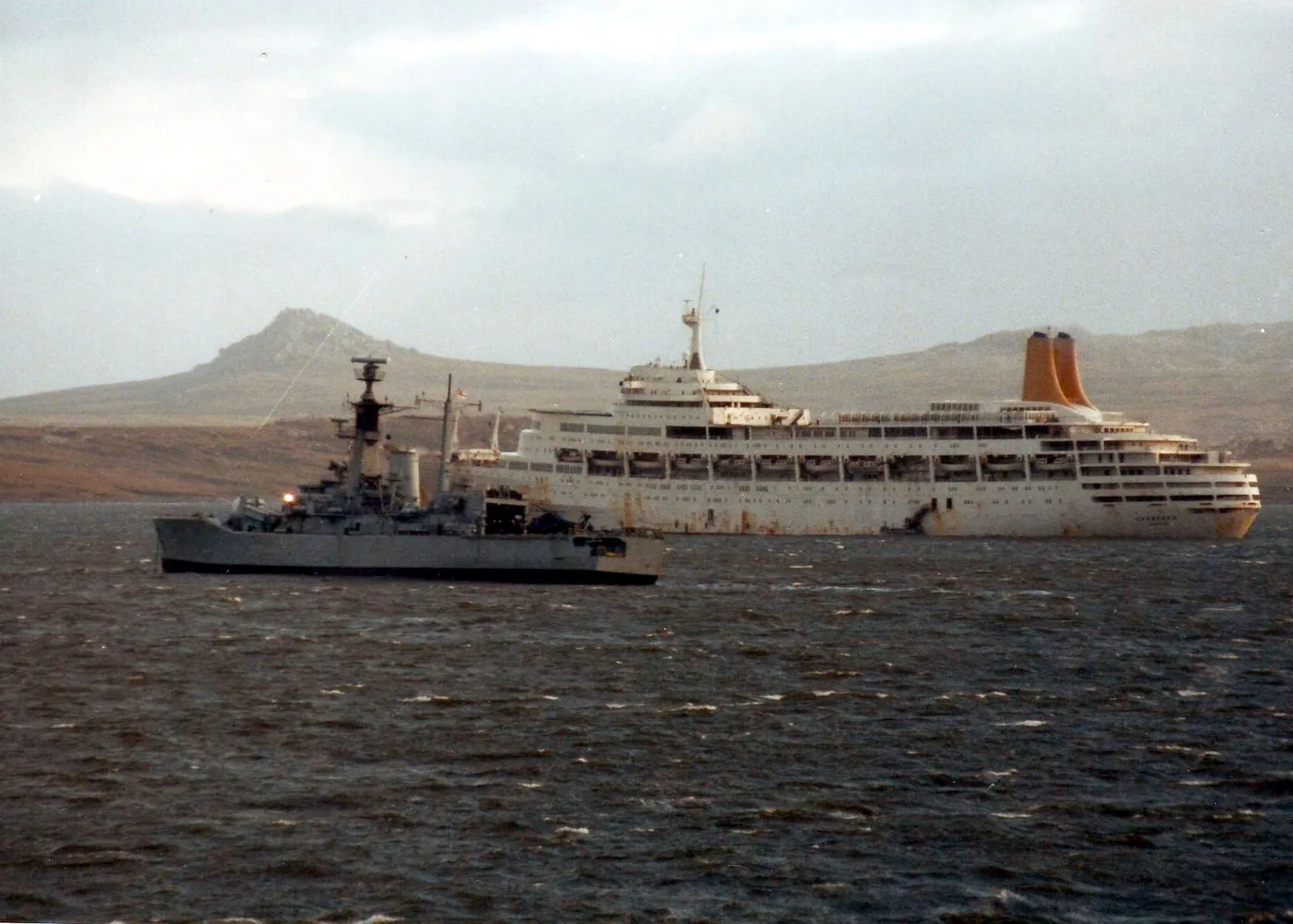
The Falklands War was a ten-week conflict in 1982 between Britain and Argentina over the Falkland Islands, a small British territory in the South Atlantic about 300 miles off the Argentine coast and 8,000 miles from Britain. Argentina invaded the islands on April 2, 1982, and Britain sent a naval task force to retake them. Argentina surrendered on June 14. The war killed 649 Argentines, 255 British personnel, and three Falkland Island civilians. It destroyed Argentina's military government and led to the country's return to democracy. In Britain, it turned Margaret Thatcher from the least popular postwar prime minister into a landslide election winner.
Why Argentina invaded the Falkland Islands
Argentina had claimed the islands, which it calls the Malvinas, since the 1820s, before Britain took control of them in 1833. The claim was a cause that united Argentines across the political spectrum.
In 1982, Argentina was ruled by a military junta led by General Leopoldo Galtieri. The junta had murdered or forcibly disappeared an estimated 30,000 people during what became known as the Dirty War. By early 1982, the regime also faced annual inflation running past 100 percent and an economy in decline.
Galtieri calculated that taking the islands would rally the public behind his government. Several British decisions encouraged him. A 1981 defense review had proposed deep cuts to the Royal Navy, including withdrawing HMS Endurance, the only British naval vessel in the South Atlantic. Years of inconclusive talks over the islands' future had given the impression that Britain did not care much about them. Galtieri expected that Britain would protest but would not send a military force 8,000 miles to retake islands with fewer than 2,000 inhabitants.
How Britain retook the Falkland Islands
Margaret Thatcher, Britain's prime minister, ordered a task force assembled within days of the invasion, before anyone had confirmed the operation could succeed. Her reasoning was part principle: a democracy that allows a dictatorship to seize its territory and citizens invites others to try the same. It was also political: a government that accepted the loss without a fight would fall. In December 1981, Thatcher's approval rating had fallen to 25 percent, the lowest then recorded for any postwar British prime minister.
The operation was barely feasible. The nearest usable staging base was Ascension Island, a British territory in the mid-Atlantic, still more than 3,000 nautical miles from the Falklands. The task force had two small aircraft carriers, HMS Hermes and HMS Invincible, carrying about 20 Sea Harrier jets between them, against roughly 200 Argentine aircraft. The fleet had no airborne early warning system. Merchant ships were pressed into service to carry troops and equipment, including the passenger ship SS Canberra and the cargo vessel Atlantic Conveyor.
The UN Security Council passed Resolution 502 on April 3, demanding that Argentina withdraw, which gave Britain diplomatic cover to use force. On May 2, the British submarine HMS Conqueror sank the Argentine cruiser General Belgrano outside the British-declared exclusion zone, killing 323 people, the war's largest single loss of life. The sinking was controversial, though it later emerged that the Belgrano had been ordered to approach British forces. After losing the cruiser, the Argentine navy's surface fleet returned to port and did not sail again during the war. Two days later, an Argentine Exocet missile struck HMS Sheffield, the first British warship lost to enemy action since World War II.
Argentine pilots attacked British ships at extremely low altitude in the confined waters around the islands. Many of their bombs failed to explode because the fuses did not have enough time to arm at such low release heights. At least 13 bombs struck British ships without detonating. If more of them had gone off, the war could have ended differently.
British troops landed at San Carlos on May 21 and fought their way east through Goose Green and across the ridges above Stanley, the islands' capital. Argentina surrendered on June 14, 73 days after the invasion.
What happened after the Falklands War
The defeat destroyed Argentina's military government. Galtieri was removed within days. The junta called elections, and in October 1983 Raúl Alfonsín won the presidency, ending seven years of military rule. The return to democracy opened the way for prosecuting the junta's leaders for the crimes of the Dirty War.
In Britain, Thatcher's approval ratings doubled. She won a landslide in the June 1983 general election, and the war became a defining story of her time in office. The government reversed the cuts from the 1981 defense review, concluding that aircraft carriers and the ability to project force far from home were still needed.
The war was a lesson in miscalculation on both sides. Argentina's junta misread British budget cuts and routine diplomacy as indifference, taking them as a signal that Britain would not fight. Britain failed to see that its own actions, especially withdrawing its only naval vessel from the South Atlantic, could be read as an invitation to invade.
Who owns the Falkland Islands today?
The Falkland Islands remain a British Overseas Territory. About 3,700 people live there, most of British descent. In a 2013 referendum, 99.8 percent of islanders voted to remain British.
Argentina still claims sovereignty. In September 2026, President Javier Milei renewed Argentina's claim at the United Nations, calling for a peaceful solution. The dispute has intensified as plans for oil production near the islands raise the economic stakes. Argentina does not recognize the islanders' right to decide their own future, arguing that sovereignty is a matter between Buenos Aires and London, not a question of self-determination.