
Royal Navy
The Royal Navy is Britain's naval force, founded in 1546, which dominated the world's oceans for over a century and helped build the British Empire.
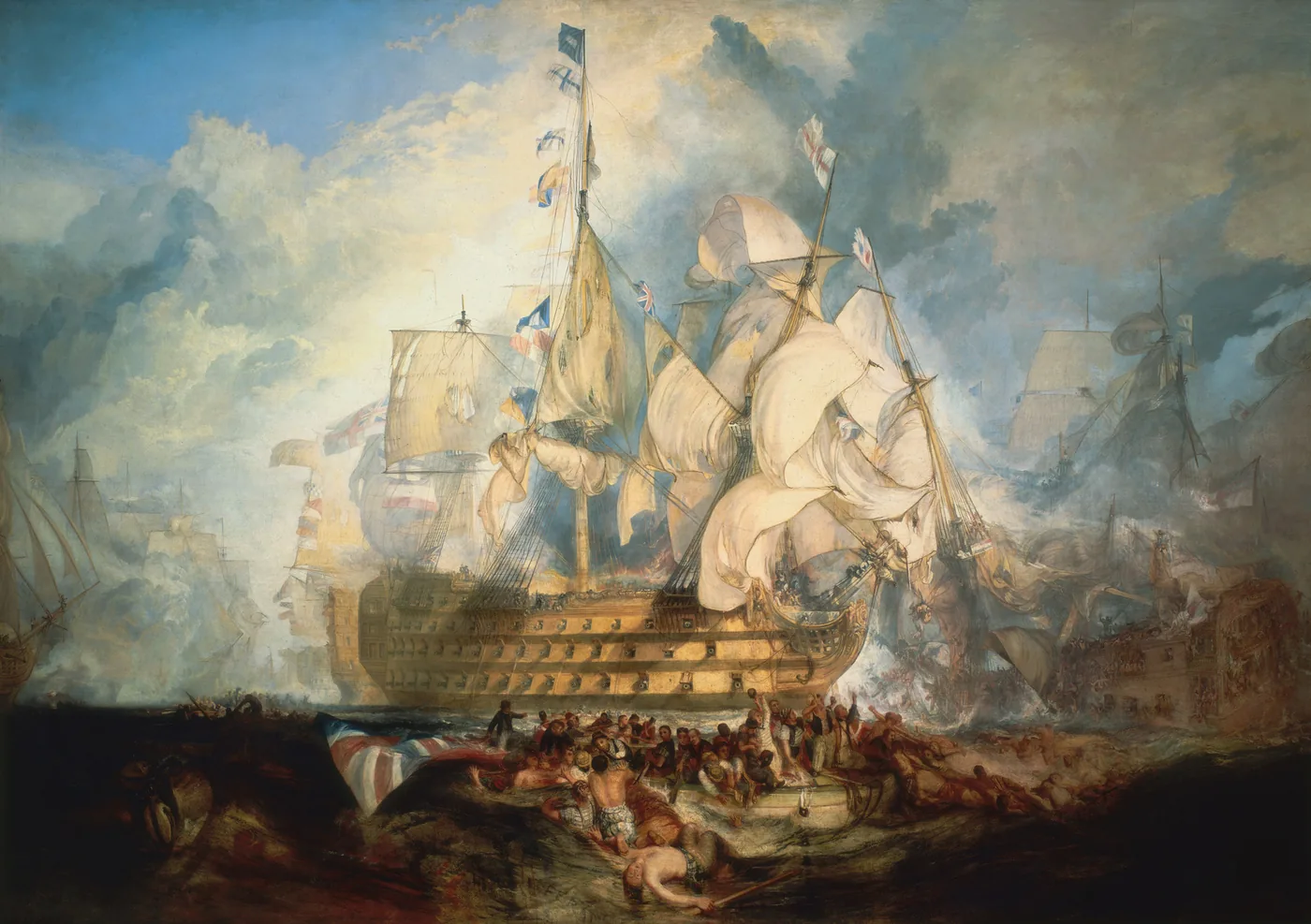
The Royal Navy is the naval force of the United Kingdom, formally established in 1546 under King Henry VIII. For most of its history, Britain did not have a large army by European standards. Its strength was at sea. After Admiral Horatio Nelson destroyed the combined French and Spanish fleets at the Battle of Trafalgar in 1805, the Royal Navy controlled the world's oceans for roughly a century. During that time, Britain built an empire covering about a quarter of the earth's land surface, and the navy made it possible. The fleet protected trade routes, enforced British interests from the Caribbean to China, and made any invasion of the British Isles nearly impossible.
How Britain paid for the world's largest fleet
Building a single warship took several thousand oaks, enough cordage to stretch for miles, and acres of sailcloth. The dockyards at Portsmouth, Plymouth, and Chatham employed more workers than any other enterprise in the country. Britain's population was smaller than France's, and keeping a larger fleet meant finding a way to sustain the cost.
The answer was financial. The Bank of England, founded in 1694, allowed the government to borrow against future tax revenue and keep ships at sea. The Navigation Acts channeled merchant shipping through routes that generated government income and trained the sailors who would crew warships in wartime. Other European powers had navies, but Britain built a financial system specifically designed to pay for one.
From Trafalgar to global reach
On October 21, 1805, a British fleet of 27 ships under Admiral Horatio Nelson met a combined French and Spanish fleet of 33 ships off Cape Trafalgar, near the southern tip of Spain. The British destroyed or captured 18 enemy ships without losing a single one of their own. Nelson was killed during the battle, shot on the quarterdeck of his flagship HMS Victory.
Trafalgar did not end the war against Napoleon. Napoleon held his grip on mainland Europe for ten more years. But the English Channel, just 21 miles wide at its narrowest, stopped him, and British forces could come ashore anywhere on his coastline.
After Napoleon's final defeat in 1815, no navy challenged Britain for a century. The Royal Navy used that time to build a global system. Britain held Gibraltar, Malta, Aden, the Cape of Good Hope, Singapore, and Hong Kong, all positioned as coaling stations so warships could refuel across every ocean. Royal Navy surveyors charted coastlines around the world, and their charts and the Greenwich meridian became international standards.
That reach served different purposes at once. After Britain outlawed the Atlantic slave trade in 1807, the Royal Navy's West Africa Squadron spent about 50 years intercepting slave ships, seizing roughly 1,600 vessels and freeing about 150,000 people. More than 1,500 British sailors died in the effort, most from tropical disease. During the same decades, Royal Navy ships shelled Canton to force open China's ports in the Opium Wars.
The Dreadnought arms race
In 1889, the British Parliament passed the Naval Defence Act, which set the "two-power standard": the Royal Navy would keep a fleet no smaller than the combined fleets of the two next-largest naval powers, at the time France and Russia. Parliament voted more than £20 million to build the ships.
In 1906, Britain launched HMS Dreadnought. Dreadnought carried ten 12-inch guns and was faster than any existing battleship. It made every older battleship obsolete, including Britain's own fleet. The launch reset the count of modern capital ships to near zero for every navy, and Germany used that opening to begin building a modern battle fleet from scratch.
Britain won the race. The Grand Fleet that entered the First World War was the most powerful naval force the world had seen, yet it spent most of the war at anchor in Scapa Flow, Scotland. A British defeat at sea would have opened Britain to blockade and cut it off from its empire. Winston Churchill later observed that Admiral John Jellicoe, the fleet's commander, was the one person on either side with the power to lose the entire war in a single afternoon.
When did Britain lose naval supremacy?
At the Washington Naval Conference in 1922, Britain formally accepted naval parity with the United States. No previous treaty had given another power equal standing with the Royal Navy. The agreement recognized what the First World War had already shown: Britain could no longer outbuild the American economy.
By 1945, American shipyards controlled the Atlantic, and the Royal Navy was the junior partner. After the war, Britain's weakened economy and the loss of its empire left no reason, and no money, for a global fleet.
How big is the Royal Navy today?
In 1982, the Royal Navy sent a task force to retake the Falkland Islands, but the fleet that sailed was already far smaller than the force that had once patrolled the world. As of 2026, the Royal Navy operates about 60 commissioned ships, including two aircraft carriers and ten submarines.
The United States Navy maintains 11 carrier strike groups and is the dominant naval power in the world. China's navy has become the largest fleet by hull count. The strategic idea the Royal Navy proved, that controlling sea lanes lets a country protect its trade and project power without occupying territory, still shapes how nations compete over maritime chokepoints today.