
Great Zimbabwe
Great Zimbabwe was a medieval stone city in southern Africa, capital of a Shona kingdom that traded gold across the Indian Ocean from about 1100 to 1450.
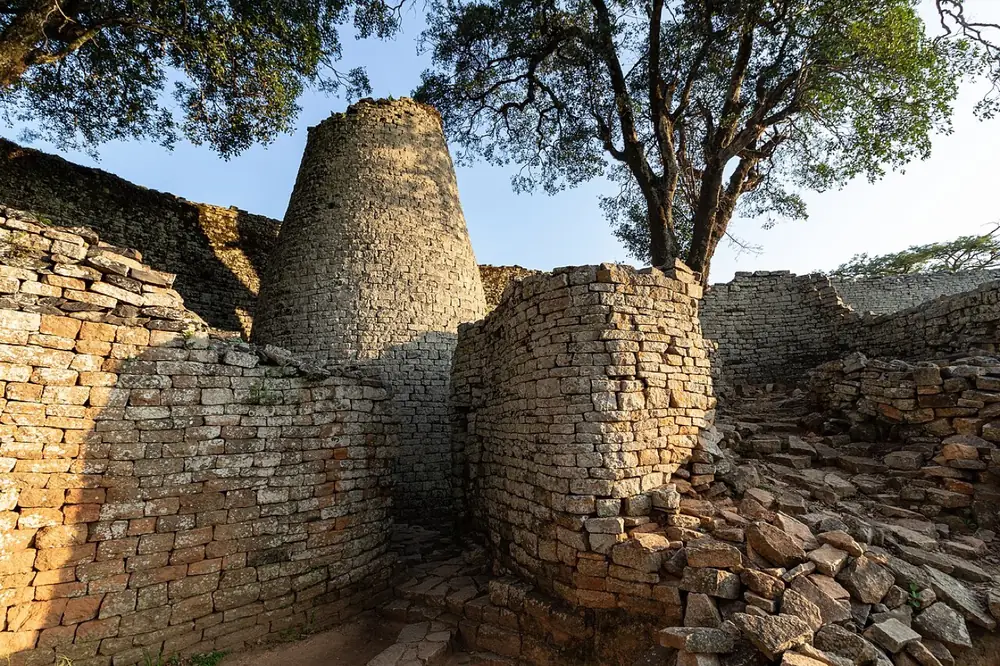
Great Zimbabwe was a stone city in the hills of what is now southeastern Zimbabwe, the capital of a Shona kingdom that lasted from about 1100 to 1450. Its builders fitted granite blocks together without mortar, and the walls still stand. At its peak the city held an estimated 10,000 to 18,000 people and controlled a trade network that sent African gold as far as China. In Shona, the word "zimbabwe" means "houses of stone." The modern country took its name from the ruins, and a carved bird found at the site appears on the national flag.
How Great Zimbabwe grew rich on gold and cattle
The kingdom had two sources of wealth. On the highveld, its rulers controlled large herds of cattle, which served as the main currency of status and power in southern African society. Beyond its herds, the kingdom sat astride the gold fields of what is now Zimbabwe and controlled the routes that carried gold and ivory east to the Indian Ocean coast.
At the Swahili port of Sofala, and farther north at Kilwa, Muslim merchants shipped the gold and ivory across the Indian Ocean to buyers in Arabia, India, and as far as China. Excavations at Great Zimbabwe have turned up Chinese celadon pottery, Persian glass beads, and Arab coins. These finds show that a landlocked city in the African interior was connected by trade to much of the known world.
The city's rulers are hard to identify by name. No writing survives from Great Zimbabwe, and the names of its kings come only from oral traditions passed down through the Shona. The kingdom was governed by a hereditary monarchy whose power rested on control of cattle, gold, and the trade routes between them.
The city itself spread over nearly 80 hectares in three main areas. The Hill Complex, the oldest part, sat on a granite hilltop. The Valley below held houses and smaller enclosures. Nearby stood the Great Enclosure, the largest ancient stone structure in sub-Saharan Africa. Its curving outer wall runs about 250 meters around and rises as high as 11 meters, built from roughly a million shaped granite blocks fitted together without mortar. Inside stands the Conical Tower, a solid stone structure about 9 meters tall with no doorway and no interior chamber. Its purpose is unknown.
Eight soapstone birds carved on top of meter-tall columns were found at the site, seven of them at the Hill Complex. They combine human and bird features, with lips instead of beaks and five-toed feet instead of claws. Scholars believe they were symbols of royal authority.
Why was Great Zimbabwe abandoned?
By about 1450, the city was largely empty. No one knows exactly why. The most likely explanation is that the population outgrew what the surrounding land could support. Up to 18,000 people in a valley for centuries would have used up firewood, timber, and fertile soil. Drought and cattle disease may have made things worse. At the same time, gold deposits nearby were running low, and trade was shifting to ports farther north.
Around this time, a prince named Nyatsimba Mutota left Great Zimbabwe and founded a new state, the Mutapa Empire, in the Zambezi valley to the north. Within a generation, the Mutapa state had eclipsed the old capital. Great Zimbabwe's population drifted away, and the city fell into ruin.
Who built Great Zimbabwe?
The ancestors of the Shona people who still live in the region. Archaeologists settled this question more than a century ago, but colonial governments worked for decades to deny it.
The German geologist Karl Mauch reached the ruins in 1871. He found wooden lintels at the site, decided they smelled like Lebanese cedar, and concluded the site was the biblical land of Ophir, built by Phoenicians or the Queen of Sheba. The wood was later identified as a local species. Mauch did not believe Africans could have built the structures. The claim suited the white settlers who moved into the region and named their colony Rhodesia, after Cecil Rhodes.
In 1905, the British archaeologist David Randall-MacIver studied pottery and other evidence at the site and concluded that Great Zimbabwe was medieval in date and built by Africans. In 1929, the British archaeologist Gertrude Caton-Thompson confirmed his findings after a more thorough excavation. The scientific question was answered.
The Rhodesian government refused to accept the answer. Through the 1960s and 1970s, it pressured museums and guidebooks to avoid stating that Africans built the site. Peter Garlake, the country's inspector of monuments and a leading expert on Great Zimbabwe, was forced to leave Rhodesia in 1970 after insisting on what the evidence showed. He returned only after independence in 1981.
The country won independence in 1980 and renamed itself Zimbabwe. The new nation put one of the carved soapstone birds on its flag and coat of arms. In 1986, Great Zimbabwe was inscribed as a UNESCO World Heritage Site. The ruins remain the largest medieval stone complex in sub-Saharan Africa.