
Nelson Mandela
Nelson Mandela spent 27 years in prison, then negotiated the end of apartheid and became South Africa's first Black president.
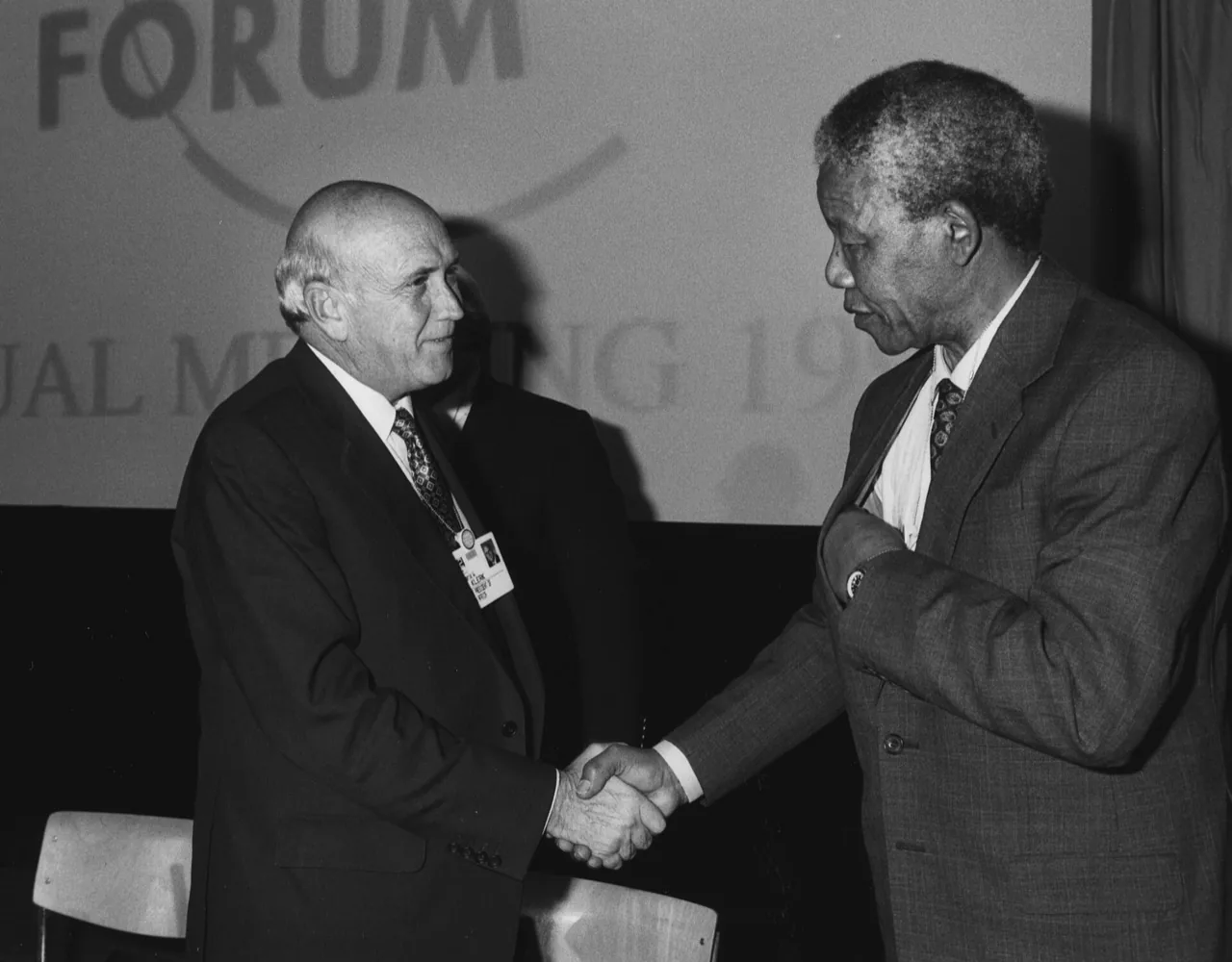
Nelson Mandela was a South African anti-apartheid leader who spent 27 years in prison, negotiated the end of white minority rule, and became South Africa's first Black president in 1994. He was born in 1918 into a Thembu chiefly family in the village of Mvezo, in the Transkei. As a young man he left for Johannesburg after refusing a marriage his family had arranged. He became a lawyer, and in 1952 he and Oliver Tambo started the first law firm in the country run by Black partners. He served one term as president and died in 2013 at age 95. When Mandela walked out of prison in 1990, South Africa had a well-armed white government, an armed liberation movement, and township violence that would kill about 14,000 people over the next four years. Most comparable transitions ended in civil war. South Africa held an election.
Why was Nelson Mandela in prison?
Mandela was convicted of sabotage in 1964 for co-founding Umkhonto we Sizwe, the military branch of the African National Congress. He had joined the ANC in 1944 and steered it toward mass resistance to apartheid. For years the ANC's opposition was nonviolent. In 1960, police killed 69 unarmed protesters at Sharpeville, and the government outlawed the ANC. Mandela concluded that peaceful protest had failed. In 1961 he co-founded Umkhonto we Sizwe. The group's early attacks struck electricity pylons and government offices, targets picked so that no one would be killed.
Police captured him in 1962, and the government put him on trial for sabotage in what became known as the Rivonia Trial. He expected a death sentence. On April 20, 1964, he spoke from the dock for three hours, laying out his vision of a nonracial democracy and closing with the declaration that he was willing to die for it. The court sentenced him to life in prison instead.
Mandela was sent to Robben Island. His days were spent breaking rocks in a lime quarry. The authorities permitted a single visit and a single letter twice a year. He used the time to study law through a correspondence course. He taught himself Afrikaans and studied Afrikaner history, learning to engage his jailers on their own terms. He kept the political prisoners united and spent years negotiating concessions from the prison authorities.
How Mandela negotiated the end of apartheid
In 1985, South Africa's president, P. W. Botha, offered to release Mandela if he renounced violence. Mandela refused. His daughter Zindzi read his answer to a crowd: a prisoner cannot negotiate, only a free man can. But by 1986, Mandela had opened a private channel to government officials from inside the prison, without informing ANC leaders in exile. If those discussions had leaked, he could have lost the movement's trust entirely.
He was released on February 11, 1990, at the age of 71. What followed was not a smooth handover. Negotiations between the ANC and President F. W. de Klerk's government collapsed twice. Much of the township violence during this period was fueled by factions within the security forces who hoped to wreck the transition. In April 1993, Chris Hani, who after Mandela was the liberation movement's most popular leader, was shot dead outside his home by Janusz Walus, a Polish immigrant and white supremacist. South Africa came close to open war. Mandela appeared on national television and asked the country for calm.
The settlement exchanged governing power for economic stability. White South Africans held on to their property, pensions, and civil service jobs. The ANC gained control of the government through the ballot. A Truth and Reconciliation Commission, led by Archbishop Desmond Tutu, offered amnesty to anyone who confessed their politically motivated crimes publicly and in full. The arrangement gave South Africa an accounting of what had happened under apartheid, but meant that many perpetrators were never prosecuted.
South Africa's first free election was held on April 27, 1994. Mandela won and became president at 75. At the 1995 Rugby World Cup final, he walked onto the field in a Springbok jersey, a symbol long associated with Afrikaner rugby and resented by many Black South Africans, and handed the trophy to captain Francois Pienaar. He left office in 1999 after a single term.
South Africa after Mandela
The agreement that ended apartheid did not change who owned the land or the major corporations. South Africa has one of the highest levels of inequality of any country measured by the World Bank, with a Gini coefficient of about 0.54. As of early 2026, the unemployment rate was about 33 percent. The ANC, the party Mandela led to power, has been plagued by corruption in the decades since.
Critics of the 1993 settlement say it gave away economic justice in exchange for political power. Its defenders say the alternative was a conflict whose outcome no one could predict. The democracy Mandela helped build has survived for more than thirty years, and the transition he led remains one of the few cases where a country moved from minority rule to democracy without a war.