
No Man's Land
No man's land was the strip of cratered, wire-strewn ground between opposing trenches on the Western Front in World War I.
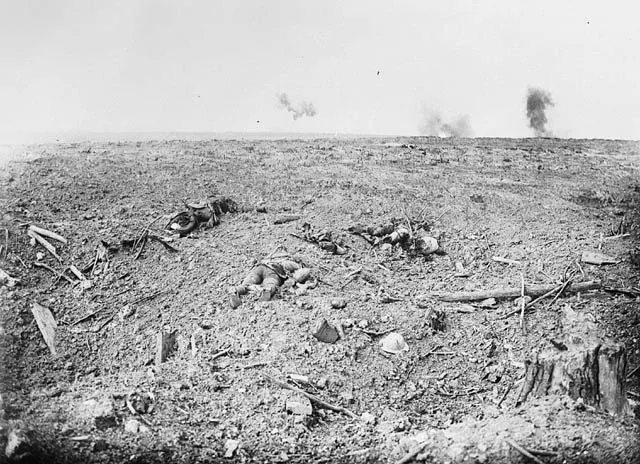
No man's land was the strip of ground between the opposing front-line trenches during World War I. On the Western Front, it ran for roughly 440 miles from the Belgian coast to the Swiss border, but its width was usually measured in hundreds of yards. In some places it shrank to less than 50 yards. The ground was cratered by constant shellfire, strung with dense belts of barbed wire, and scattered with the bodies of soldiers who could not be recovered. Crossing it on foot, under fire, was the only way to attack the enemy's position, and tens of thousands of men died trying. The phrase itself is much older. The Domesday Book of 1086 records it as "Nanesmaneslande." The war gave the old term its modern meaning.
How no man's land became a killing ground
By the end of 1914, three weapons had tipped the balance decisively toward defenders. Machine guns could fire hundreds of rounds a minute across open ground. Barbed wire, strung in thick belts in front of each trench line, slowed attacking soldiers long enough for the guns to cut them down. Artillery could hit any visible position, and constant shelling turned the soil between the trenches into overlapping craters that filled with rainwater.
Attacking soldiers had nothing to match these defenses. To assault the enemy trench, infantry climbed out of their own trench, walked or ran across open ground, cut through wire under fire, and tried to reach the enemy line before the machine guns killed them. Commanders on both sides kept ordering these attacks because they had no other way to break the deadlock. The attacks kept failing for the same reasons.
The cost was enormous. On July 1, 1916, the first day of the Battle of the Somme, British forces suffered 57,470 casualties, including 19,240 killed. Most of those men fell in no man's land. At Passchendaele in 1917, more than three months of fighting churned the ground of Flanders into liquid mud. The water table in that part of Belgium sits close to the surface, and the shelling destroyed the drainage systems that kept the fields dry. Wounded soldiers who slipped off the narrow duckboard paths slid into water-filled shell craters and drowned. Bodies snagged on the barbed wire remained for weeks, visible from both trench lines.
The Christmas truce in no man's land
On Christmas Eve 1914, along parts of the Western Front, British soldiers heard German troops in the opposite trenches singing carols. Some German soldiers placed small Christmas trees along the tops of their parapets. The next morning, soldiers from both sides climbed out unarmed and met in no man's land. They shook hands, exchanged cigarettes and uniform buttons, and buried their dead, whose bodies had lain between the lines for weeks. In some places they played football.
The truce was not universal. It happened in scattered sections of the front, lasted a day or two in most places, and never happened again on the same scale. Senior commanders on both sides ordered it stopped and made clear that anyone who repeated it would be punished.
How wide was no man's land?
The width varied along the Western Front. The average distance between opposing trenches was about 250 yards. At Guillemont on the Somme it was about 50 yards. At Cambrai it stretched to more than 500 yards. In a few places the trenches came within 10 yards of each other, close enough for soldiers to hear enemy conversations.
The width changed constantly. An artillery bombardment could destroy a section of trench and push the line back. A successful attack could move it forward. But on the Western Front, these changes were usually measured in yards, not miles, and the front line barely shifted for three years.
Does no man's land still exist?
Parts of it do. After the war, the French government declared a Zone Rouge (Red Zone) across roughly 1,200 square kilometers of northeastern France. The soil was poisoned by arsenic, chlorine, and phosgene from chemical weapons, and the ground was full of unexploded shells. The restricted area has since shrunk to about 100 square kilometers, but sections of it remain off-limits.
Every year, farmers across northern France and Belgium plow up unexploded shells, shrapnel, and barbed wire from the old front lines. This annual collection is called the Iron Harvest. France's mine-clearance service alone recovers about 900 tons of unexploded munitions each year. At the current rate of removal, clearing the old battlefields will take several hundred more years.
The phrase survived the war too. Before 1914 it was an obscure term for unclaimed ground between parishes and, in medieval London, for land outside the city wall used for executions. The war made it one of the most recognized phrases in English. Today people use it to describe anything from a stalled negotiation to the empty hallway between two rival teams at work.