
Poison Gas in WWI
Poison gas was a chemical weapon first used on a large scale in World War I, killing about 90,000 soldiers and wounding over a million.
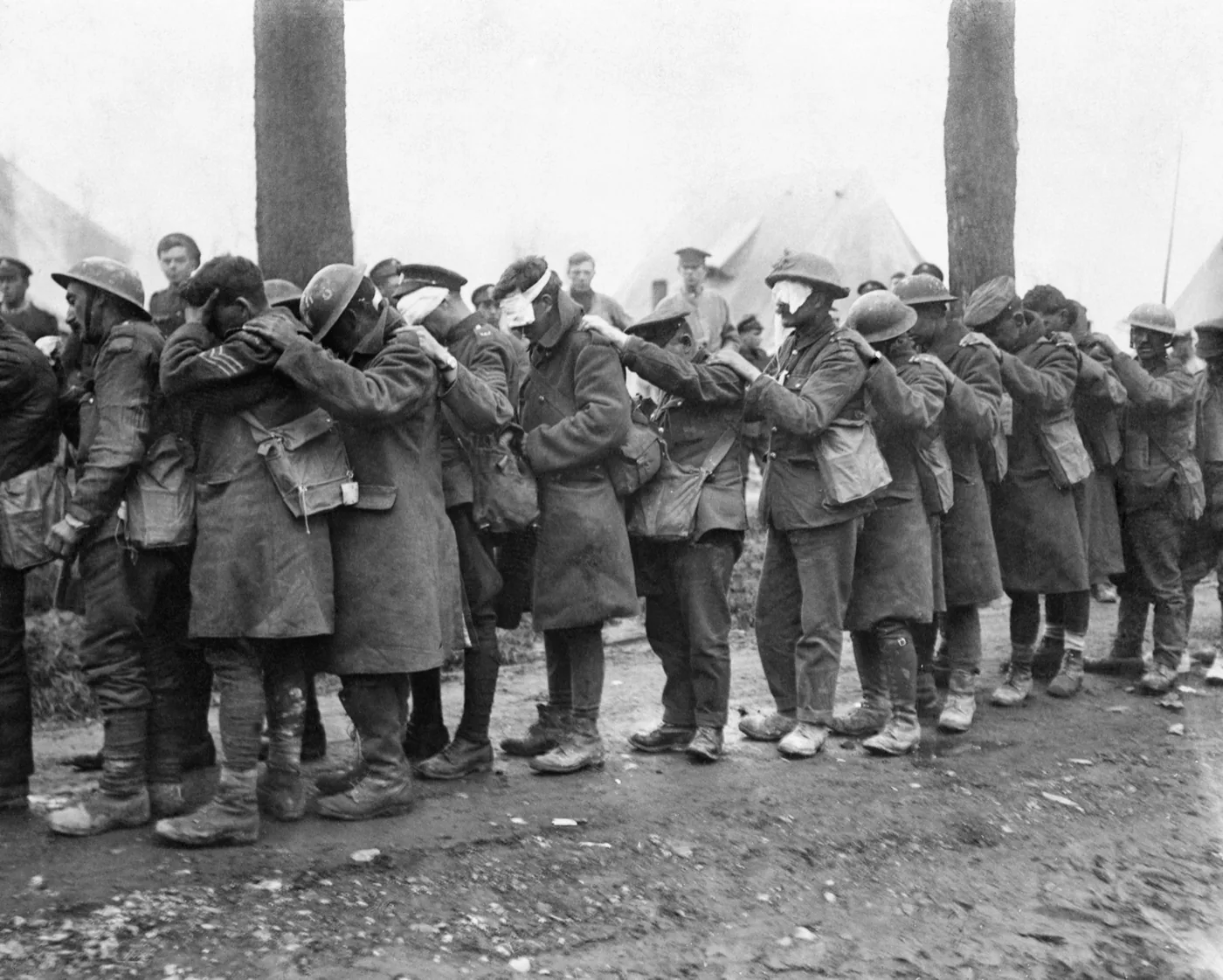
Poison gas was the most feared weapon of World War I, though not the deadliest. On April 22, 1915, German troops opened thousands of steel cylinders at Ypres in Belgium and released a cloud of chlorine toward the Allied trenches. It was the start of modern chemical warfare. Over the next three years, both sides deployed increasingly lethal gases: chlorine, phosgene, and mustard gas. Gas killed about 90,000 soldiers and wounded over a million. That was a small fraction of the war's military dead, most of whom were killed by artillery and machine guns. But gas frightened soldiers more than other weapons did, because it killed slowly and could leave survivors with damaged lungs and failing eyesight for the rest of their lives.
How Fritz Haber brought poison gas to the battlefield
The driving force behind the first large-scale gas attack was Fritz Haber, a German chemist who had already changed the world in a different way. His Haber-Bosch process turned nitrogen from the air into ammonia, making synthetic fertilizer possible. He would win the Nobel Prize in Chemistry for it in 1918. Haber saw chemistry as a way to break the stalemate of trench warfare. He proposed using chlorine, a common industrial chemical that is heavier than air, as a weapon. The gas would sink into enemy trenches and suffocate the men inside.
Haber went to the front himself to oversee the attack. His team placed 5,730 cylinders of chlorine along a four-mile stretch of the line at Ypres and waited weeks for the wind to blow toward the Allied side. On the afternoon of April 22, 1915, they opened the valves. A grey-green cloud drifted across no-man's-land and reached the positions held by two French units, the 45th Algerian Division and the 87th Territorial Division. The 87th was made up of older reservists. Chlorine reacts with moisture in the lungs to form acid. Men clawed at their throats. Within minutes, a four-mile gap opened in the Allied line.
Ten days later, Haber's wife Clara Immerwahr shot herself in their garden with his military pistol. Clara was a chemist herself, the first woman to earn a doctorate in chemistry from the University of Breslau. Haber left for the Eastern Front the next morning.
From chlorine to mustard gas
Chlorine had obvious weaknesses as a weapon. Soldiers could see the greenish cloud coming, and its sharp smell gave warning. Even a wet rag pressed to the mouth offered some protection. Both sides quickly worked to develop something more effective.
Phosgene came next. It was nearly colorless and far deadlier than chlorine. Its worst feature was that the damage was often delayed by a full day. A soldier could feel fine in the evening and die of fluid in the lungs by morning. Phosgene caused about 85% of all gas deaths in the war.
On July 12, 1917, the German army fired the first mustard gas shells, again at Ypres. Mustard gas worked differently from the earlier agents. It was not mainly a killer but a blistering compound that raised welts on exposed skin, could blind soldiers for days or permanently, and scarred the lungs. Unlike chlorine or phosgene, it was an oily liquid that stuck to boots, uniforms, and the ground itself, making an area dangerous for days after the shelling.
Each new gas prompted a new defense. Early in the war, soldiers held wet cloths to their faces. By 1916, armies had issued proper gas masks: chemical-soaked hoods and rubberized masks with filters. The standard British model by the war's end was the box respirator, which drew air through a canister of chemical filters worn on the chest. Troops practiced getting their masks on in seconds. Armies even designed protective gear for the horses and mules that hauled supplies to the front.
How many soldiers did poison gas kill in World War I?
Gas killed about 90,000 to 100,000 soldiers in World War I and wounded about 1.2 million. Roughly half the dead were Russian soldiers, because Russia was slow to supply gas masks to its troops. Compared to artillery and machine guns, which killed millions, gas was a far less efficient killer.
But the casualty figures understate gas's effect on soldiers who survived. Thousands were left with damaged lungs, scarred skin, or permanent blindness. A well-known photograph from April 1918 shows a line of British soldiers, temporarily blinded by gas, each holding the shoulder of the soldier in front. Wilfred Owen, a British officer who served in the trenches, described watching a man "guttering, choking, drowning" during a gas attack in his poem "Dulce et Decorum Est." Owen was killed in action one week before the war ended.
Was poison gas banned after World War I?
The horror of gas warfare led to the Geneva Protocol of 1925, in which most of the world's governments pledged not to use chemical or biological weapons in wartime. The Protocol did not ban making or stockpiling them. Every major army in World War II held gas stockpiles, but gas was almost never used on the battlefield, except by Japan in China. The shared fear of retaliation kept it off the front lines.
The Geneva Protocol's limits led to a stronger treaty. In 1993 governments signed the Chemical Weapons Convention, which banned the development, production, and stockpiling of chemical weapons, not just their use. As of 2026, 193 countries are parties to the convention. Four UN member states have not joined: Egypt, Israel, North Korea, and South Sudan.
The revulsion at poison gas that began in the trenches of World War I still shapes international law. Chemical weapons remain one of the few categories of weapons that nearly every country has agreed never to use.