
Oliver Cromwell
Oliver Cromwell led Parliament's armies in the English Civil War, signed the king's death warrant, and ruled England as Lord Protector.
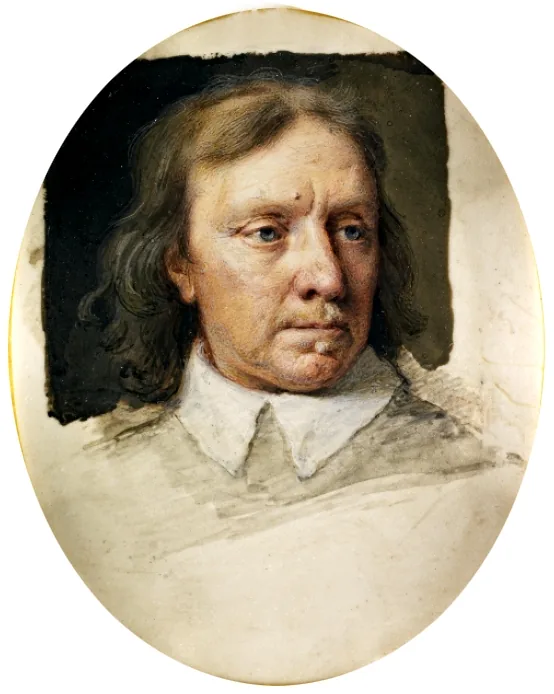
Oliver Cromwell (1599–1658) led Parliament's armies in the English Civil War, signed the death warrant of King Charles I, and ruled England, Scotland, and Ireland as Lord Protector from 1653 until his death. Only one other commoner, his son Richard, has served as England's head of state. Before the crisis that made his career, Cromwell was a minor landowner from Huntingdon with a seat in Parliament that nobody noticed. He had no military training. He was forty years old when the quarrel between king and Parliament began, and he had done nothing remarkable. A dozen years later, he held more power than Charles I ever had. Cromwell was certain that God guided him personally, and that belief shaped nearly everything he did.
How Cromwell won the English Civil War
Cromwell discovered he was a gifted cavalry leader. He recruited his troopers for religious conviction rather than social rank, drilled them to attack in formation and pull back together rather than chasing plunder, and paid them. This approach shaped the New Model Army, England's first professional standing army, created in 1645. The army promoted officers on merit and was full of devout soldiers who saw themselves as doing God's work.
At the Battle of Naseby in June 1645, the New Model Army broke the main Royalist army and effectively brought the first civil war to an end. The wars killed about one English person in twenty, a higher share of the population than Britain lost in the First World War.
King Charles I refused to accept defeat. He negotiated in bad faith with Parliament and with foreign powers and provoked a second civil war in 1648. The army had had enough. In December 1648, Colonel Thomas Pride and his soldiers removed from Parliament every member who wanted to keep negotiating with the king. The remaining members, known as the Rump Parliament, put Charles I on trial for waging war on his own subjects. Cromwell was one of the men who signed the death warrant. On January 30, 1649, Charles I was beheaded outside the Banqueting House in Whitehall. It was not an assassination or a palace coup. A sitting king had been put on trial by his own parliament and executed by its order, and Europe had never seen anything like it.
How Cromwell ruled as Lord Protector
The republic that replaced the monarchy could not agree on a constitution. Cromwell sent soldiers into the chamber in April 1653 and told the members to go home because they had done the country no good. Within months he was Lord Protector, governing under a written constitution backed by a standing army.
Cromwell's authority exceeded anything Charles I had wielded. He divided England into regions, each governed by a major-general who policed public morals and taxed former Royalists. He used the English navy to seize Jamaica from Spain and fought a naval war with the Dutch over trade. He allowed most Protestant denominations to worship freely and in 1656 permitted Jews to return to England for the first time since their expulsion in 1290. In 1657 Parliament offered Cromwell the crown. He refused, but he kept his power.
What did Oliver Cromwell do in Ireland?
Cromwell landed in Ireland in August 1649 to put down a combined Catholic and Royalist uprising. His campaign began with the storming of Drogheda in September, where Cromwell's forces killed the garrison and many townspeople. The same happened weeks later at Wexford. Cromwell described the killings as God's righteous judgment on the Irish. The terror worked as intended: town after town surrendered after word of Drogheda and Wexford spread.
The settlement that followed did more lasting damage than the sieges. The Cromwellian land confiscation stripped Catholic landowners of their property and forced them west of the River Shannon. Before the wars, Catholics had owned roughly 60% of Irish land. By the time the settlement was finished, they held about 8%. The phrase "to Hell or to Connacht" comes from this forced relocation. Historians estimate that Ireland lost somewhere between 15% and 40% of its population during these years, from fighting, famine, and plague combined. It was one of the worst demographic disasters in early modern Europe.
Cromwell's campaign in Ireland is the central reason he remains one of the most divisive figures in British and Irish history. In England, Cromwell is remembered as the man who established Parliament's authority over the crown. In Ireland, he is remembered for mass killing and land confiscation on a national scale.
Cromwell's death and legacy
Cromwell died of natural causes on September 3, 1658. His son Richard Cromwell succeeded him as Lord Protector but lasted only eight months before the army turned against him. Parliament called Charles II back from exile in 1660 to take the throne.
The new monarchy took its revenge on Cromwell's corpse. In 1661, Cromwell's body was dug up, hanged at Tyburn, and beheaded. His head was put on a pole on the roof of Westminster Hall, where it remained for about 25 years before a storm blew it down. The head passed through private collectors for centuries and was not buried until 1960, at Sidney Sussex College in Cambridge, where Cromwell had once been a student.
A statue of Cromwell stands outside the Houses of Parliament, erected in 1899 and unveiled at 7:30 in the morning to avoid protests. Petitions to remove it still come up regularly. No English monarch after Cromwell ever again governed without Parliament for long.