
One-Child Policy
China's one-child policy limited most couples to one child from 1979 to 2015 and left the country with a shrinking, aging population.
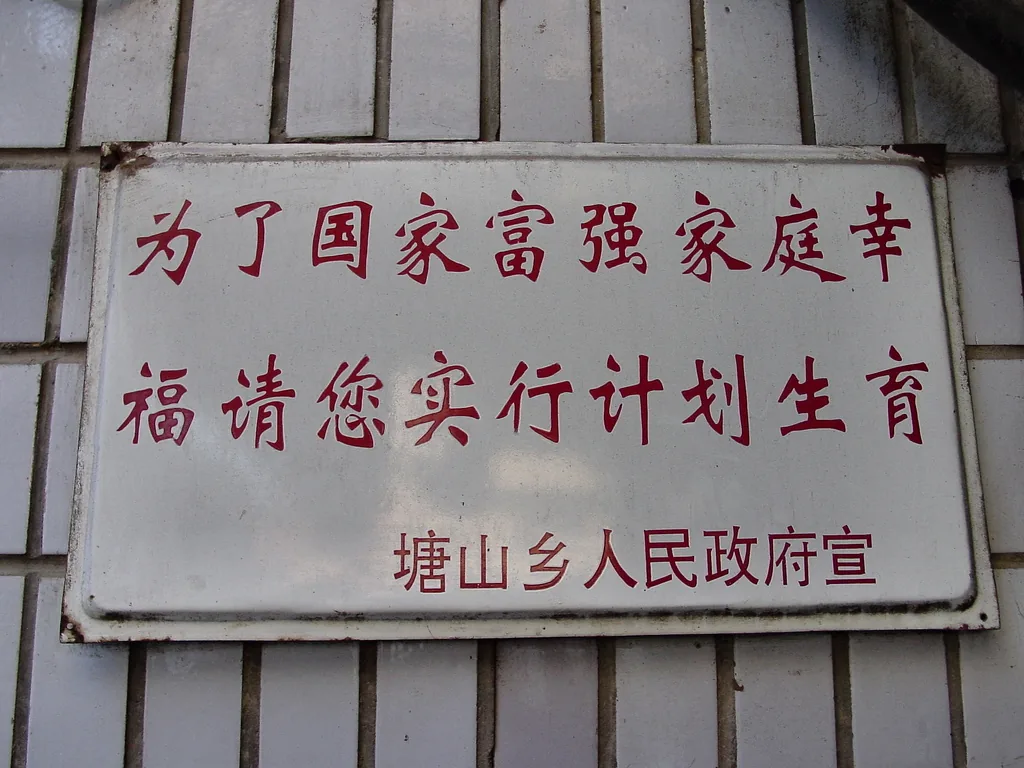
China's one-child policy was a government rule that limited most Chinese couples to having one child. It was in force from 1979 to 2015, making it the most sweeping state intervention in human reproduction ever attempted. The Chinese government has claimed the policy prevented about 400 million births, but many demographers doubt that figure, because China's birth rate was already falling before the policy began. What the policy did produce was a generation with far more men than women, a rapidly aging population, and a workforce that began to shrink just as the restriction was lifted.
How China's one-child policy began
In the late 1970s, Deng Xiaoping committed China to a program of rapid economic modernization. China's leaders feared that a population approaching one billion would consume every gain the reforms produced. They had already tried a gentler approach. Starting in 1973, a campaign called "later, longer, fewer" raised the marriage age, encouraged three-year gaps between births, and limited families to two children. It worked: China's fertility rate fell from about 5.7 children per woman in 1969 to 2.7 by 1978, one of the sharpest declines in modern history.
But Deng's planners decided two children was not enough. The most influential voice belonged to Song Jian, a missile scientist who had spent his career on guidance systems for nuclear weapons. In 1978, Song attended a conference in Helsinki where he encountered Western models of population growth. He applied the same control theory he used on missile trajectories to human reproduction, and his calculations predicted that China's population would pass two billion unless the birth rate dropped further. Song's models helped convince China's leaders to impose the one-child limit.
How was the one-child policy enforced?
Couples needed a government birth permit before having a child. Those who complied received cash bonuses and workplace benefits. Those who had a second child without permission faced fines that could amount to several times a family's annual income. Local officials had birth quotas, and missing them meant demotion.
At its cruelest, the policy relied on forced sterilizations and forced late-term abortions. Enforcement was harshest in cities, where the government had the tightest control. In rural areas the rules were more often bent. Farmwork required labor, and local officials found it harder to monitor families spread across the countryside. In the countryside, if a couple's first child was a girl, local authorities often permitted a second pregnancy. Ethnic minorities faced looser rules than the Han majority.
The policy's name overstates its reach. Between the rural exemptions, the minority exceptions, and uneven enforcement, many families had two or more children. But in urban China, where most of the population lived by the policy's later years, the one-child rule was strictly enforced.
What the one-child policy did to China's population
China has a strong cultural preference for sons. When the one-child limit combined with the spread of cheap ultrasound technology in the 1980s, the result was widespread sex-selective abortion. Parents who could have only one child chose to have a boy. By 2015, China had roughly 34 million more men than women. Scholars call the surplus of men unable to find wives "bare branches," and the millions of women who were never born "missing women."
The policy also compressed into one generation a demographic shift that, in other countries, unfolds over several. It produced a rapidly aging population, with a shrinking base of young workers supporting a growing number of retirees. The problem is captured by the phrase "4-2-1 family": one adult child responsible for two aging parents and four grandparents. The number of working-age Chinese reached its highest point in 2015, the year the one-child limit was lifted, and has declined since then.
China's birth rate after the one-child policy
In 2015, China raised the limit to two children per couple. In 2021, it raised the limit to three, and later that year the government removed all penalties for exceeding the limit. None of these changes reversed the decline. In 2025, China recorded about 7.9 million births, the lowest on record, and its fertility rate fell to roughly 0.93 children per woman. A population needs a rate of about 2.1 to hold steady.
The reasons are partly economic and partly cultural. Housing costs in Chinese cities are among the highest in the world relative to income. Working hours are long. But beyond cost, a generation raised as only children now sees a one-child family as normal. The behavior the policy created continued after the policy ended.
In most countries, incomes rise first, giving people time to build savings and governments time to build pension systems before the population ages. China's one-child policy reversed that sequence, accelerating its population's aging while the country was still middle-income. Demographers have summed up the result in a phrase that has followed China's planners for years: China is growing old before it grows rich.