
PLO (Palestine Liberation Organization)
The PLO is the organization that represents the Palestinian people internationally, founded in 1964 and led by Yasser Arafat for 35 years.
The Palestine Liberation Organization, or PLO, is the body that represents the Palestinian people in international politics. The Arab League created it in 1964, originally as a way for Arab governments to keep Palestinian politics under their control. After the Arab defeat in the 1967 war, Yasser Arafat and his Fatah faction took over the PLO and made it independent of the governments that created it. Before the PLO won recognition, Palestinians were treated internationally as a refugee problem discussed by other governments. Arafat spent three decades building the PLO into a government in exile. He won it recognition as the sole representative of the Palestinians and a seat at the United Nations, but never a state.
How the PLO was founded
The Arab League created the PLO in 1964. Its main sponsor was Egypt's president, Gamal Abdel Nasser, who wanted a Palestinian organization he could direct. The first chairman was Ahmad Shukeiri, a diplomat and lawyer chosen because Arab governments considered him reliable. At its founding the PLO had no real armed forces and no independence from its sponsors. Its purpose was to channel Palestinian national feeling in a direction that served Egypt, Syria, and the other Arab states.
That arrangement lasted three years. In June 1967, Israel defeated Egypt, Syria, and Jordan in six days and took the West Bank, Gaza Strip, Sinai Peninsula, and Golan Heights. The defeat discredited the idea that Palestinians should wait for Arab armies to liberate their homeland. Armed Palestinian groups that had been fighting on their own moved to take control of the PLO. Yasser Arafat, the head of the largest faction, Fatah, became PLO chairman in February 1969.
How Arafat built the PLO into a government in exile
Arafat was born in Cairo in 1929 to a Palestinian father, though he claimed throughout his life to have been born in Jerusalem. He trained as an engineer in Cairo and co-founded Fatah in Kuwait in the late 1950s. He would lead the PLO for thirty-five years, until his death in 2004.
Under Arafat, the PLO set up a state within a state in Jordan, with its own checkpoints, taxes, and armed fighters. By 1970 it was openly challenging King Hussein. In September 1970, Hussein sent his army against the PLO. The fighting killed thousands and became known as Black September. By mid-1971 the PLO had been expelled to Lebanon.
In Lebanon the PLO became a major armed force in a country already divided along sectarian lines. Factions linked to the PLO also carried out attacks abroad. The most notorious was at the 1972 Munich Olympics, where a group called Black September took eleven members of the Israeli Olympic team hostage. Two were killed at the start. The other nine were killed during a failed rescue attempt, along with a German police officer and five of the attackers. The PLO's presence in Lebanon helped trigger the Lebanese civil war in 1975. Israel invaded Lebanon in 1982 to destroy the PLO's bases, and Arafat and the PLO leadership left Beirut by sea for Tunis, about 1,400 miles from Palestine.
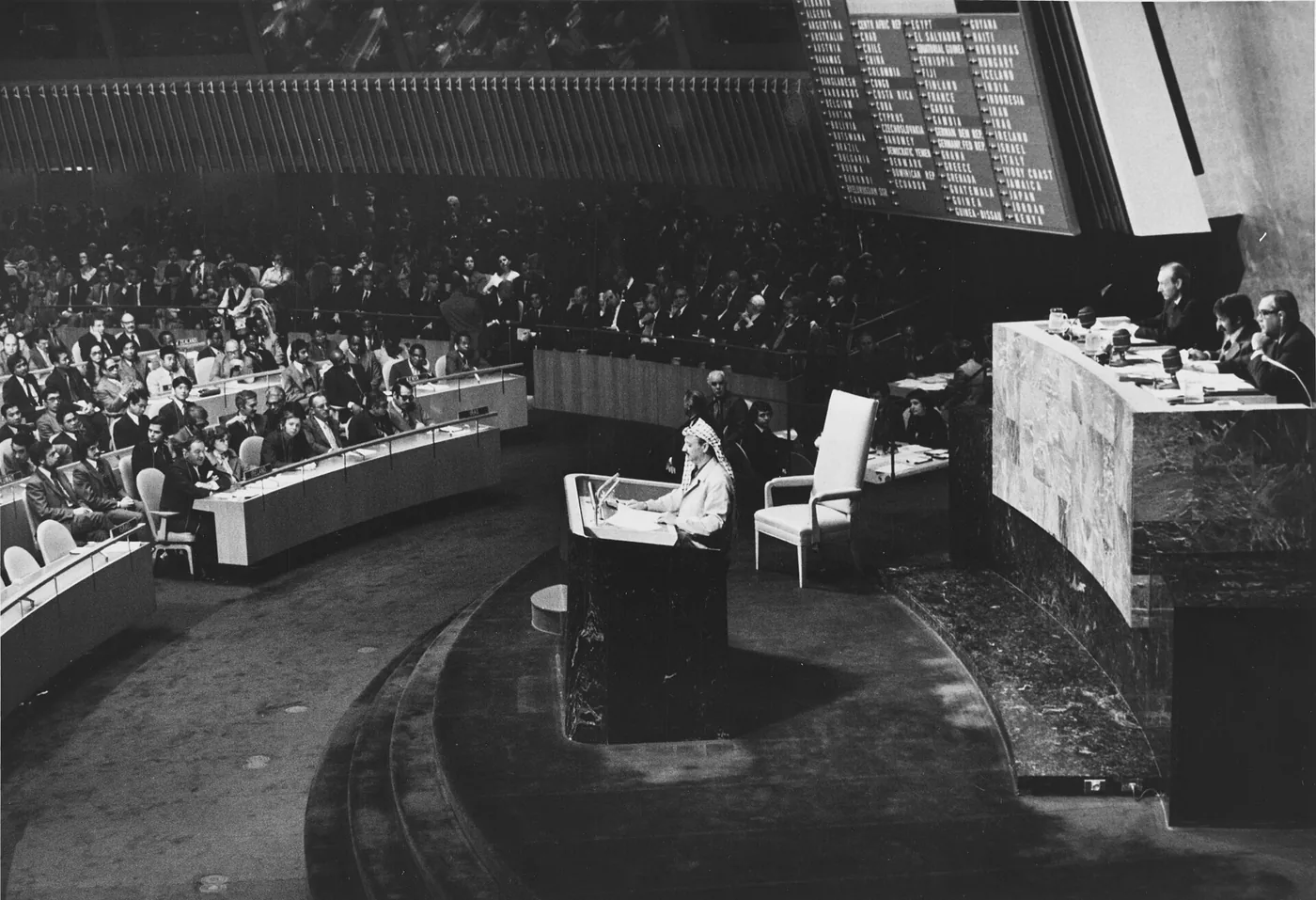
In October 1974, the Arab League at its summit in Rabat declared the PLO the sole legitimate representative of the Palestinians. That decision removed Jordan's claim to represent the West Bank. The following month, Arafat addressed the United Nations General Assembly. He told the delegates he had come carrying an olive branch and a gun. "Do not let the olive branch fall from my hand," he said. The General Assembly granted the PLO observer status on November 22, 1974.
In November 1988, the Palestine National Council met in Algiers and declared an independent Palestinian state. At the same meeting, the PLO accepted UN Security Council Resolutions 242 and 338. Those resolutions called for Israeli withdrawal from territories occupied in 1967 and implicitly recognized Israel's right to exist. The PLO also renounced terrorism. These steps opened a direct dialogue with the United States.
The Oslo process followed in 1993. Arafat and Israeli Prime Minister Yitzhak Rabin exchanged letters of mutual recognition: the PLO recognized Israel's right to exist, and Israel recognized the PLO as the representative of the Palestinian people. The agreement created the Palestinian Authority in 1994 to govern parts of the West Bank and Gaza. Arafat returned to Gaza that year, after twenty-seven years outside Palestine.
What is the difference between the PLO and the Palestinian Authority?
The PLO and the Palestinian Authority are different organizations. The PLO is the umbrella body that holds international recognition as the representative of all Palestinians, including those living outside the West Bank and Gaza. It signed the Oslo Accords and negotiates on final-status issues like borders, Jerusalem, and refugees. The Palestinian Authority is the local government that Oslo created. It runs schools, collects taxes, and has a police force, but it is not a sovereign state.
Arafat died in November 2004. Mahmoud Abbas succeeded him as both PLO chairman and PA president, and still held both positions in 2026 at the age of 90. Hamas was never a member of the PLO. It won the 2006 Palestinian legislative elections and took control of Gaza by force in 2007. That split left the PLO and the PA governing only parts of the West Bank while Hamas ran Gaza. In July 2026, Hamas formally dissolved its civil administration in Gaza as part of a ceasefire agreement, though the territory's future governance remained unresolved.
As of 2025, 157 countries recognized the State of Palestine, and Palestine held observer status at the United Nations. The PLO controls no territory with defined borders. The organization won recognition from most of the world's governments as the representative of the Palestinian people, but the state it set out to create does not yet exist.