
Pompeii
Pompeii was a Roman town buried by Mount Vesuvius in 79 AD, preserved under ash and now the best record of everyday Roman life.
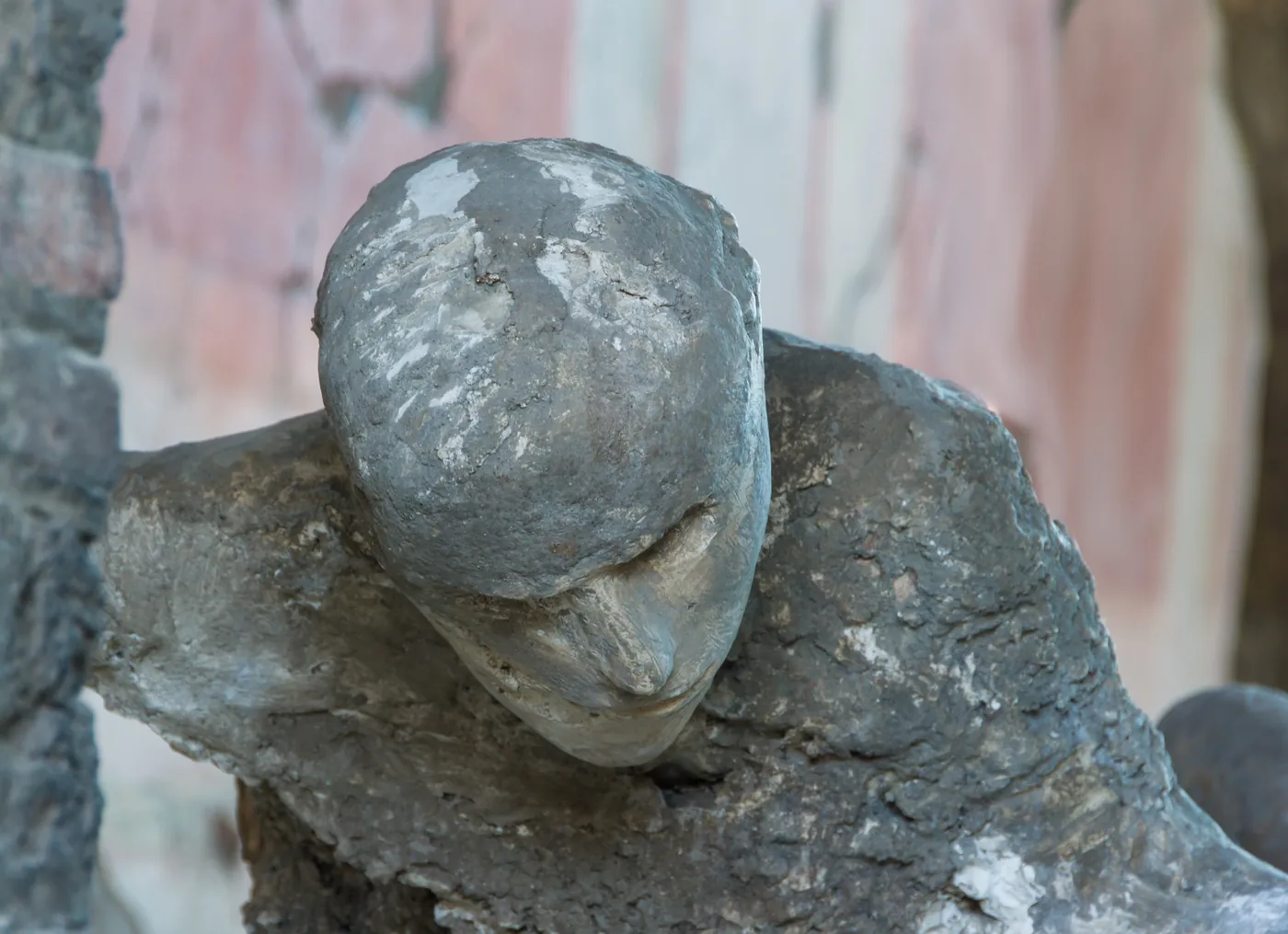
Pompeii was a Roman town on the Bay of Naples, buried under a thick layer of ash and pumice stone when Mount Vesuvius erupted in 79 AD. About 11,000 people lived there before the eruption. Most fled during the early hours, but around 2,000 died, most of them caught by the wall of hot gas and debris that rolled down the slopes the next morning. The ash that destroyed the town also preserved it. When archaeologists uncovered Pompeii eighteen centuries later, they found ovens that still held loaves of bread, tavern counters still marked with dried wine, election slogans painted on walls, and crude jokes scratched into plaster. It is the most complete picture of ordinary daily life that has survived from the Roman world.
How the eruption destroyed Pompeii
Pliny the Younger was 17 years old and staying with his uncle, Pliny the Elder, at the naval base of Misenum, across the Bay of Naples, when Vesuvius erupted. He later described the event in a pair of letters addressed to Tacitus, the only surviving eyewitness account from the ancient world. He wrote that a tall cloud of debris shot up from the mountain and spread at the top in a shape like an umbrella pine tree. Then came darkness, falling ash, and panic.
The eruption had two phases. The first rained pumice stones down on Pompeii for hours. Many residents escaped during this stage. The deadly phase followed the next morning. Pyroclastic surges, fast-moving clouds of superheated gas and volcanic debris, poured down the slopes. They reached temperatures high enough to kill on contact and moved fast enough that no one still in the town could outrun them.
Pliny the Elder commanded the Roman fleet at Misenum. When he saw the eruption cloud, he ordered ships toward the coast to rescue people. He landed at Stabiae, a few kilometers south of Pompeii, but onshore winds trapped his ships in the harbor. He was in his mid-fifties and reportedly in poor health. The next morning, he collapsed on the beach and died, probably from breathing volcanic gases. Volcanologists now call this type of explosive, towering eruption "Plinian," after the account his nephew wrote of it.
The nearby town of Herculaneum was buried even more deeply than Pompeii. Across both towns and the surrounding area, the total death toll is unknown.
How archaeologists uncovered Pompeii
Pompeii lay buried and largely forgotten for more than 1,600 years. Excavation began in 1748 under Charles III of Bourbon, the king of Naples. The rediscovery of Pompeii and the nearby Herculaneum caused excitement across 18th-century Europe. Frescoes and furnishings from the sites helped inspire the neoclassical style in art and architecture, and both towns became standard stops on the Grand Tour, the educational trip across Europe that wealthy young men took to complete their schooling.
In 1863, Giuseppe Fiorelli, the director of excavations, introduced a technique that became one of the most famous in archaeology. Over the centuries, the bodies of the dead had decomposed inside the hardened ash, leaving hollow spaces shaped exactly like people. Fiorelli poured liquid plaster into these voids. When the plaster set and the surrounding ash was chipped away, what remained were detailed casts showing victims frozen in their last moments: curled up, clutching belongings, or bent over a child.
Excavation continues today. Only about two-thirds of the town has been uncovered so far. In recent years, archaeologists have found frescoes depicting scenes from the Trojan War, a rare blue-painted shrine, and a construction site that was still active when the eruption struck.
What has Pompeii revealed about Roman life?
The ash preserved more than grand architecture. It kept the kind of everyday details that rarely survive from the ancient world. Pompeii has shops, taverns, a brothel whose walls displayed paintings advertising what was for sale, and houses of every size, from mansions with garden courtyards to small rooms above storefronts. Election slogans are painted on building facades, some endorsing candidates for local office. Graffiti scratched into walls records everything from love notes to bathroom humor.
These ordinary traces are what make Pompeii valuable to historians. Most of what survives from ancient Rome is monumental: the Colosseum, aqueducts, inscriptions by emperors. Pompeii shows what life looked like for bakers, barkeepers, and tradespeople. It is the closest anyone can get to seeing an ordinary Roman street as it looked two thousand years ago.
When was Pompeii buried?
The traditional date of the eruption is August 24, 79 AD, based on the letters of Pliny the Younger. In 2018, archaeologists found a charcoal inscription at Pompeii dated to October 17, and some scholars argued the eruption happened in mid to late October instead. Autumn fruit and heavy clothing found on some victims supported a later date. But subsequent analysis questioned how much weight the inscription could bear as evidence, and in 2024 the director of the Pompeii archaeological park, Gabriel Zuchtriegel, argued that no evidence yet disproves August 24. The question is not fully settled, but August 24 remains the most widely accepted answer.
Is Mount Vesuvius still active?
Mount Vesuvius is not extinct. It is classified as dormant, and its last eruption was in 1944. About three million people now live in the Naples metropolitan area, many of them within range of a future eruption. Roughly 700,000 live in the designated "red zone" on the volcano's slopes, the area most at risk from pyroclastic flows. Italian authorities maintain an evacuation plan, but no one knows when the next eruption will come or how large it will be.