
Roman Aqueducts
Roman aqueducts were gravity-fed channels that carried fresh water from mountain springs to cities across the Roman Empire.
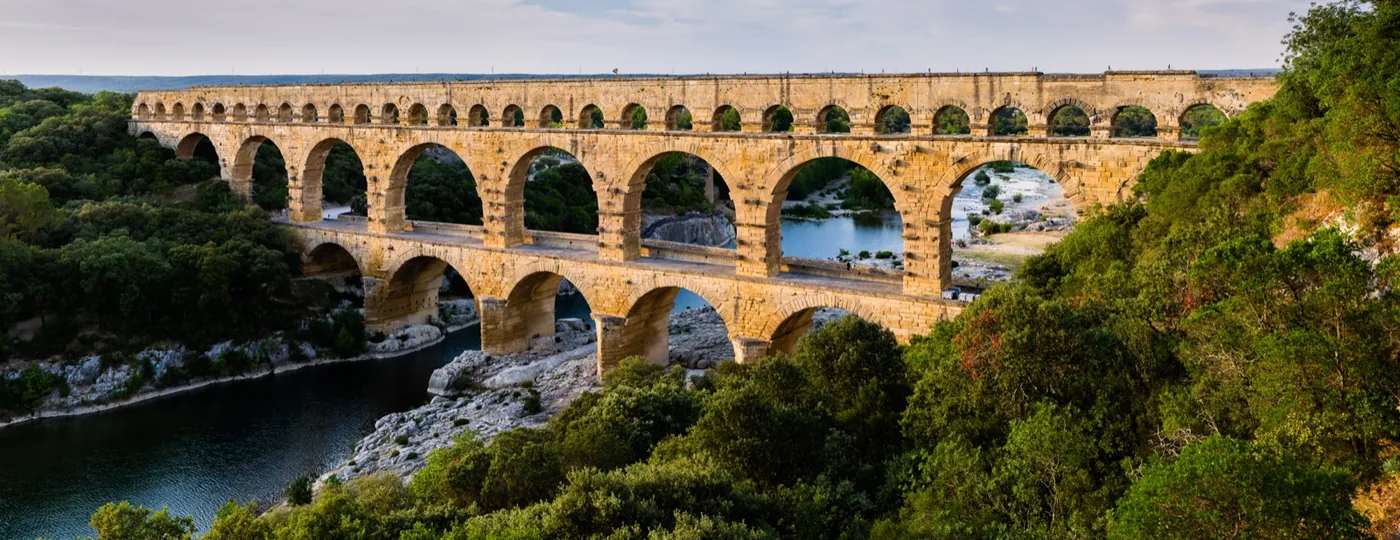
A Roman aqueduct was a channel that carried fresh water from springs in the hills to a city below, using nothing but gravity. The first one, the Aqua Appia, dates to 312 BC. By the third century AD, the city of Rome had eleven aqueducts, supplying water to hundreds of public fountains, large bathing complexes, and latrines that flushed with a constant stream. Across the empire, Romans built more than 1,000 aqueducts. The builders needed a water source at a higher elevation than the city and a channel with just enough downward slope to keep the water flowing. In practice, holding that slope over tens of kilometers of hills and valleys was one of the hardest things Roman engineers did.
How Rome built its water supply
In 312 BC, a Roman politician named Appius Claudius Caecus held the office of censor, a powerful position that included control over public construction. He started two projects at once: the Via Appia, Rome's first major road, and the Aqua Appia, Rome's first aqueduct. Both were named after him. He went blind in old age, which is how he got the name Caecus, Latin for "the blind."
The Aqua Appia ran about 16 kilometers from springs east of Rome. Over the next five and a half centuries, especially during the Pax Romana, Rome added ten more aqueducts. The city's population grew past a million, and public water was central to daily life. Fountains ran continuously. The great bathing complexes, open to everyone from senators to laborers, used enormous amounts of water. Romans saw abundant public water as a mark of civilization, and building a new aqueduct was a common way for an emperor to show generosity.
Around AD 97, the emperor Nerva appointed Sextus Julius Frontinus to manage Rome's water supply. Frontinus wrote a two-volume manual called De Aquaeductu that covers each aqueduct's engineering, its maintenance schedule, and the legal rules for water distribution. The book also complains about citizens who broke into the pipes illegally to steal water for their private homes. Frontinus's manual is the best surviving account of how the Roman water system actually worked.
How did Roman aqueducts work?
Every aqueduct started at a water source that sat higher than the city it served. The channel sloped gently downhill the entire way, and gravity pulled the water along. No pumps were needed.
The difficulty was controlling the slope. If the channel was too steep, the water would rush and wear it away. If it was too shallow, the water would stop moving. The aqueduct that fed the city of Nîmes in southern France covered about 50 kilometers and fell only about 12 meters over that distance, roughly 25 centimeters per kilometer. Roman surveyors measured these tiny gradients with an instrument called the chorobates, a six-meter wooden beam with plumb lines and a water channel cut into its top surface. When the water in the groove sat level, the beam was flat.
Most of an aqueduct ran underground in a covered channel, protected from weather and from enemies who might cut the water supply. The tall stone arches that people picture when they hear "aqueduct" were built only where the channel had to cross a valley. The Pont du Gard, part of the Nîmes aqueduct, is a three-tiered bridge that carried the water channel nearly 49 meters above the Gardon river. When a valley was too deep for a bridge, engineers used inverted siphons. These were sealed lead pipes that ran the water down one side of the valley and up the other, with the pressure of the water column pushing it uphill.
Did Roman lead pipes cause lead poisoning?
Water reached Roman homes and fountains through pipes that were often made of lead. The Latin word for lead, plumbum, is where the English word "plumbing" comes from. A popular theory holds that Romans slowly poisoned themselves by drinking water from these pipes, and that lead exposure contributed to the decline of the empire.
The Romans themselves knew something was wrong with lead. The architect Vitruvius, writing around 15 BC, noticed that workers in lead foundries were pale and sickly. He recommended using clay pipes for water instead. His advice was mostly ignored.
Modern research suggests the health effects were limited. Roman water ran constantly through the pipes rather than sitting in them. Minerals in the hard water quickly built up a layer of limescale inside the pipes, sealing the lead away from the water. Lead exposure was real, and recent studies show that Romans also breathed in lead from silver mining and smelting. But most scholars today do not believe that lead water pipes played a significant role in Rome's decline.
Roman aqueducts still standing today
After the fall of Rome's western empire in the fifth century, many aqueducts were cut by invaders or fell into disrepair. Without organized maintenance, the channels silted up and stopped carrying water. Rome's population shrank from over a million to tens of thousands, and the city did not have a comparable water supply again for more than a thousand years.
The structures themselves survived. The Pont du Gard still stands near Nîmes. The aqueduct of Segovia in Spain, built with granite blocks fitted together without mortar, has its full line of 167 arches and was still carrying water as recently as the 1970s. Aqueduct remains stand across three continents, from North Africa to Turkey to Britain. Both the Pont du Gard and the Segovia aqueduct are UNESCO World Heritage Sites.
The aqueducts did one thing: they moved clean water. No ancient civilization built water infrastructure on this scale, and no one matched it again until the nineteenth century.