
Pax Romana
The Pax Romana was roughly two centuries of peace and prosperity inside the Roman Empire, lasting from 27 BC to AD 180.
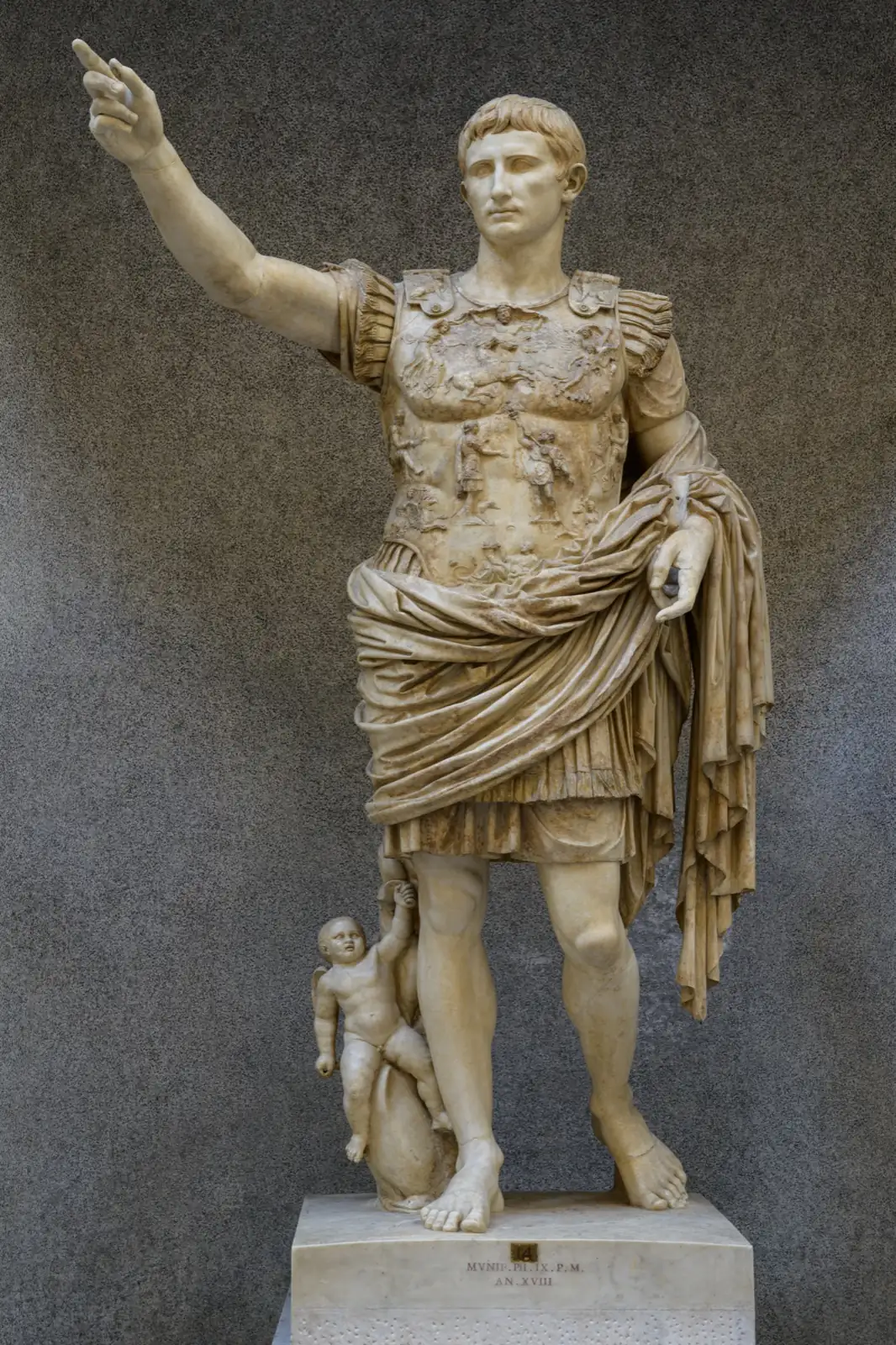
The Pax Romana, Latin for "Roman Peace," was the roughly two-century period of internal stability in the Roman Empire, from 27 BC to AD 180. It began with the reign of Augustus and ended with the death of Marcus Aurelius. By the second century AD, a person could travel from northern Britain to the Euphrates River using the same coins and the same legal system throughout. The empire held about 70 million people at its peak, roughly a quarter of the world's population. It was the longest stretch of general peace that the Mediterranean world had ever seen.
How Augustus built the Pax Romana
Augustus came to power after decades of civil war that had destroyed the Roman Republic. Born Gaius Octavius, he was the great-nephew of Julius Caesar. Caesar adopted him in his will, and Augustus learned of the adoption only after Caesar was assassinated in 44 BC. Years of civil war followed. When Augustus defeated Mark Antony and Cleopatra at the Battle of Actium in 31 BC, he had no remaining rivals.
Augustus did not call himself a king. He kept the Roman Senate and the old republican titles, but concentrated real power in his own hands. He reduced the army from about 50 legions to 28, turning a collection of personal armies into a single professional force. He stationed these legions along the empire's borders, from the Rhine and Danube in the north to the Euphrates in the east. The army's job was to hold those borders and keep the interior at peace.
Augustus was 18 when he entered politics, and he ruled for over 40 years until his death in AD 14 at the age of 75. He was sickly for much of his life and personally modest in his habits. The Roman biographer Suetonius described his house on the Palatine Hill in Rome as surprisingly plain for the most powerful man in the world.
Life across the Roman Empire
With the borders held, the interior prospered. The Roman navy cleared the Mediterranean of pirates. Paved roads linked the provinces, and ships moved Egyptian grain and Gallic wine safely across open water. Pepper and silk from India and China reached Roman markets by sea and along the Silk Road. A single currency and a common legal system made trade simple across vast distances. A trader in Lyon could strike a deal with a trader in Antioch on the same terms as with someone in the next town.
Provincial cities built aqueducts, public baths, and theaters. A shared culture, Greek in the east and Latin in the west, ran from Britain to Syria. For those living within the empire's borders, it was a good time to be alive.
But the peace did not extend to everyone. The interior stayed calm only because the army used constant force along the borders, and the economy depended on enslaved labor. For conquered peoples on the periphery, Roman peace often meant violent subjugation, forced removal, and killing. In AD 70, after Judaea rose in revolt, the general Titus besieged Jerusalem for nearly five months, took the city, and burned the Second Temple to the ground. Tacitus, writing a generation later, invented a speech for Calgacus, a chief in what is now Scotland, that captured what Roman peace looked like from the receiving end. Calgacus tells his men that the Romans "make a desert and call it peace."
Why did the Pax Romana end?
The Pax Romana lasted partly because of a run of capable rulers. For most of the second century, each emperor adopted his successor based on ability rather than blood. Nerva adopted Trajan, Trajan adopted Hadrian, Hadrian adopted Antoninus Pius, and Antoninus Pius adopted Marcus Aurelius. Historians later called these five the "Five Good Emperors."
But Rome never established a fixed rule for who became emperor next. The adoption system worked only because each man chose well. The system had already broken once: when Nero killed himself in AD 68, four men claimed the throne within a single year before Vespasian restored order.
Marcus Aurelius was the last of the Five Good Emperors. He was also a Stoic philosopher. He wrote the Meditations for himself, not for publication, in his tent during campaigns on the Danube frontier. The book became one of the most widely read works of philosophy in history. Marcus Aurelius spent much of his reign fighting wars along the borders. When he died in AD 180, he left the empire to his biological son, Commodus, rather than adopting a capable successor.
Commodus neglected government, spent his time fighting as a gladiator in the Colosseum, and often dressed as the Greek hero Hercules. He was assassinated in AD 192, and his death triggered a civil war. By passing power to his son, Marcus Aurelius broke the pattern that had kept the empire stable.
The Pax Romana as a model
The Pax Romana became a model for the idea that a single dominant power can keep a wide region at peace. In the nineteenth century, British writers used "Pax Britannica" to describe the period of relative stability that the Royal Navy enforced after 1815. After 1945, American commentators adopted "Pax Americana" for the international order the United States built after World War II. Each term borrowed Rome's central promise: one strong power holds the peace for everyone.
The Pax Romana remains the standard reference point for debates about whether a dominant country can keep the world at peace, and what happens when it can no longer do so.