
Watergate
Watergate was the 1972 break-in at the Democratic National Committee and the cover-up that led to President Nixon's resignation.
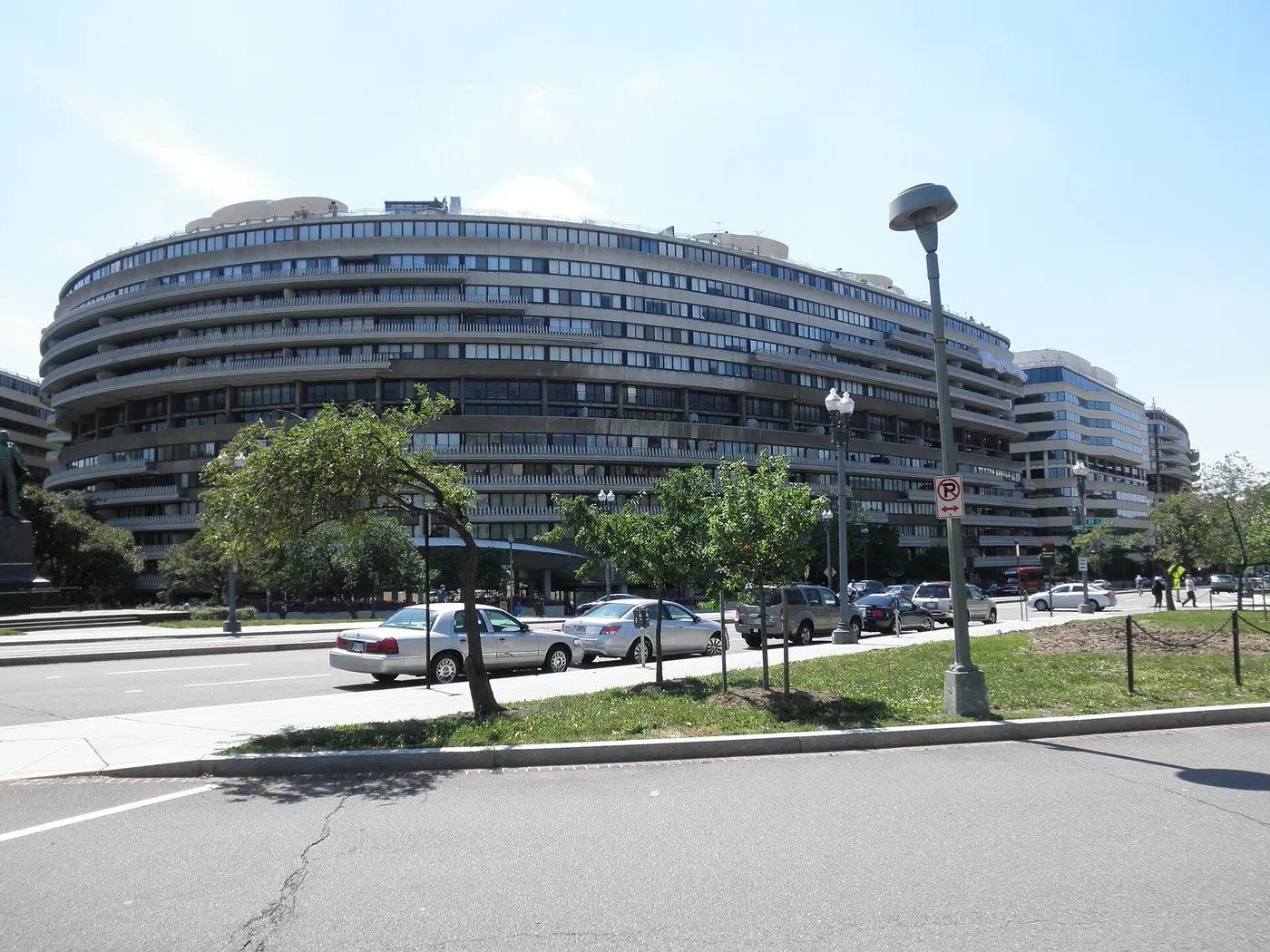
Watergate is the name of both an office complex in Washington, D.C. and the political scandal that brought down an American president. In the early hours of June 17, 1972, a security guard named Frank Wills noticed tape holding a door unlocked in the Watergate office building and called the police. Officers arrested five men inside the headquarters of the Democratic National Committee. The men carried cameras, bugging equipment, and sequentially numbered hundred-dollar bills, and one of the five worked for President Richard Nixon's re-election campaign. Over the next two years, reporters, judges, and members of Congress uncovered a pattern of illegal activity that reached into the White House itself. On August 9, 1974, Nixon became the first and only American president to resign from office.
The break-in and the cover-up
Nixon did not need what was in the DNC's files. He won re-election five months later by a margin that gave him forty-nine of fifty states. But the break-in was one piece of a much larger operation.
Inside the White House, a unit nicknamed "the Plumbers" existed to stop leaks such as the Pentagon Papers, the classified Vietnam War study that the New York Times had published in 1971. The Plumbers had already burglarized the office of Daniel Ellsberg's psychiatrist, searching for embarrassing personal information about the man who leaked the papers. The White House kept an "enemies list" and placed wiretaps on journalists and government officials. Agencies including the CIA and the IRS were directed against political opponents.
Within days of the break-in, the White House arranged payments to keep the burglars quiet and pressured the CIA to order the FBI to drop its investigation, claiming national security was at stake. That order came from Nixon himself. A president personally obstructing a federal investigation was the crime at the center of Watergate.
How the Watergate tapes brought down Nixon
Several institutions worked independently to uncover the scandal. Two junior Washington Post reporters, Bob Woodward and Carl Bernstein, followed the money and the connections for months when few other reporters thought the story mattered. A source inside the FBI guided their work, known only as "Deep Throat." He was identified in 2005 as Mark Felt, the FBI's associate director.
John Sirica, the federal judge assigned to the burglars' trial, did not believe five men had planned the operation on their own. He handed down harsh provisional sentences to pressure them into revealing who had sent them. In the summer of 1973, a Senate committee held televised hearings that drew tens of millions of viewers. During those hearings, a former White House aide named Alexander Butterfield mentioned that Nixon had been taping every conversation inside the Oval Office. From that point, the tapes were the central issue.
Nixon claimed they were protected by executive privilege and refused to hand them over. The special prosecutor, Archibald Cox, went to court to compel their release, and Nixon responded by ordering Cox fired on October 20, 1973. Attorney General Elliot Richardson and Deputy Attorney General William Ruckelshaus both resigned rather than carry out the order. The press called it the Saturday Night Massacre. For the first time, polls showed a plurality of Americans wanted Nixon impeached.
In July 1974, the Supreme Court ruled unanimously in United States v. Nixon that a president cannot use executive privilege to withhold evidence required for a criminal prosecution. The tapes were handed over. One recording, made on June 23, 1972, less than a week after the burglary, captured Nixon directing the CIA to block the FBI investigation. When that tape was released on August 5, 1974, Nixon's remaining support in Congress vanished. He resigned four days later.
How did Watergate get its name?
The scandal is named after the Watergate complex, the office and apartment building where the break-in took place. The building itself is often said to be named after a set of ceremonial steps near the Lincoln Memorial, known as the Water Gate, that lead down toward the Potomac River. The steps were originally planned as a formal entrance for dignitaries arriving by boat.
The scandal also gave English a lasting suffix. Since the 1970s, political scandals have routinely had "-gate" attached to their names.
What happened after Nixon resigned?
Gerald Ford, Nixon's vice president, took office immediately. On September 8, 1974, Ford pardoned Nixon for all federal crimes he had committed or might have committed as president. Nixon was never tried.
Others were. More than forty people were convicted in connection with the scandal, including Attorney General John Mitchell, White House Chief of Staff H.R. Haldeman, and Chief Domestic Adviser John Ehrlichman. Congress passed reforms including new campaign finance limits and the special prosecutor statute, though most of those laws were later weakened or allowed to expire.
Watergate remains the standard reference point for presidential abuse of power in the United States.