
Zulu Kingdom
The Zulu Kingdom was a military state in southern Africa built by Shaka in the 1810s and destroyed by Britain after the Anglo-Zulu War of 1879.
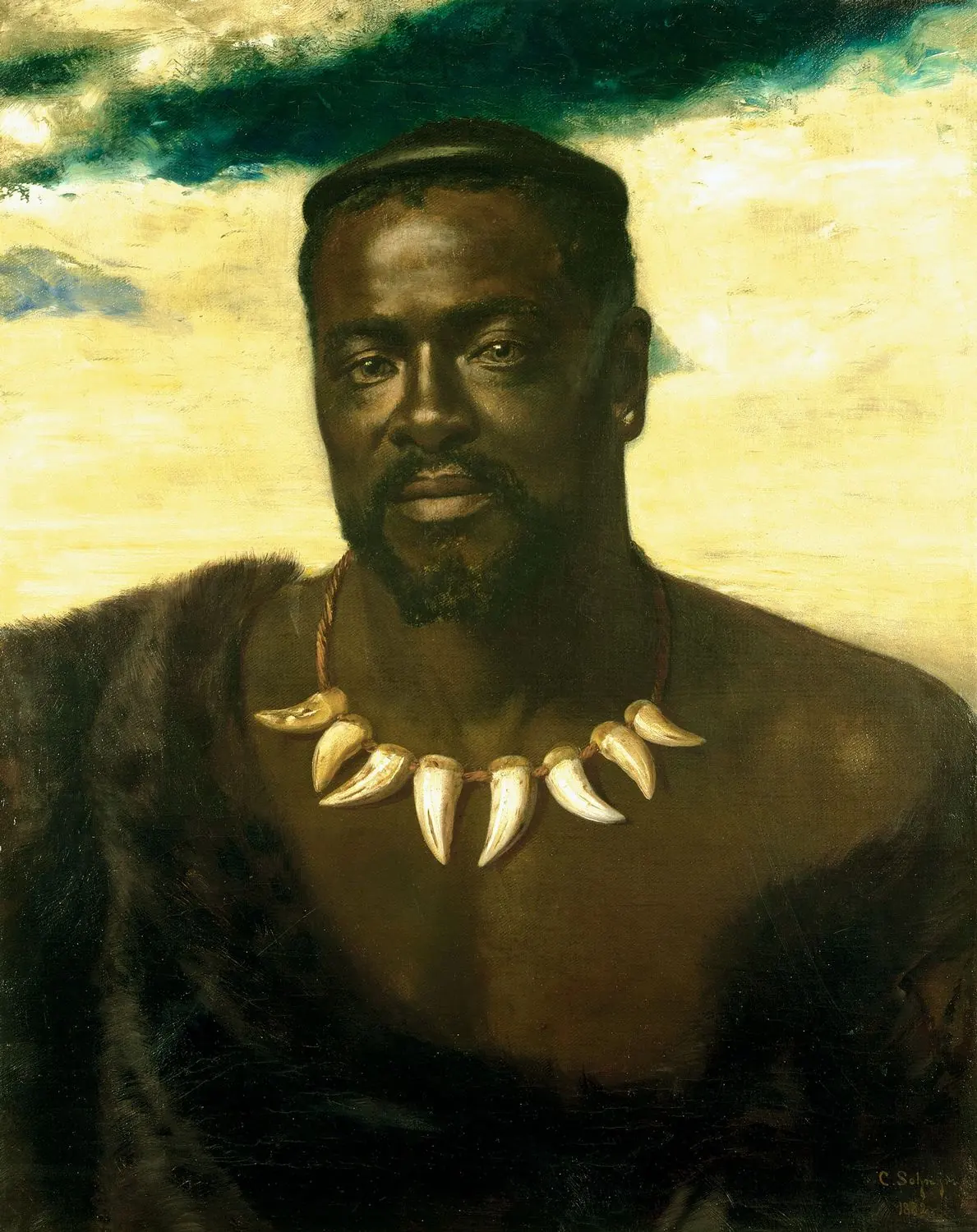
The Zulu Kingdom was a state in southern Africa, in what is now the KwaZulu-Natal province of South Africa. Shaka kaSenzangakhona built it between about 1816 and 1828, turning a chiefdom that numbered only a few thousand into a centralized military power that could field roughly 40,000 warriors. On January 22, 1879, a Zulu army destroyed a British column at the Battle of Isandlwana, killing about 1,300 men. No indigenous force in Africa had ever dealt the British Army a worse defeat. Britain annexed the kingdom in 1887, and it was folded into the colony of Natal ten years later.
How Shaka built the Zulu Kingdom
Shaka was born around 1787. His father, Senzangakhona, was chief of a small clan called the Zulu. His mother, Nandi, came from a neighboring clan. The relationship was considered improper, and Nandi and her son were driven out when Shaka was young. He grew up among the Mthethwa people and trained as a warrior under their chief, Dingiswayo. When Shaka took leadership of the Zulu around 1816, the clan numbered only a few thousand.
Shaka's most important innovation was social. He reorganized Zulu society around amabutho, age-based regiments. Young men from every clan in the kingdom were taken from their homes and housed in royal barracks, where their loyalty belonged to the king rather than to their families. This broke the power of individual clans and turned a loose collection of lineages into a centralized state.
The military changes were just as significant. Shaka replaced the thrown assegai, a long javelin, with the iklwa, a short stabbing spear designed for close combat. His armies used a formation called the impondo zankomo, or "horns of the buffalo." A central force pinned the enemy in place while two flanking groups of younger warriors ran wide to surround it. Zulu armies moved without baggage trains and could cover long distances on foot in a single day.
Shaka was assassinated by his half-brothers in September 1828. By then the kingdom controlled a large part of southeastern Africa. The wave of upheaval across the region during these decades is known as the Mfecane. Historians once attributed the Mfecane directly to Shaka's conquests, but the causes were broader. Drought, the slave trade from Delagoa Bay, and the advance of Boer settlers into the interior all played a part. European settlers later found it useful to describe the land as depopulated by African wars, rather than as territory they were taking from people who still lived on it.
The Anglo-Zulu War
Cetshwayo kaMpande became king of the Zulu in 1872. By the late 1870s, the kingdom stood in the way of British plans to unite all of southern Africa under one administration. Its territory lay between the Transvaal and the Indian Ocean, it had never been conquered, and it could put roughly 40,000 men into the field.
The war was started locally, not from London. Sir Bartle Frere, who served as British High Commissioner in southern Africa, wanted a confrontation. In December 1878, Frere issued Cetshwayo an ultimatum. Among other demands, it required the king to disband his entire army within thirty days. Frere acted without authorization from the British government, gambling that a quick victory would be forgiven.
The British invasion began in January 1879. Within eleven days it met disaster. On January 22, a British column camped at the base of a hill called Isandlwana without building fortifications. A Zulu force of about 20,000 warriors found the camp and surrounded it, using the same encirclement formation Shaka had developed decades earlier. By the end of the afternoon, about 1,300 of the column's soldiers had been killed, most of them by Zulu warriors armed with stabbing spears and hide shields.
That evening, a garrison of about 150 British soldiers held off a Zulu attack at a nearby mission station called Rorke's Drift. It was a minor action, but London promoted it heavily and awarded eleven Victoria Crosses for the defense.
The British came back with reinforcements and defeated the Zulu at the Battle of Ulundi on July 4, 1879. Cetshwayo fled and was captured in August. In 1882, Cetshwayo traveled to London to plead for restoration of his kingdom. He met Queen Victoria at Osborne House. Victoria's advisers had cautioned her against too friendly a meeting. But she wrote in her journal that Cetshwayo was "a very fine man" with "an intelligent face." Cetshwayo's restoration was agreed, but he returned to a kingdom torn apart by civil war and died on February 8, 1884.
What happened to the Zulu Kingdom?
After the war, Britain chose not to annex Zululand right away. Instead the British split the territory among thirteen handpicked chiefs, selected specifically because they were unlikely to support the royal family. The strategy worked as intended. It produced years of civil war that broke the kingdom's political structure more thoroughly than direct occupation would have.
Britain formally annexed Zululand in 1887. In 1897, it was merged into the colony of Natal. The office of Zulu king was later recognized under the title of Paramount Chief, but the kingdom as an independent state was finished.
Europeans remembered the Zulu as the one African power that could fight a European army and win. But the Zulu Kingdom was not unusual in having organized military command and battlefield tactics. It was unusual in having them recorded in detail by the Europeans it defeated, because the British needed to explain how they had lost at Isandlwana. Less than twenty years later, at the Battle of Omdurman in 1898, machine guns and rapid-fire artillery rendered close-combat warfare against European forces impossible. The European partition of Africa, the Scramble for Africa, went forward on the belief that no African army could defeat a European one. The Zulu Kingdom's brief success at Isandlwana did not change that, but it made the kingdom one of the best-documented African states from the colonial period.