
Scramble for Africa
The Scramble for Africa was the partition of nearly the entire continent by European powers between 1884 and 1914, redrawing its borders in a generation.
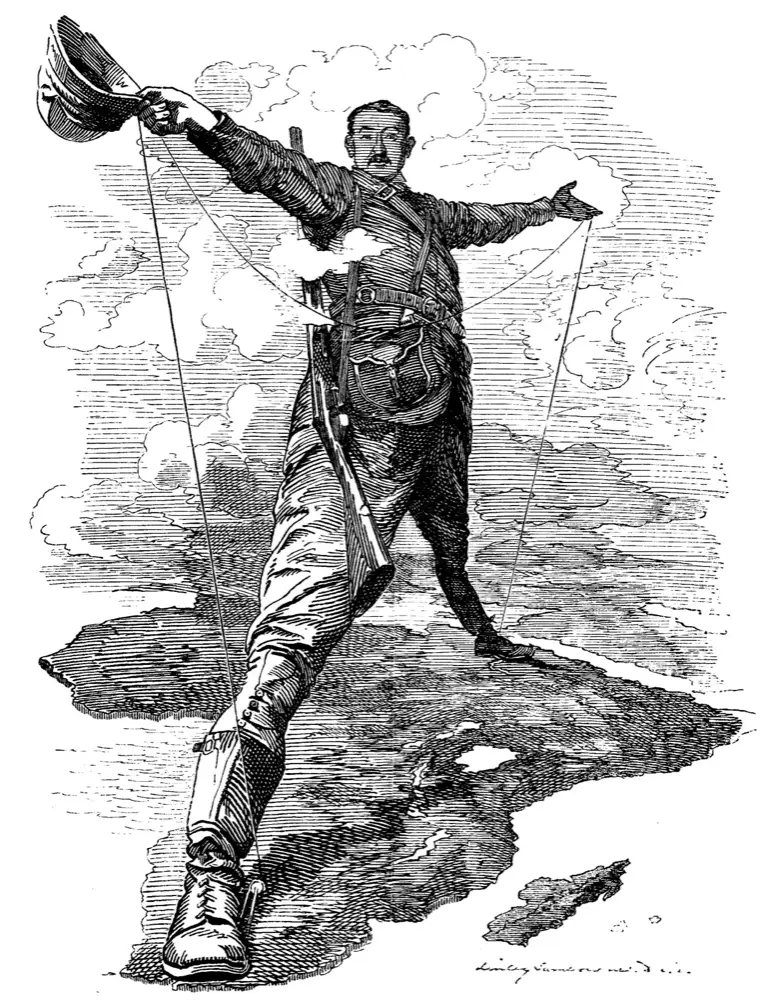
The Scramble for Africa was the partition of nearly the entire African continent by European powers between 1884 and 1914. In 1870, European governments held about 10 percent of Africa, mainly coastal forts and scattered settlements. By 1914 they had taken roughly 90 percent of the continent. Ethiopia and Liberia were the only two countries that kept their independence. The conquest happened within a single generation, without the consent of any African people, and faster than almost any territorial seizure in history. The motives were a mix of economics, control of strategic routes like the Suez Canal, national prestige, and a belief that Europe had a duty to bring civilization to the continent. The borders the European powers drew, many of them straight lines cutting through deserts, river systems, and communities, are still the borders of Africa today.
How the Berlin Conference started the race for Africa
For centuries, Europeans had traded along Africa's coasts but could not push inland. Three advances in the second half of the 19th century changed that. Quinine, a drug made from cinchona bark, gave Europeans their first reliable defense against malaria in tropical Africa. The Maxim gun, invented in 1884 by the American-born British engineer Hiram Maxim, was the first true machine gun. It could fire several hundred rounds per minute and gave small European columns a decisive advantage over much larger African forces. Steamships carried troops up rivers that had been impassable, railways pushed inland behind them, and the telegraph let European governments direct campaigns thousands of miles away in near real time.
The technology was ready, but there were no rules for who could claim what. In November 1884, German chancellor Otto von Bismarck convened a conference in Berlin to settle how European powers could claim African territory. Fourteen nations sent delegates, including the United States and the Ottoman Empire. No African leader was invited or consulted.
The Berlin Conference did not hand out colonies. It established the principle of "effective occupation": a government could assert ownership of territory only if it had real control there, with administrators and troops, not just by planting a flag on a beach. That single rule transformed a gradual coastal presence into a race for the interior. Every power rushed to occupy territory before its rivals could. France took most of West Africa and much of North Africa. Britain claimed a nearly unbroken corridor from Egypt to South Africa. Germany, Belgium, Portugal, Italy, and Spain divided much of the rest. Surveyors drew borders on maps in European capitals, through peoples and places they had never seen.
Leopold II and the Congo Free State
The deadliest chapter of the Scramble played out in the Congo Basin. Belgium's King Leopold II convinced the other European powers at Berlin to recognize his personal control of the territory, which was about 76 times the size of Belgium. Leopold II owned it not as a Belgian colony but as a private estate, called the Congo Free State. Leopold II never set foot in the Congo. He ran the territory from Brussels through a mercenary force called the Force Publique, and spent much of the revenue on palaces and public buildings in Belgium.
The colony existed to extract ivory and, above all, rubber. When villages failed to meet rubber quotas, Leopold II's agents raided them. Guards amputated workers' hands, even children's, to account for every bullet spent. The resulting death toll from killings, famine, and disease is difficult to measure, but the most commonly cited estimate is around 10 million people.
Reports of the atrocities reached Europe through missionaries and journalists. The British journalist E.D. Morel and the diplomat Roger Casement led an international campaign that forced Leopold II to give up the territory to the Belgian government in 1908.
How did Ethiopia resist the Scramble for Africa?
Ethiopia was the only African country to defeat a European army and keep its independence during the Scramble. In 1895, Italy attempted to take control of Ethiopia after a dispute over the Treaty of Wuchale. Emperor Menelik II had spent years preparing for a European attack. He imported modern rifles from France and Russia and assembled an army of roughly 100,000 men. At the Battle of Adwa on March 1, 1896, Ethiopian forces destroyed the Italian invasion force. Italy recognized Ethiopian independence later that year in the Treaty of Addis Ababa.
Liberia, the only other African country that remained independent, owed its status to its founding by the American Colonization Society in the 1820s and its close ties to the United States, which discouraged European claims.
Why Africa's colonial borders still cause conflict
Africa's colonial borders still cause conflict because European powers drew them to divide territory among themselves, without considering the peoples living on the land. The borders split peoples such as the Somali across multiple countries and forced rival communities into single states. When colonial rule ended across Africa in the 1950s and 1960s, the newly independent states inherited this map.
In July 1964, the Organization of African Unity voted to accept the colonial borders as they stood on the day of independence, rather than risk wars over redrawing them. More than a century after the Berlin Conference, those borders are still the borders of Africa. Many of the continent's recurring civil conflicts, particularly across the Sahel, trace directly to the mismatch between the colonial map and the people living within it.