
How far ahead is China in energy?
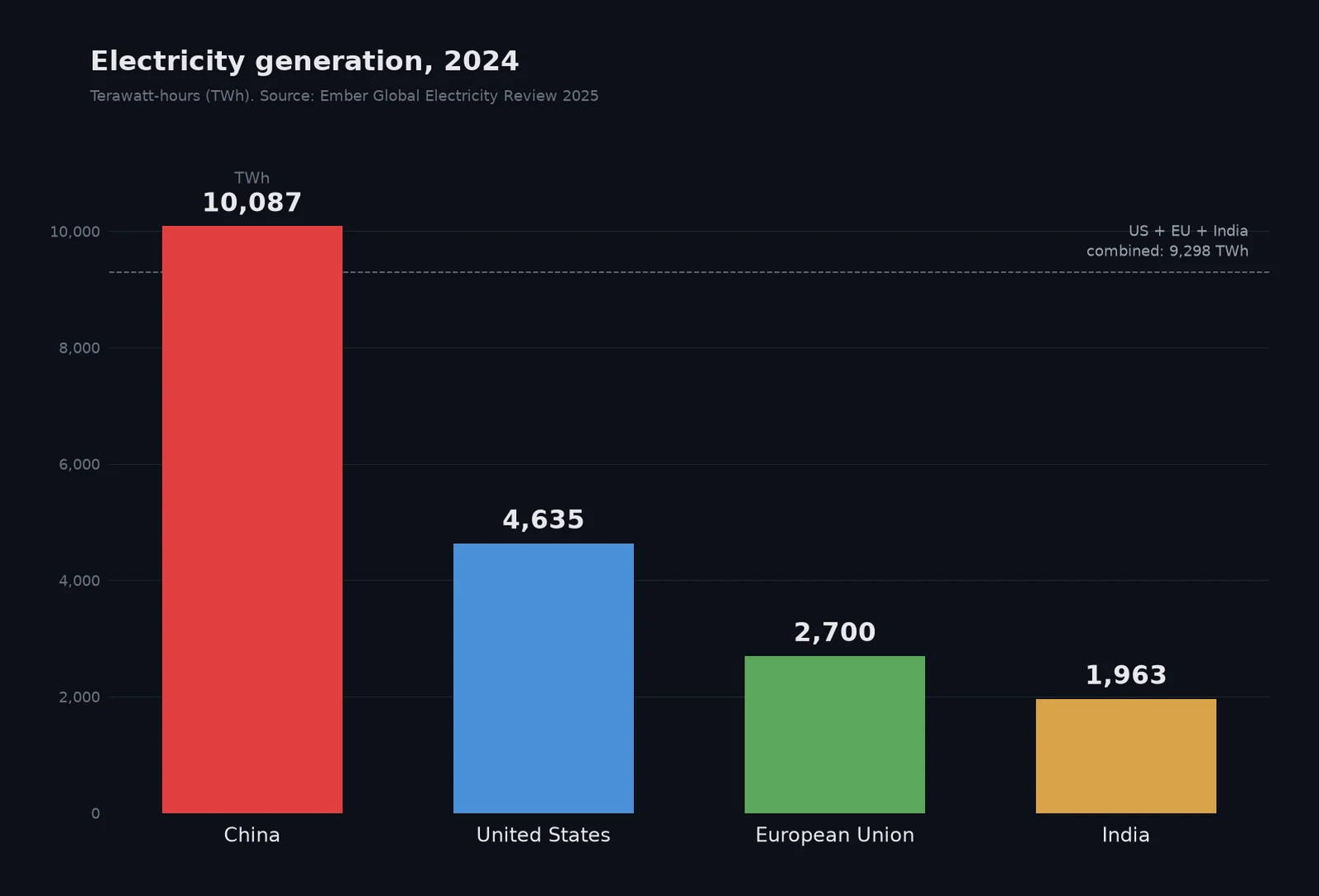
China generates more electricity than the US, EU, and India combined. It makes 85 percent of the world's solar panels and nearly half its new nuclear reactors.
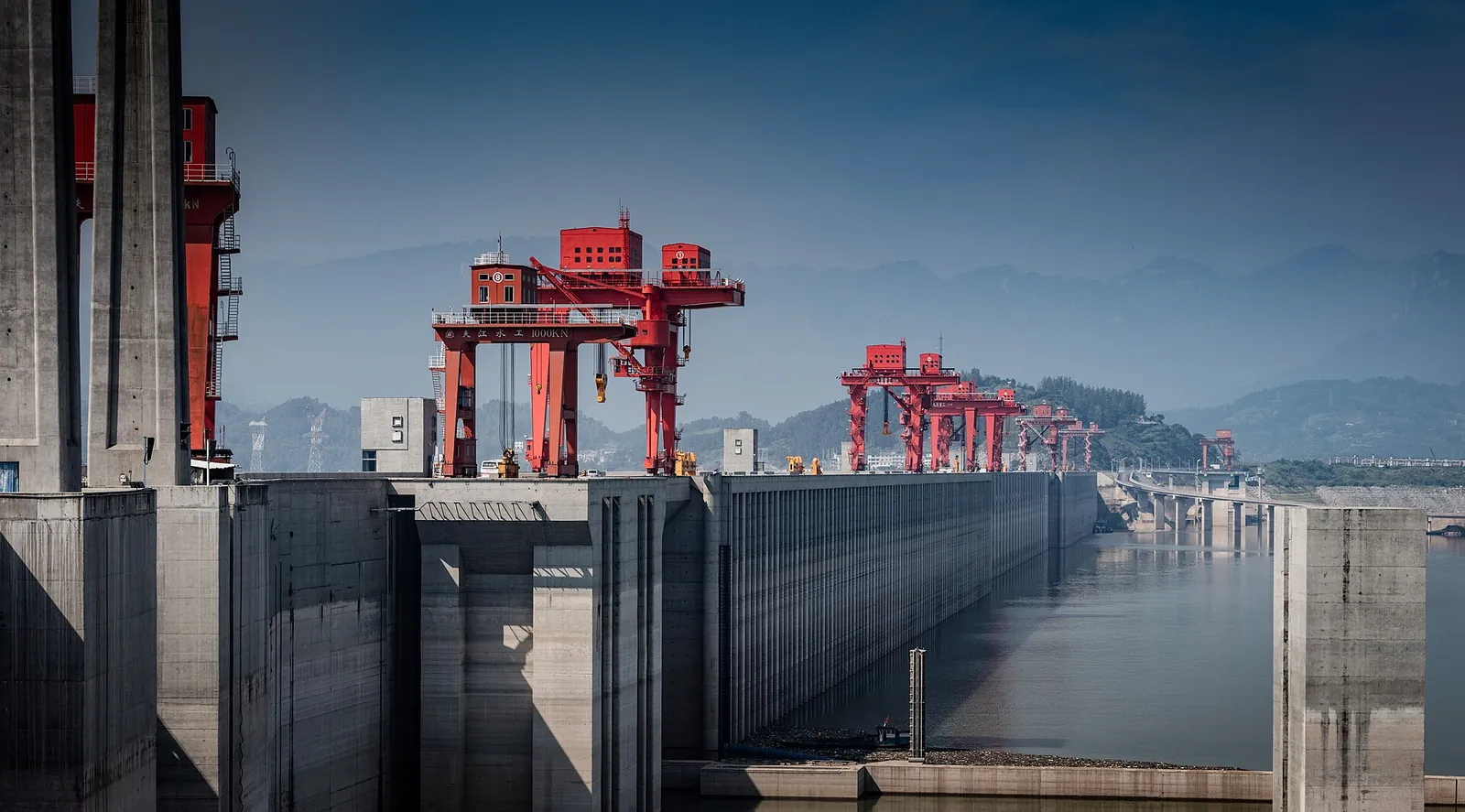
In the first six months of 2025, China installed 210 gigawatts of solar panels. That is more solar capacity than the United States has built in its entire history. Across electricity generation, solar manufacturing, batteries, nuclear construction, and wind power, China is not just ahead of the United States. In most of these categories it is ahead of the rest of the world combined, and the gap is still growing.
More electricity than the US, EU, and India combined
In 2024, China generated 10,087 terawatt-hours of electricity. The United States generated 4,635. China produced more than twice as much, and more than the US, the European Union, and India combined.
None of this happened by accident. Beginning in the early 2000s, Beijing designated energy as a strategic industry and directed cheap state capital toward it at a scale no market economy has replicated. State-owned banks lent at below-market rates. Provincial governments offered free land and tax holidays to manufacturers. Central planners set capacity targets, and when industry hit them ahead of schedule, they raised the targets and kept building. The bottleneck in most countries is not technology. It is permits, financing, and political will. China's government structure can bypass all three.
The solar factory of the world
China produces 85 percent of the world's solar panels. Four companies, LONGi, Trina Solar, JA Solar, and Jinko Solar, dominate global manufacturing so completely that most countries installing solar energy are buying Chinese products whether they intend to or not.
Inside China, the installations are even larger than the exports. In the first half of 2025, China installed 210 gigawatts of solar, more than the entire installed capacity of the United States, which took decades to build. China hit its own 2030 target for combined wind and solar capacity six years early, in 2024. The government set that target expecting it would take a decade. Chinese industry reached it in four years. When the target was met, Beijing raised it and kept going.
The speed comes from a manufacturing ecosystem that no other country has built. Chinese factories produce solar panels at roughly half the cost of American or European ones, not because of lower quality but because of scale, vertical integration, and years of state subsidies that kept manufacturers alive through price wars that would have bankrupted Western competitors. By the time the US and Europe started treating solar as a serious industry, China already owned the supply chain from polysilicon refining to finished modules.
Batteries and electric cars
The same pattern played out in batteries. CATL held 39 percent of the global EV battery market in 2025. Its founder, Zeng Yuqun, grew up in Ningde, a small city in Fujian province, earned a doctorate in physics from the Chinese Academy of Sciences, and co-founded a lithium battery company in 1999 that was later acquired by Japan's TDK Group. In 2011 he spun off the electric vehicle battery division as CATL and built it into the world's largest battery maker in about a decade.
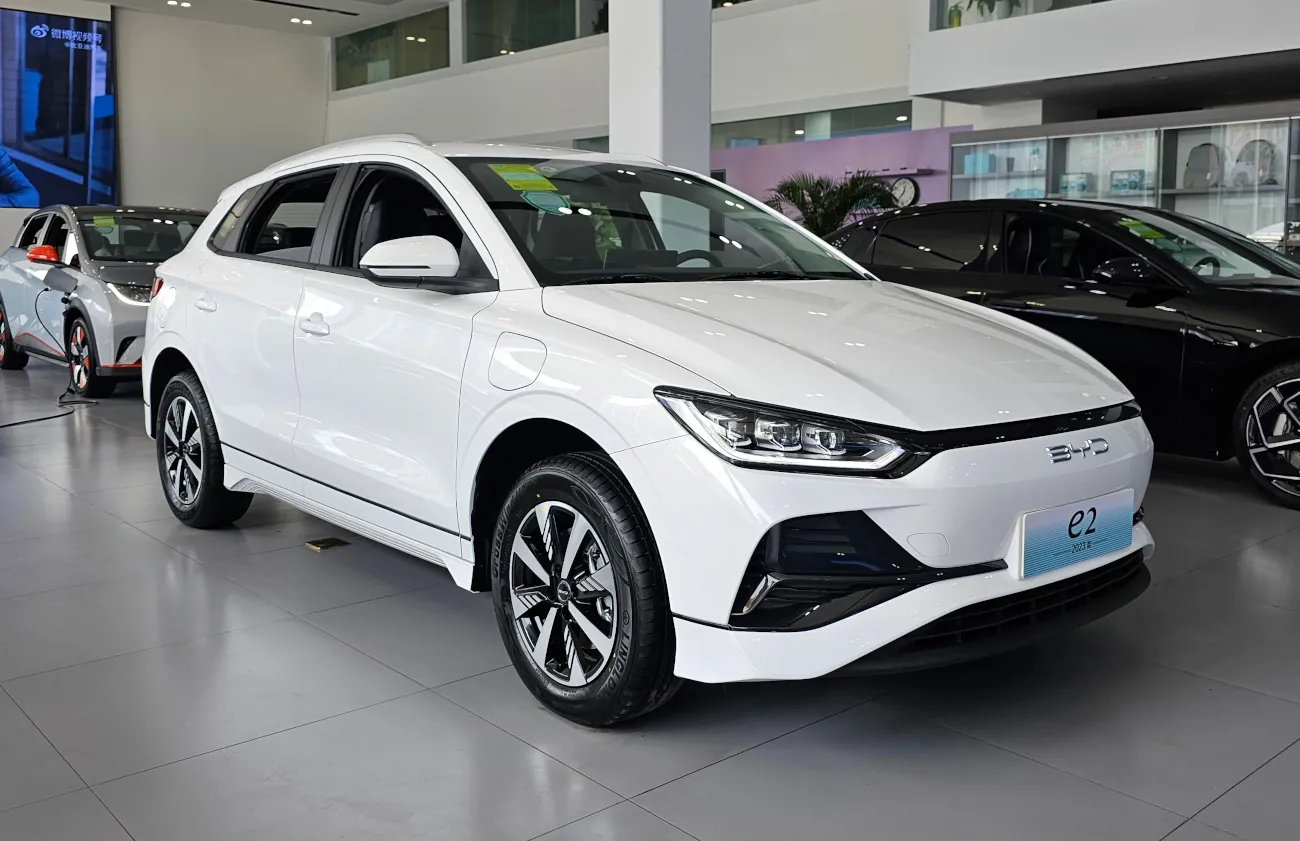
BYD, the second-largest, was founded by Wang Chuanfu, who grew up an orphan in Anhui province. Both of his parents died before he finished high school, and his older brother and sister raised him. He studied metallurgy and in 1995 started a company making rechargeable batteries for cell phones with money borrowed from a cousin. Thirty years later, BYD sold more than four million cars in 2024 and was exporting to over 90 countries. Together, six Chinese companies controlled 69 percent of the global EV battery market.
CATL has also begun mass-producing sodium-ion batteries that use sodium instead of lithium and already deliver a range of about 500 kilometers per charge. If the technology scales, it would cut the battery industry's dependence on lithium, which is expensive and concentrated in a handful of countries. This is what the Chinese energy strategy looks like at the company level: dominate the current technology while already developing the replacement.
Nuclear power at a pace nobody else matches
China has 38 nuclear reactors under construction, nearly half of all nuclear construction on the planet. In April 2025, it approved 10 new reactors in a single round, worth about $27 billion. It was the fourth consecutive year that China approved 10 or more reactors at once.
The contrast with the United States tells the story. The US completed its first new nuclear reactors in roughly 30 years when the Vogtle units 3 and 4 in Georgia came online in 2023 and 2024. The project ran years behind schedule and billions over budget. China approves as many reactors in a single round as the US finished in a generation. The difference is not technology. American and Chinese reactors use similar designs. The difference is that China's state-owned nuclear companies build on standardized sites with a trained workforce that moves from one project to the next, while American projects start from scratch each time, fighting through years of permitting and litigation before pouring any concrete.
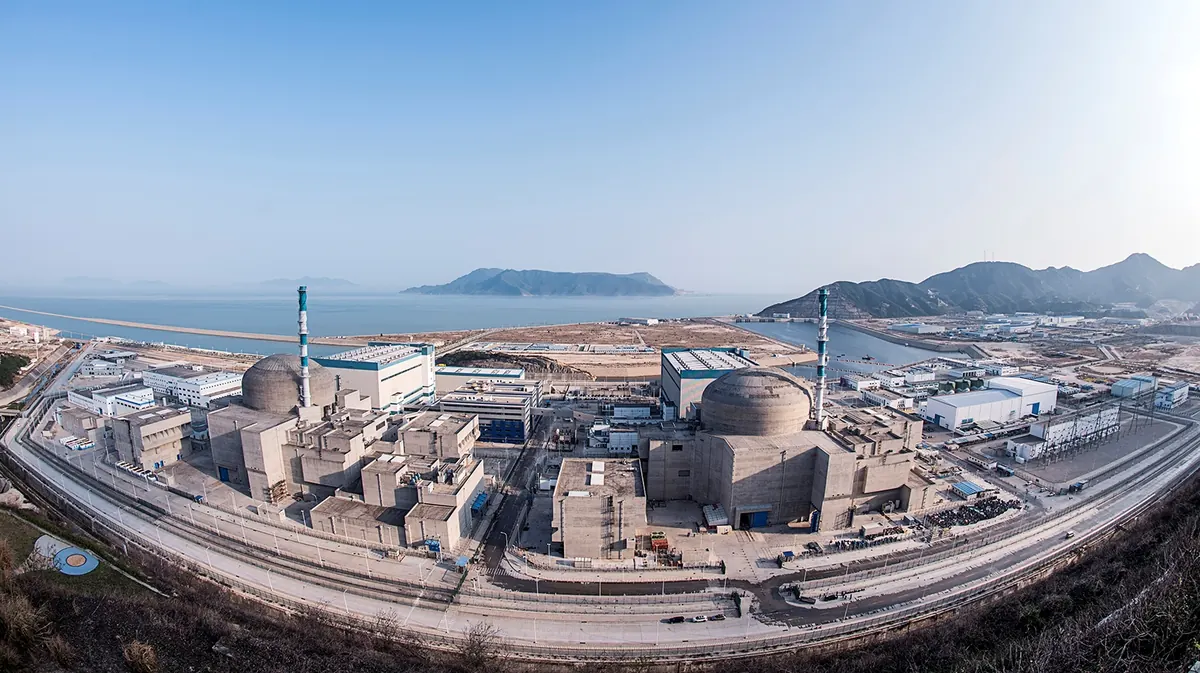
China is also already testing the next generation. In December 2023, the Shidaowan plant in Shandong province began commercial operation as the world's first high-temperature gas-cooled pebble-bed reactor, a design that cannot melt down the way a conventional reactor can. While other countries debate whether to build nuclear plants at all, China is building the current generation at industrial scale and prototyping the future.
Still the world's largest coal burner
China burns about 55 percent of the world's coal. Coal still provides roughly 58 percent of its electricity, and in 2024 Chinese coal consumption hit a new all-time record. China is the world's largest coal burner and the world's largest clean energy builder at the same time.
But the balance is shifting. In the first half of 2025, electricity from renewable sources surpassed electricity from coal for the first time in China's history. China is not shutting down coal. It is growing fast enough that clean energy is overtaking coal's share without the old plants needing to close.
What this means for the rest of the world
China's position in clean energy manufacturing is becoming a geopolitical fact in the way that Saudi Arabia's position in oil has been for the past 50 years. Countries that want to decarbonize need solar panels, batteries, and electric vehicles. China makes most of them. The supply chain runs from raw materials (China also dominates rare earth refining and lithium processing) through component manufacturing to finished products.
For China, the energy buildout serves a strategic purpose beyond economics. China imports large volumes of oil and gas, much of it through the Strait of Malacca, a narrow waterway between Malaysia and Indonesia that a hostile navy could block. Every kilowatt-hour generated from domestic solar, wind, or nuclear reduces China's dependence on tankers making it through that strait. The clean energy transition is also an energy security policy.
For the United States and Europe, the situation is a dilemma with no quick fix. Their own climate targets depend on Chinese-made equipment. But relying on a single country for the hardware of the energy transition creates the kind of vulnerability that depending on Middle Eastern oil created in the 1970s. Both the US and Europe have passed laws to subsidize domestic clean energy manufacturing, and the US has reopened the Mountain Pass rare earth mine in California. But China invested roughly $675 billion in clean energy in 2024, nearly as much as the US and Europe combined. It added more clean energy capacity in 2025 alone than most countries have in total. Closing a gap this wide will take a decade of sustained spending, and so far the gap is still getting wider.
Test what you learned
5 questions on this article. About two minutes, no signup.