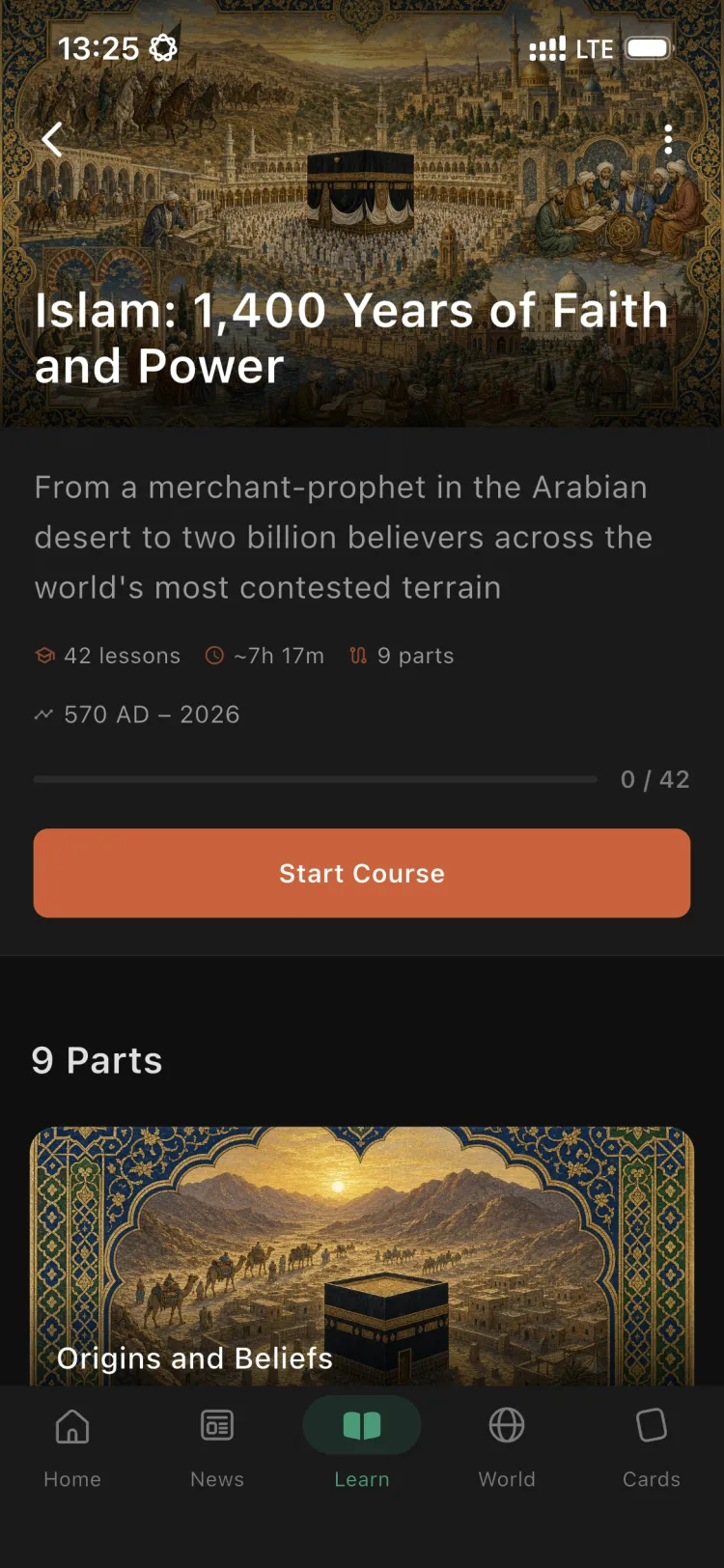
Islam: 1,400 Years of Faith and Power
Muhammad, a merchant in the trading city of Mecca, built a state that united Arabia. Within a generation of his death, his followers split over who should lead them. Today Islam has two billion believers and no single voice.
570 AD to 2026 · 9 parts · 42 lessons · about 7.5 hours
Free for 7 days, cancel anytime. iPhone and Android.
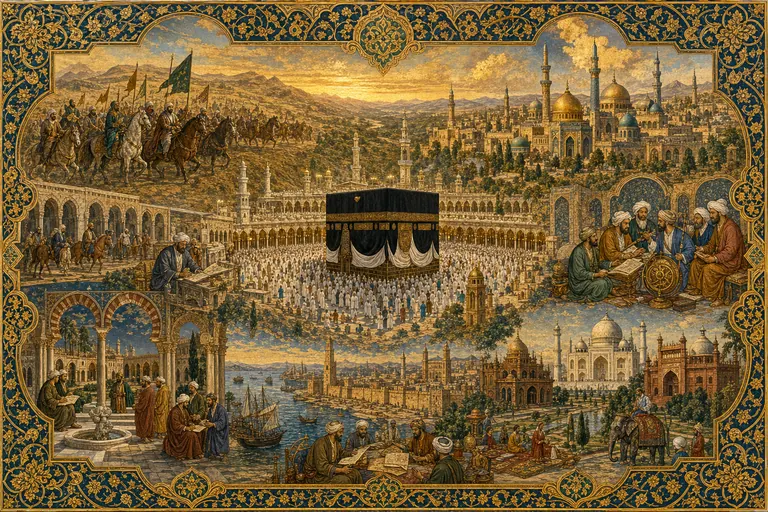
Questions this course answers
- Why does the Islamic calendar begin with Muhammad's move to Medina rather than his birth?
- How did Arab armies destroy the Persian Empire in less than twenty years?
- What caused the Sunni-Shia split, and why does it still shape the Middle East?
- What was the House of Wisdom in Baghdad, and what did its scholars achieve?
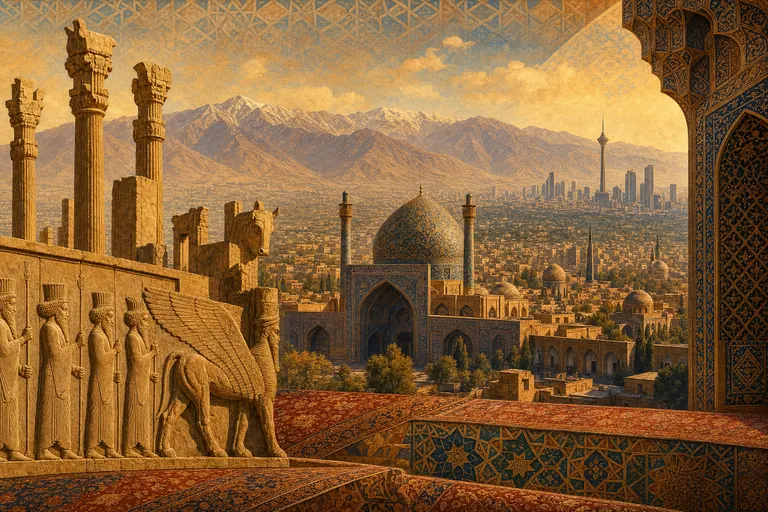
- How did Iran become Shia after nine hundred years as a Sunni country?
- How did Saudi oil money reshape global Sunni Islam after 1973?
Nine parts, 42 lessons
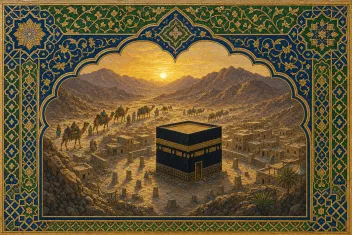 Part 1 · 570 to 632 AD
Origins and Beliefs
Islam rests on tawhid, the oneness of God. Muhammad built a state in Medina after 622, united Arabia, and died in 632 without naming a successor.
-
1
8 min
What Islam Teaches
Two billion people follow Islam. Its central belief is tawhid, the oneness of God. Sharia is a legal tradition whose five major schools often disagree.
-
2
8 min
Arabia Before Islam
Before Islam, Arabia was a crossroads of trade routes linking Rome, Persia, Ethiopia, and India. Mecca was a major caravan city.
-
3
7 min
Muhammad: Prophet and Statesman
The Islamic calendar counts from 622, the year Muhammad moved from Mecca to Medina, where feuding tribes invited him in as an arbiter with full authority.
-
4
8 min
The Unification of Arabia
In ten years a few hundred refugees became masters of the Arabian Peninsula, more through diplomacy than battle. Then Muhammad died without naming a successor.
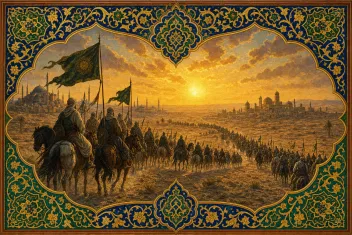 Part 2 · 632 to 680 AD
The Great Conquests and the First Split
In nineteen years Arab armies destroyed the Sasanian Empire and took Syria and Egypt from Byzantium. Then a Muslim civil war began the Sunni-Shia split.
-
5
8 min
The Rashidun: The Rightly-Guided Caliphs
Two of the first four caliphs were assassinated by fellow Muslims. The era Sunni tradition idealizes was one of the most violent in early Islamic history.
-
6
8 min
Byzantium and Persia Fall
Arab armies took Syria, Egypt, Iraq, and Persia within nineteen years of Muhammad's death. Byzantium and Persia had just exhausted each other in a long war.
-
7
9 min
The First Fitna
Caliph Uthman was murdered by Muslim rebels in 656. The war that followed between Ali and Muawiya ended with Ali assassinated and Muawiya as caliph.
-
8
9 min
Karbala and the Birth of Shia Islam
In 680 at Karbala in Iraq, an Umayyad army of about 4,000 killed Muhammad's grandson Hussein, who had 72 followers. It became the founding tragedy of Shi'ism.
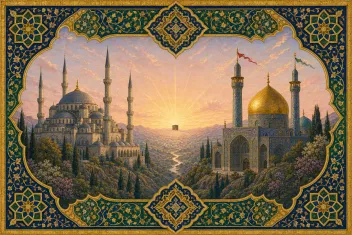 Part 3 · 632 AD to 2026
Sunni vs Shia: The Split That Shapes Geopolitics
The split is about one question: where does religious authority come from? Today Saudi Arabia and Iran use the split to frame their rivalry from Iraq to Yemen.
-
9
8 min
Who Was Supposed to Lead?
Sunnis say the community and its scholars hold religious authority. Shia say God gave it to a chosen line of Imams descended from Muhammad's cousin Ali.
-
10
9 min
Theological and Legal Differences
Sunnis and Shia share one Quran but use different hadith collections, pray in different postures, and organize clerical authority differently.
-
11
10 min
The Geography of the Split
Roughly 90% of Muslims are Sunni and 10% are Shia, but that 10% is concentrated. Iran became Shia after 1501, and Iraq in the 18th and 19th centuries.
-
12
11 min
The Internal Diversity of Shia Islam
Twelvers run Iran, Ismailis follow the Aga Khan, Yemen's Houthis draw on Zaydi tradition, and Syria's Alawis gave the Assads their base. They agree on little.
-
13
10 min
Modern Sunni-Shia Fault Lines
Iraq, Syria, Yemen, Lebanon, Bahrain: each is a battleground where Saudi Arabia and Iran fight indirectly through local actors.
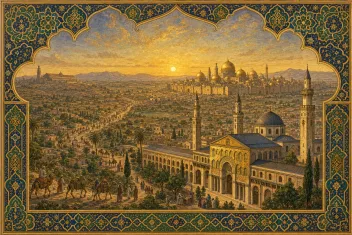 Part 4 · 661 AD to 1258
The Caliphates: Empire and Civilization
The Umayyads ruled from Damascus and the Abbasids from Baghdad, while rival caliphs held Cairo and Cordoba. Science and learning flourished across the Muslim world.
-
14
9 min
The Umayyad Arab Empire
The Umayyads moved the capital to Damascus, built the first Islamic monumental architecture, and ran an Arab ethnic hierarchy that helped topple the dynasty.
-
15
10 min
The Furthest Conquests: Spain to India
Three Arab campaigns begun in 711 took Spain, Sind, and most of Central Asia within a decade. By 750 the empire stretched from the Atlantic to China's borders.
-
16
10 min
The Abbasid Revolution
In 750 the Abbasids, an Arab family backed by Persian-speaking troops from Khurasan, overthrew the Umayyads and built a new capital at Baghdad.
-
17
10 min
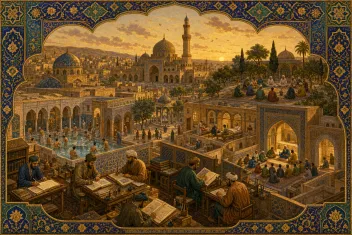
Baghdad and the House of Wisdom
Baghdad's translation movement brought Greek, Persian, and Indian learning into Arabic, and its scholars added new work, such as al-Khwarizmi's algebra.
-
18
9 min
The Fatimid Shia Caliphate
The Ismaili Shia took Egypt in 969 and built Cairo, al-Azhar, and a rival caliphate that proved the Abbasid claim to universal authority was a fiction.
-
19
10 min
Cordoba: The Western Caliphate
In 929 the Umayyads of Spain declared a caliphate at Cordoba, a city of paved streets and public libraries where Christians and Jews lived under Muslim rule.
 Part 5 · 750 AD to 1500
How Islamic Civilization Worked
Islam has no pope or central authority. It held together through the legal schools, the Sufi brotherhoods that spread the faith, and the yearly Hajj to Mecca.
-
20
10 min
The Legal Schools (Madhhabs)
Saudi Islam, Turkish Islam, and Indonesian Islam look different because each was shaped by a different legal school. Five schools divide the Muslim world.
-
21
10 min
Sufism and the Spread of Islam
Indonesia, the world's largest Muslim country, was converted by Sufi mystics rather than Arab armies. Most of the modern Muslim world converted through Sufism.
-
22
11 min
Mecca and the Hajj as Institution
Every year 2 to 3 million Muslims converge on Mecca for five days. The Hajj has run for 1,400 years and is the largest religious gathering on Earth.
 Part 6 · 1055 to 1500
Crusades, Moors, and Mongols
Crusaders took Jerusalem, Christian kingdoms took Muslim Spain, and the Mongols sacked Baghdad in 1258. Saladin retook Jerusalem and the Mamluks stopped the Mongols.
-
23
11 min
The Seljuks and the World Before the Crusades
The Seljuk Turks beat Byzantium at Manzikert in 1071 and opened Anatolia to Turkish settlement, but their empire had split apart before the Crusaders arrived.
-
24
10 min
The Crusades from the Islamic Side
Early Muslim chronicles barely mention the First Crusade. The wars that loom enormous in Western memory were a border problem for the broader Muslim world.
-
25
10 min
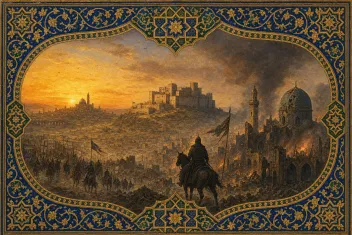
Saladin and the Recovery of Jerusalem
Saladin, a Kurd born in Tikrit, spent most of his first eighteen years in power fighting Muslim rivals before he won at Hattin and retook Jerusalem in 1187.
-
26
12 min
Al-Andalus and the Reconquista
Muslim rule in Spain lasted 781 years and ended with the fall of Granada in 1492. The Christian Reconquista came in bursts, with long pauses between them.
-
27
10 min
The Mongols Destroy Baghdad, 1258
The Mongols sacked Baghdad in 1258 and threw its libraries into the Tigris, which reportedly ran black with ink. The Abbasid caliphate in Baghdad was over.
-
28
12 min
The Mamluks Save Islam at Ain Jalut
At Ain Jalut in 1260, a Mamluk army under Qutuz and Baybars stopped the Mongols' westward advance. The Mamluk Sultanate ruled Egypt and the Levant until 1517.
 Part 7 · 1500 to 1800
The Gunpowder Empires
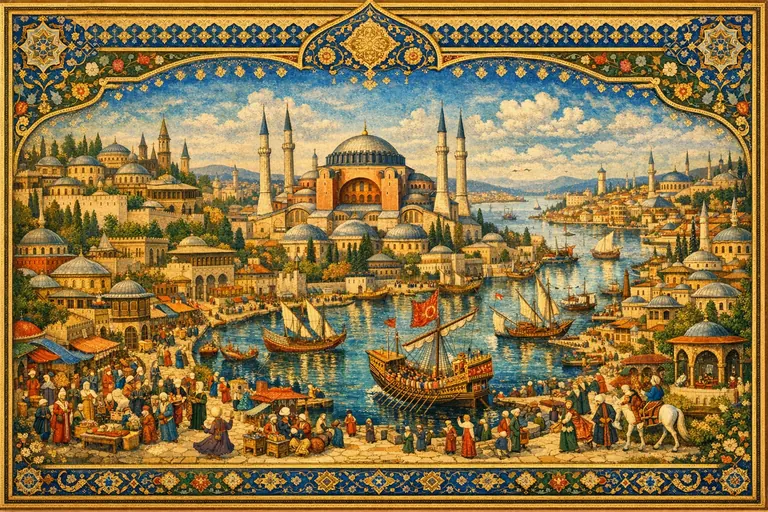
From 1500 to 1800 the Ottoman, Safavid, and Mughal empires ruled much of the Muslim world. Ottoman-Safavid wars drew the Sunni-Shia fault line.
-
29
11 min
The Ottoman Sultan Becomes Caliph
Ottoman Sultan Selim I conquered the Mamluks in 1517 and carried the caliphal claim from Arab to Turkish hands, where it stayed for four centuries.
-
30
12 min
How Iran Became Shia
Shah Ismail declared Twelver Shi'ism Iran's state religion in 1501 and enforced the conversion by violence. Iran had been Sunni for nine centuries.
-
31
11 min
The Sunni-Shia Imperial War
From 1514 the Ottomans and Safavids fought a series of wars over Iraq and the Caucasus. The 1639 Treaty of Zuhab fixed a line near the modern Iran-Iraq border.
-
32
13 min
Mughal Islam in a Hindu World
The Mughals ruled the richest state on Earth, whose people were 80 percent Hindu. Akbar's pluralism and Aurangzeb's rigorism still divide Indian politics.
 Part 8 · 1700 to 1924
Decline, Reform, and Colonialism
For the first time in 1,200 years most Muslims fell under non-Muslim rule. The Wahhabi movement began in Arabia, and Turkey abolished the caliphate in 1924.
-
33
12 min
Wahhabism and the First Saudi State
In 1744 Ibn Abd al-Wahhab and Muhammad ibn Saud made a pact at Diriyah. Their state fell in 1818, but the alliance became the basis of modern Saudi Arabia.
-
34
12 min
Colonialism and the Muslim World
From 1798 to 1914 the share of Muslims under European rule rose from roughly 5 to 80 percent. British India alone held more Muslims than the Ottoman Empire.
-
35
12 min
The Islamic Modernism Debate
Between 1880 and 1930, Afghani, Abduh, and Iqbal argued that Muslims should combine their own tradition with selective borrowing from Europe.
-
36
11 min
The Abolition of the Caliphate
On March 3, 1924, the Turkish parliament abolished the caliphate by a vote. The last caliph, Abdulmecid II, was put on a train to Switzerland the next morning.
 Part 9 · 1924 to 2026
Islam in the Modern World
The Muslim Brotherhood, Saudi religious funding, the Iranian Revolution, and jihadism shaped modern Islam. No government speaks for its two billion followers.
-
37
15 min
The Muslim Brotherhood: Birth of Political Islam
In 1928 Hassan al-Banna, an Egyptian schoolteacher, founded the Muslim Brotherhood with six canal workers. It became the model for Sunni Islamist movements.
-
38
12 min
Saudi Wahhabism Goes Global
After the 1973 oil shock, Saudi Arabia spent an estimated 75 to 100 billion dollars exporting its Wahhabi tradition: mosques, madrasas, and textbooks worldwide.
-
39
12 min
Iran 1979: Shia Political Islam Revived
Iran's 1979 revolution gave political Islam its first working state, which projected power through Hezbollah, the Iraqi Shia, the Houthis, and Hamas.
-
40
13 min
Jihadism: Al-Qaeda and ISIS
Al-Qaeda carried out the September 11 attacks, and ISIS briefly ruled perhaps 10 million people in Syria and Iraq. Most of their victims were Muslims.
-
41
12 min
Islam in the West
Western Europe's Muslim population grew from roughly 250,000 in 1960 to 25 to 30 million by 2026. Integration is now a major political issue across the West.
-
42
12 min
Islam Today: Two Billion and Diverse
Arab Muslims are only about 20 percent of all Muslims. The largest Muslim populations are in Indonesia, Pakistan, India, Bangladesh, and Nigeria.
Lessons you can finish in one sitting.
Each lesson tells one part of the story and explains why it happened, with maps, images and quotes from the sources. A few questions at the end check that it stuck, and the key facts go into the course's flashcards.
- 7 to 15 minutes a lesson
- Four questions after each lesson
- 294 flashcards for this course