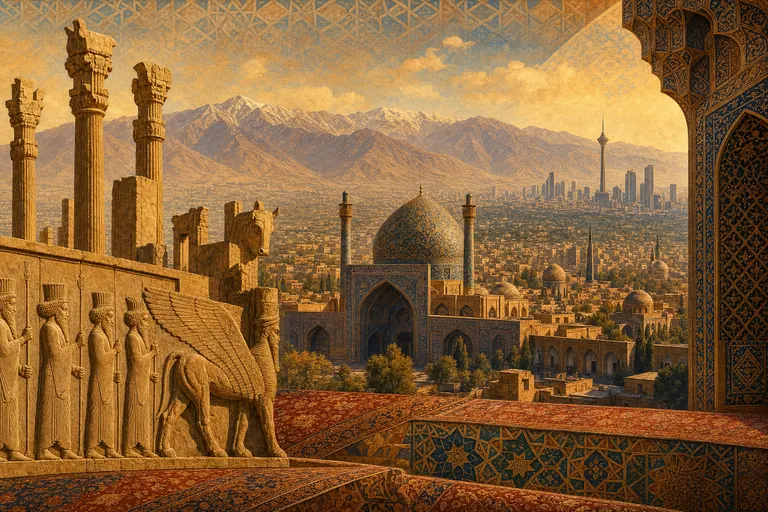
The Ottoman Empire
The Ottoman Empire began in 1299 as a band of Turkish frontier raiders. Over six centuries it captured Constantinople, ruled lands on three continents, and collapsed after World War I. Its breakup shaped the borders of the modern Middle East.
1299 to 1923 · 6 parts · 32 lessons · about 3.5 hours
Free for 7 days, cancel anytime. iPhone and Android.
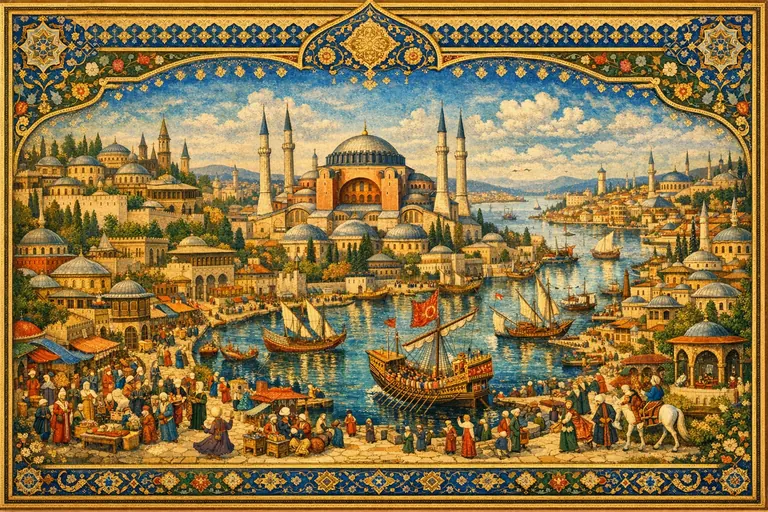
Questions this course answers
- How did a band of Turkish raiders on Byzantium's border build a world empire?
- Why was Suleiman's legal code more important than any of his conquests?
- How did the Janissaries go from elite soldiers to a corrupt militia that deposed sultans?
- How did the failed siege of Vienna in 1683 begin the Ottoman retreat in Europe?
- How did nationalism tear apart the Ottoman Empire one ethnic group at a time?
- Why does the map drawn by Sykes and Picot still shape the modern Middle East?
Six parts, 32 lessons
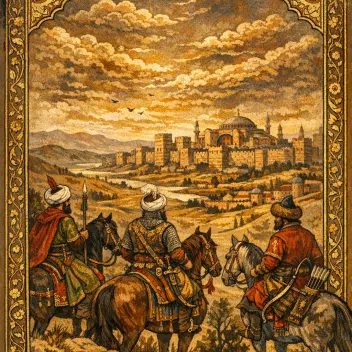 Part 1 · 1299 to 1453
Rise of the Ottomans
How a band of Turkish raiders on Byzantium's border became a state, crossed into Europe, survived catastrophe, and captured Constantinople in 1453.
-
1
5 min
Osman and the Frontier Warriors
In 1299 Osman ruled a borderland smaller than Connecticut. The Ottomans grew by granting conquered land to warriors and absorbing the people they defeated.
-
2
6 min
The Balkans Fall
A Byzantine emperor invited Turkish troops to Europe as mercenaries during a civil war. The troops stayed, and Christian rulers were too divided to stop them.
-
3
5 min
Lightning and Catastrophe
Bayezid built the fastest-expanding empire in the world. Timur destroyed it in a single afternoon at Ankara in 1402, nearly erasing the Ottomans forever.
-
4
5 min
The Interregnum and Recovery
After Ankara, four sons of Bayezid fought a decade-long civil war, and Sheikh Bedreddin led a revolt. The Ottoman state still reassembled.
-
5
6 min
1453: The Fall of Constantinople
On May 29, 1453, the army of 21-year-old Sultan Mehmed II broke into Constantinople after a 53-day siege, ending the Byzantine Empire.
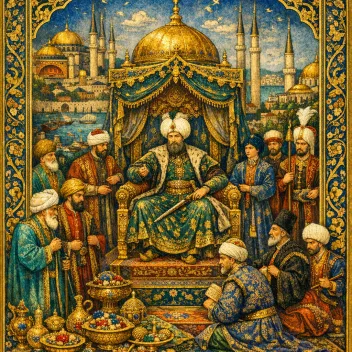 Part 2 · 1453 to 1566
The Golden Age
From the rebuilding of Constantinople to Suleiman's empire at its zenith: the conquest of the Arab world, the claim to the caliphate, and the limits of power at Vienna.
-
6
6 min
Mehmed the Conqueror Rebuilds
Mehmed II found Constantinople with fewer than 50,000 people and rebuilt it into a multiethnic capital of 100,000 through forced resettlement.
-
7
5 min
Selim the Grim: From Balkans to Arabia
In eight years Selim I doubled the Ottoman Empire, crushed the Safavids, and claimed guardianship of Mecca and Medina. Selim executed seven grand viziers.
-
8
5 min
Suleiman the Magnificent
Suleiman ruled for 46 years, longer than any other Ottoman sultan. He left a legal code that lasted three centuries and had his ablest son, Mustafa, executed.
-
9
6 min
Suleiman's Wars: Vienna, the Mediterranean, and the Limits of Power
Suleiman crushed the Hungarian army at Mohacs in about two hours and took Rhodes, but his 1529 siege of Vienna failed because of mud, rain, and distance.
-
10
6 min
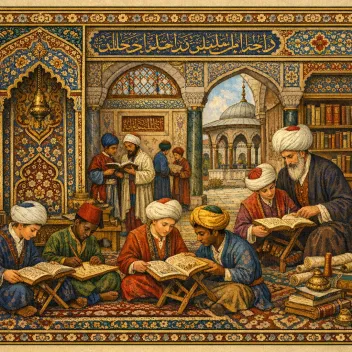
The Empire at Its Zenith
No state in Europe matched the Ottoman Empire in population, revenue, or diversity. Shepherd boys became grand viziers, and expelled Spanish Jews found refuge.
 Part 3 · 1363 to 1826
How the Empire Worked
The child levy that made slave boys into grand viziers, the Janissaries who became kingmakers, tolerance as strategy, and trade across three continents.
-
11
6 min
The Devshirme: Slaves Who Ruled an Empire
Ottoman officials took Christian boys from Balkan villages and trained them as Janissaries or statesmen. The system produced 79 grand viziers.
-
12
7 min
The Janissaries: The Sultan's Fist
The Janissaries were among the first infantry in Europe to use firearms. They later became a hereditary corps that deposed sultans and murdered reformers.
-
13
5 min
The Millet System: Tolerance as Strategy
In 1492 Sultan Bayezid II sent ships to rescue Jews expelled from Spain. Christians and Jews ran their own courts in return for higher taxes.
-
14
6 min
Crossroads of Three Continents
The Ottoman Empire taxed the trade between Asia, Europe, and Africa. Vasco da Gama's sea route of 1498 and New World silver slowly eroded that wealth.
-
15
6 min
Mosques, Miniatures, and the Cultural Synthesis
Mimar Sinan, a Christian boy conscripted as a slave, became the greatest architect of the Islamic world and designed 476 buildings across a 50-year career.
 Part 4 · 1566 to 1800
The Long Decline
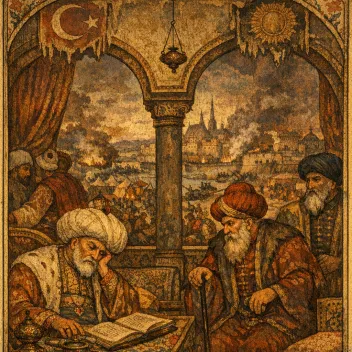
Weak sultans, powerful mothers, the military revolution the Ottomans missed, the failed siege of Vienna in 1683, and the first reform attempts that ended in murder.
-
16
6 min
After Suleiman: The Sultanate of Women
After Suleiman, many sultans withdrew into the harem. For nearly a century their mothers, women once sold as slaves, ran the Ottoman Empire.
-
17
6 min
Why Europe Caught Up
Europe reinvented warfare, finance, and knowledge faster than the Ottoman Empire could adapt, and the Janissaries resisted military reform.
-
18
6 min
The Siege of Vienna: The Turning Point
In 1683 Polish King John Sobieski broke the Ottoman siege of Vienna with a cavalry charge. The war that followed cost the Ottomans Hungary and Transylvania.
-
19
6 min
The First Reform Attempts
Selim III built a European-style army and hired French advisors. The Janissaries deposed him in 1807, and he was murdered the following year.
 Part 5 · 1839 to 1914
The Sick Man of Europe
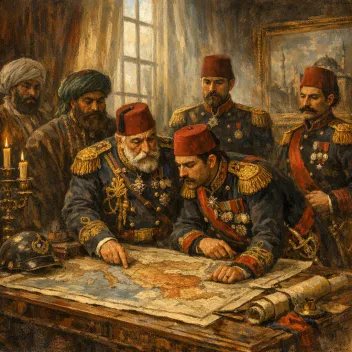
In the 1800s the Tanzimat reforms modernized the Ottoman state but left it deep in debt, and the Balkan nations broke away one by one.
-
20
7 min
The Tanzimat: Modernization from Above
In 1839 the Ottoman Empire began European-style reforms. They brought new courts and schools, heavy debt, and a constitution that lasted 13 months.
-
21
7 min
The Sick Man of Europe
Tsar Nicholas I called the Ottoman Empire a sick man in 1853 and asked what should happen when it died. That question dominated European diplomacy for 70 years.
-
22
6 min
The Balkans Break Away
Between 1821 and 1878 the Ottoman Empire lost most of its European territory to nationalism, one ethnic group at a time. Greece showed the template.
-
23
8 min
The Armenian Question
Unlike the Balkan peoples, the Armenians had no great power to protect them. Promised reforms went unenforced, and massacres began in 1894.
-
24
6 min
The Young Turks: Revolution of 1908
In 1908 Young Turk officers rose against Sultan Abdulhamid II to restore the constitution. Within five years they had abolished parliament and shot opponents.
-
25
7 min
On the Eve of World War
From 1912 to 1914 the Ottoman Empire lost most of its European lands, saw Britain seize two paid-for battleships, and signed a secret alliance with Germany.
 Part 6 · 1914 to 1923
Collapse and Legacy
The war that destroyed a 600-year empire: the Armenian genocide, the Arab revolt, the partition of the Middle East, and Mustafa Kemal, who built Turkey from the ruins.
-
26
7 min
The Fatal Alliance: Why the Ottomans Chose Germany
The Ottoman Empire joined World War I to recover lost land. Instead Enver Pasha's Caucasus campaign cost 77,000 soldiers, and the call to holy war failed.
-
27
8 min
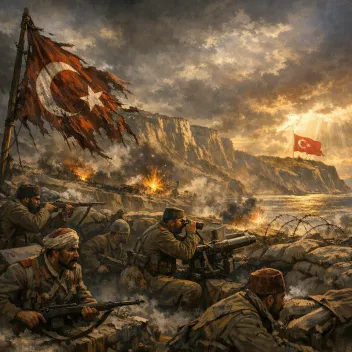
Gallipoli: The Battle That Made a Nation
The Allies attacked the Ottoman Empire at Gallipoli and failed after eight months. Mustafa Kemal, a junior Ottoman colonel there, later founded Turkey.
-
28
8 min
The Armenian Genocide
Between 1915 and 1918 the Ottoman government, with Talaat Pasha as interior minister, organized the systematic killing of 600,000 to 1.5 million Armenians.
-
29
7 min
The Arab Revolt and Lawrence of Arabia
Britain needed the Arabs to fight the Ottomans and promised an independent state. While making that promise, Britain was dividing the same land with France.
-
30
7 min
Sykes-Picot: Drawing the Modern Middle East
Mark Sykes of Britain and François Georges-Picot of France secretly drew a line from Acre to Kirkuk that shaped the borders of the modern Middle East.
-
31
7 min
Atatürk and the Birth of Turkey
The Allies carved up Anatolia in a treaty. Mustafa Kemal refused, fought four armies, and proclaimed a republic that abolished the caliphate.
-
32
8 min
Why the Ottoman Empire Matters
The Syrian war, Kurdish statelessness, Iraqi sectarianism, and the caliphate question all have roots in the Ottoman Empire and its collapse.
Lessons you can finish in one sitting.
Each lesson tells one part of the story and explains why it happened, with maps, images and quotes from the sources. A few questions at the end check that it stuck, and the key facts go into the course's flashcards.
- 5 to 8 minutes a lesson
- Two to four questions after each lesson
- 245 flashcards for this course