World History: 12,000 Years of Civilization
Over the last 12,000 years, farming created property, hierarchy, and the first states. Empires from Rome to the Soviet Union rose and fell, and the order built after 1945 became today's contested multipolar world.
10,000 BC to 2026 · 5 parts · 41 lessons · about 4 hours
Free for 7 days, cancel anytime. iPhone and Android.
Questions this course answers
- Why did humans start farming if it made life worse?
- How did the Mongol Empire kill an estimated 40 million people and still unify Eurasian trade?
- Why did Ming China burn the largest fleet on Earth and turn inward?
- How did the Atlantic slave trade build the economies of two continents?
- How did industrialization hand Europe the weapons to conquer the world?
- Why didn't the end of the Cold War bring lasting peace?
Five parts, 41 lessons
 Part 1 · 10,000 BC to 500 AD
The Ancient World
How agriculture created property, hierarchy, and the state, and how Greece, Persia, and Rome shaped the political vocabulary we still use.
-
1
4 min
The Agricultural Revolution
For 300,000 years, humans owned nothing. About 12,000 years ago, farming began and created property, hierarchy, taxation, and war.
-
2
5 min
The First Civilizations
Mesopotamia, Egypt, and the Indus Valley arose around 3000 BC and answered the same question three ways: who gets to rule, and why should everyone else obey?
-
3
5 min
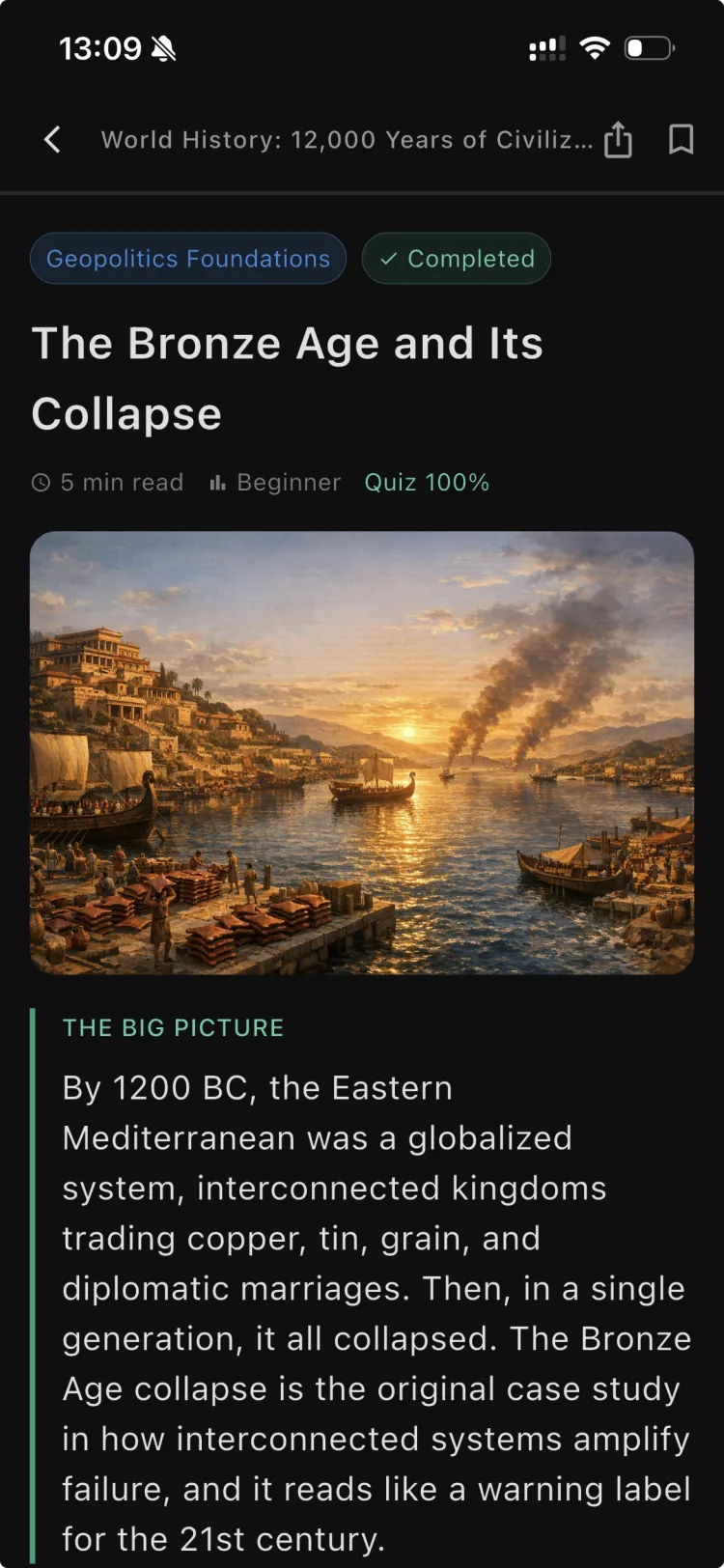
The Bronze Age and Its Collapse
Around 1200 BC, the trading kingdoms of the Eastern Mediterranean mostly fell within about 50 years, as failure in one spread to the others.
-
4
6 min
Egypt and the Nile
Whoever controlled the Nile controlled the richest civilization on Earth for 3,000 years. Today, a new Ethiopian dam on the Nile could end that monopoly.
-
5
6 min
Ancient India
The Indus Valley had flush toilets before anyone in Europe had writing. Ashoka ruled more territory than any European state would for eighteen centuries.
-
6
7 min
Ancient China
China built the idea that a state should be run by educated professionals selected on merit. The Communist Party still governs by that principle today.
-
7
7 min
Ancient Africa
Nubian kings ruled Egypt, Carthage nearly destroyed Rome, and the Shona built Great Zimbabwe. European colonizers denied this history to justify their rule.
-
8
6 min
The Greek City-States
Greece never built an empire because Greece couldn't stop fighting itself. The ideas from those fights became the vocabulary of Western political thought.
-
9
6 min
Ancient Persia
Every empire before Cyrus ruled by erasure. Cyrus let the conquered keep their religions, laws, and identities, and outlasted those who ruled by terror.
-
10
6 min
Alexander and the Hellenistic World
Alexander conquered the Persian Empire and died at 32 without a clear heir. His empire split, but the culture he spread lasted a millennium.
-
11
6 min
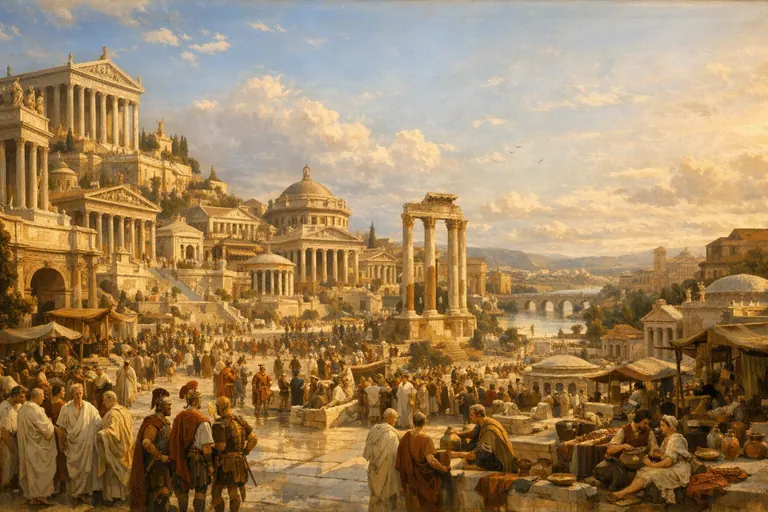
The Rise and Fall of Rome
Rome grew by turning enemies into allies and allies into citizens. Its Republic collapsed when ambitious generals stopped obeying its rules.
 Part 2 · 500 AD to 1500
The Medieval World
The Silk Roads, the rise of Islam, the Mongol conquests, and a fragmented Europe whose weakness became an accidental advantage.
-
12
6 min
The Silk Roads
For over 1,500 years, the Silk Roads carried silk, religions, gunpowder, and the Black Death across Eurasia. China's Belt and Road tries to rebuild them.
-
13
6 min
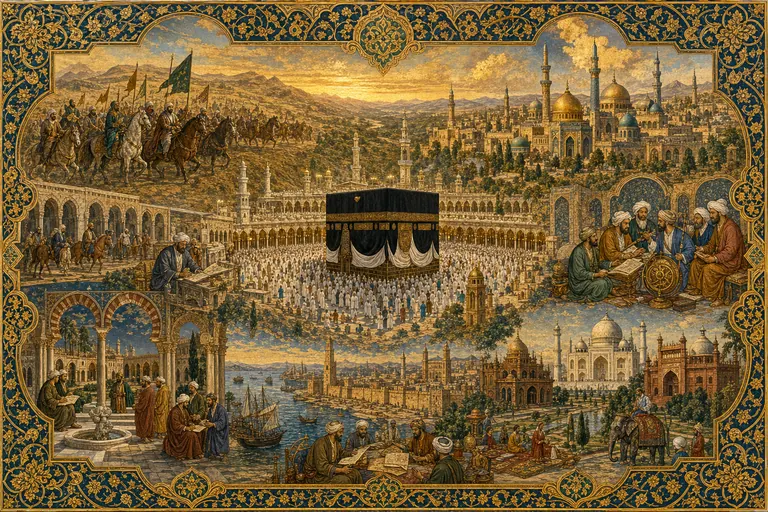
The Rise of Islam
Muhammad fled Mecca with a handful of followers in 622 AD. A century later, Muhammad's successors ruled from Spain to the borders of China.
-
14
5 min
The Islamic Golden Age
While medieval Europe forgot how to read Greek, Baghdad translated Aristotle and invented algebra, and Cordoba had a library of 400,000 volumes.
-
15
6 min
Medieval Europe
Medieval Europe was split among competing lords, bishops, and kings. That weakness became an advantage, as competition between small states drove innovation.
-
16
6 min
The Crusades
For 200 years, Christian armies fought Muslim defenders over land the size of Vermont. They gained little, but the memory still shapes Middle Eastern politics.
-
17
6 min
The Mongol Conquests
The Mongol Empire killed an estimated 40 million people and created the conditions for the most interconnected trading system the world had yet seen.
-
18
6 min
The Rise of the Ottoman Empire
In 1453, the Ottomans took Constantinople, whose walls had stood for a thousand years. Their Islamic empire was run largely by Christian-born slaves.
-
19
6 min
The Spanish Reconquista
Spain conquered Granada, expelled its Jews, and sent Columbus west, all in 1492. Spain then took its belief that conquest served God across the Atlantic.
-
20
5 min
Ming China and the Turn Inward
In 1405, Ming China launched a fleet of 300 ships that later reached East Africa. Then China burned the ships and turned inward.
 Part 3 · 1500 to 1750
The Early Modern Era
Europe crossed the Atlantic, broke Western Christianity in half, fought 130 years of religious war, and built the first global economy on enslaved African labor.
-
21
5 min
The Age of Exploration
Europe went to sea because Europe was desperate, cut off from Asian trade by the Ottomans. What followed was the worst population collapse in human history.
-
22
6 min
The Reformation and Wars of Religion
Martin Luther's 95 Theses of 1517 led to a split in Western Christianity. The 130 years of religious war that followed helped create the sovereign state.
-
23
6 min
The Atlantic Slave Trade
Roughly 12.5 million Africans were forced across the Atlantic over 400 years, building the Americas' economies and financing Europe's Industrial Revolution.
-
24
7 min
India: Mughals to Independence
Under the Mughals, India produced roughly a quarter of global GDP. By 1947, under British rule, that share had fallen to under 4%.
 Part 4 · 1750 to 1914
The Age of Revolutions & Empire
Revolutions in America, France, and Latin America rewrote the rules of legitimacy. Industrial Europe carved up the rest of the planet.
-
25
6 min
The American Revolution
America's founders disagreed on nearly everything. Their constitution, a set of compromises between people who distrusted each other, has survived 230 years.
-
26
5 min
The French Revolution
France went from liberty to political murder in five years. Every radical revolution since, from Russia to Iran, has followed some version of this pattern.
-
27
5 min
Napoleon and the New Europe
Napoleon accidentally invented modern nationalism, destroyed feudal Europe, and forced Napoleon's enemies to build the diplomatic system we still use today.
-
28
5 min
Latin American Independence
Latin America's liberators dreamed of a united continent. They got 20 separate countries, a century of strongmen, and economies dependent on commodity exports.
-
29
5 min
The Age of Revolutions
From 1776 to 1848, revolution spread as a chain reaction. Haiti proved the Enlightenment applied to the enslaved, even if the Enlightenment's authors disagreed.
-
30
7 min
Industrialization and Imperialism
The richest countries were about three times wealthier than the poorest in 1820 and roughly eleven times wealthier by 1913, with the guns to enforce it.
-
31
6 min
The Scramble for Africa
In 1884, fourteen powers met in Berlin to set rules for claiming Africa. No African was invited. Within 30 years, Europe controlled 90% of Africa.
 Part 5 · 1914 to 2026
The Twentieth Century & After
Two world wars, the nuclear standoff of the Cold War, decolonization, and the contested multipolar world of today.
-
32
6 min
The Japanese Empire
American warships forced Japan open in 1853. Within about 90 years, Japan built an empire, attacked the United States, and was hit by two atomic bombs.
-
33
6 min
World War I
Archduke Franz Ferdinand's murder triggered a war that killed 20 million people, destroyed four empires, and ended with a peace that left Germany resentful.
-
34
6 min
The Russian Revolution and the Soviet Union
In 1917, Lenin's Bolsheviks seized power in the world's largest country. Over 74 years, the Soviet Union produced both the Gulag and the space program.
-
35
7 min
World War II and the Nuclear Age
World War II killed roughly 70 to 85 million people and saw the Holocaust and the first atomic bombs. The United Nations and NATO were built after it.
-
36
6 min
The Founding of Israel
Israel's founding in 1948 gave Jews a state after 2,000 years of diaspora and displaced roughly 750,000 Palestinians, whose refugee crisis remains unresolved.
-
37
6 min
The Chinese Communist Revolution
China's Communist Party was a hunted remnant in 1934. Fifteen years later, it ruled 540 million people, largely because land reform won over the peasants.
-
38
5 min
Mao and Modern China
The Great Leap Forward killed 30 to 45 million people, and then Deng Xiaoping's reforms lifted 800 million out of poverty, both under the same party.
-
39
6 min
The Cold War and Decolonization
For 45 years, the United States and the Soviet Union competed without fighting directly. Both courted roughly 100 newly independent nations.
-
40
7 min
The Post-Cold War World
When the Berlin Wall fell, liberal democracy seemed to have won. Thirty years later, that optimism looks like the era's most consequential miscalculation.
-
41
7 min
The Multipolar World Today
The United States can no longer set the rules alone. China offers an alternative, and much of the Global South refuses to choose sides.
Lessons you can finish in one sitting.
Each lesson tells one part of the story and explains why it happened, with maps, images and quotes from the sources. A few questions at the end check that it stuck, and the key facts go into the course's flashcards.
- 4 to 7 minutes a lesson
- Two to three questions after each lesson
- 296 flashcards for this course