
Adam Smith
Adam Smith was a Scottish philosopher who wrote The Wealth of Nations in 1776, the most influential book on economics ever published.
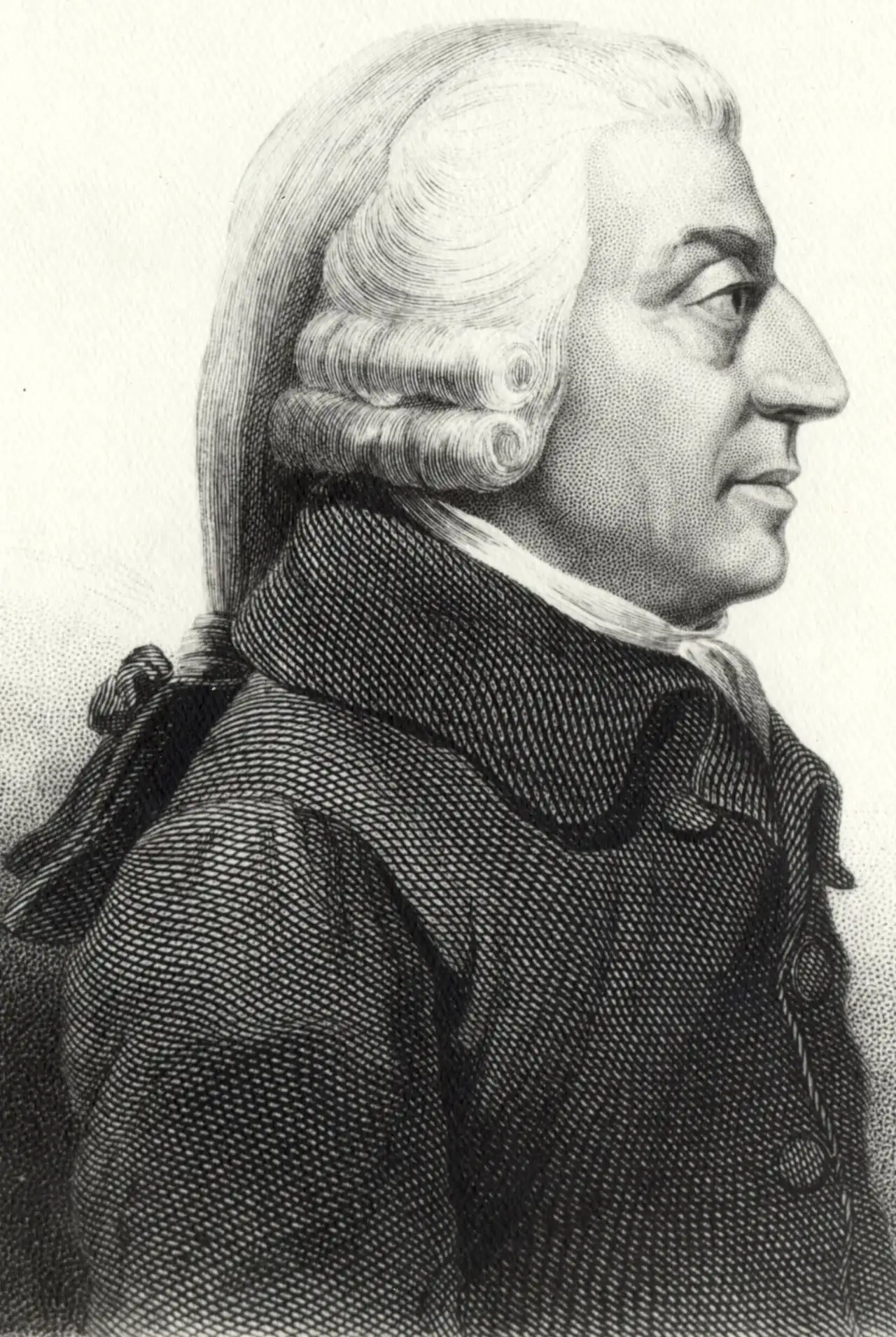
Adam Smith was a Scottish philosopher whose 1776 book, The Wealth of Nations, became the foundation of modern economics. The book sets out to explain what makes nations wealthy. Smith's central argument is that a country grows rich when its workers become more productive, that workers become more productive when they specialize in narrow tasks, and that specialization depends on the size of the market available to them. Along the way, the book makes a detailed case against the British Empire, against monopoly trading companies like the East India Company, and against the trade restrictions that 18th-century governments used to control commerce. Smith himself was not an economist. No such profession existed in his time. He held the chair of moral philosophy at the University of Glasgow, and he thought of himself as a philosopher his whole life.
How Adam Smith wrote The Wealth of Nations
Smith was born in 1723 in Kirkcaldy, a small port town on the east coast of Scotland. His father, a customs official, died before he was born, and his mother raised him alone. He never married and lived with her for most of his life. He was shy, famously absent-minded, and known for talking to himself while walking. He entered the University of Glasgow at 14, then won a scholarship to Balliol College, Oxford, where he spent six years and later wrote that most of the professors there had given up even the pretense of teaching.
He returned to Scotland and in 1752 took the chair of moral philosophy at Glasgow. His closest friend was the philosopher David Hume, and the two influenced each other for decades. In 1759 Smith published The Theory of Moral Sentiments, a book about how people form moral judgments. It argued that morality grows out of sympathy, the ability to feel what other people feel, and that people evaluate their own behavior by imagining how an impartial observer would see them. Smith kept revising this book for the rest of his life and never retracted it.
In 1764 Smith left Glasgow to tutor the young Duke of Buccleuch on a tour of France, a job that came with a pension for life. In France he met Voltaire and several French economic thinkers. He continued the research that became The Wealth of Nations, and the writing took him about ten years. The book came out in 1776, the same year the American colonies declared independence.
What The Wealth of Nations argues
The book opens with a famous example: a pin factory. A single worker performing every step alone could not make even twenty pins in a day. But when ten workers divided the process into eighteen specialized steps, the same workshop could turn out forty-eight thousand. This was Smith's way of showing that breaking work into narrow tasks dramatically raises output. The catch is that specialists need customers. A pin maker who produces thousands of pins needs a market large enough to buy them. From this Smith drew his main policy conclusion: anything that expands markets, whether better roads, open ports, or fewer trade barriers, increases a nation's wealth.
A large part of the book attacks mercantilism, the reigning theory that nations get rich by exporting more than they import and stockpiling gold. Smith argued the opposite: real wealth is what a country makes and uses, not the precious metals sitting in its vaults. He turned the same logic on Britain's colonies. The empire, Smith calculated, cost the ordinary taxpayer far more than it returned, while the profits went to a small circle of politically connected merchants. He noted that whenever rivals in the same trade gather, the meeting tends to end in some plan to fix prices or shut out competitors, and he urged Parliament to treat any regulation that merchants propose with deep skepticism. On the American colonies, he saw two choices: give them seats in Parliament, or let them be independent.
What did Adam Smith mean by the invisible hand?
Smith used the phrase "the invisible hand" only once in the entire book, in a passage explaining why merchants tend to put their money to work close to home rather than overseas. His actual argument was specific. A butcher or a baker feeds you not out of generosity but because selling food earns a living. When many people pursue their own trades this way, the result is often a better distribution of goods than any central plan could achieve. Smith never said markets solve every problem, and he did not regard people as nothing more than self-interested calculators.
His earlier book, The Theory of Moral Sentiments, is devoted entirely to sympathy and moral conscience. In The Wealth of Nations itself, Smith called for partly government-funded schools so that children of the poor could learn to read, for taxes scaled to ability to pay, and for public investment in roads and bridges. He was alarmed that factory labor, by forcing workers to repeat the same motion all day, could dull their minds, and he saw state education as the remedy. He did make an explicit exception to open trade: national security. In his words, "defense is of much more importance than opulence." For that reason he endorsed the Navigation Acts, which reserved British shipping routes for British ships.
Smith spent his final twelve years working as a customs commissioner in Edinburgh, enforcing the very tariffs his book had attacked. He seems to have enjoyed the work. Shortly before his death in 1790, he ordered that most of his unpublished papers be burned. Whatever he had been writing, he did not want anyone else to read it.