
East India Company
The East India Company was a private British corporation, chartered in 1600, that conquered and governed most of India with its own army.
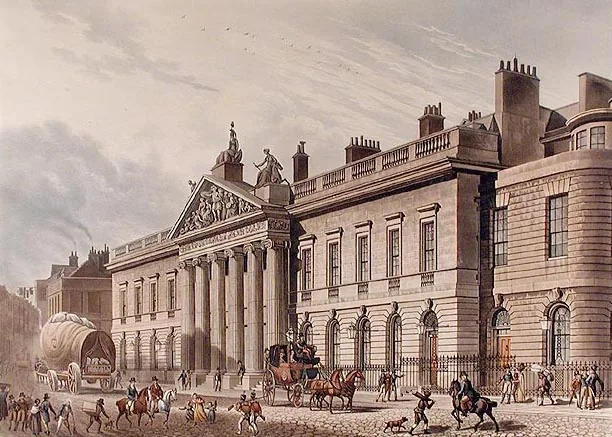
The East India Company was a private British corporation, chartered in 1600 to trade with Asia, that ended up conquering and governing most of India. Queen Elizabeth I granted its charter on December 31, 1600, giving a group of London merchants a monopoly on English trade east of the Cape of Good Hope. The Company started by trading in spices, cotton, silk, and eventually tea. At its peak it governed roughly 200 million people and commanded about 260,000 Indian soldiers led by British officers, double the size of the British Army. The Company signed treaties, minted coins, and collected taxes across a subcontinent. The British Crown took over in 1858, and Parliament dissolved the Company in 1874.
How the East India Company conquered India
For its first 150 years the East India Company operated as a trading business. It set up trading stations in Surat, Madras, Bombay, and Calcutta, and paid dividends to its shareholders from commerce. That changed at the Battle of Plassey in 1757.
Robert Clive, the Company's military commander in Bengal, had arrived in India at age 18 as a junior clerk with no military training. By 1757 he was leading the Company's forces against Siraj ud-Daulah, the Nawab of Bengal, then India's wealthiest province. Clive won less through fighting than through bribery. Before the battle he struck a deal with Mir Jafar, one of the Nawab's senior generals, who held back his troops when the fighting started. Plassey gave the Company control of Bengal, and in 1765 the Mughal Emperor formally granted the Company the diwani, the right to collect taxes across the province. From that point the Company's income came from taxes, not commerce.
In 1770, just thirteen years after Plassey, a famine struck Bengal that may have killed 10 million people, around a third of the province's population. The Company did not stop collecting taxes while people starved. Meanwhile, Britain wanted Chinese tea but had almost nothing China wanted in return. The Company's solution was to grow opium in Bengal and sell it to private traders who shipped it to Chinese ports, creating widespread addiction and eventually provoking the Opium Wars. Company officials sent vast personal fortunes back to Britain and were known as "nabobs." Their corruption became a political scandal in London, and Parliament passed laws to control the Company in the 1770s.
How the East India Company ended
In 1857, Indian soldiers serving in the Company's army rose in revolt across northern India. The Indian Rebellion of 1857 had deep causes. The Company had spent decades annexing Indian kingdoms, rewriting land laws, and undermining local customs. The immediate trigger was a rumor that new rifle cartridges were coated with beef and pork fat, which offended both Hindu and Muslim soldiers. British forces put down the revolt with severe force, and the fighting was brutal on both sides.
The revolt ended any case for letting a private company govern territory. In 1858 Parliament passed the Government of India Act, which stripped the Company of all authority and placed India under the direct control of the British Crown. This began the period known as the British Raj. The Company survived as an empty shell for another sixteen years until Parliament formally dissolved it in 1874. For a longer account of the Company's full arc, see The East India Company: the corporation that ruled with its own army.
Who owned the East India Company?
The East India Company was a private corporation, not a branch of the British government. It had shareholders who bought and sold its stock, a board of directors elected by those shareholders, and a headquarters at East India House on Leadenhall Street in London. Its full original name was the "Governor and Company of Merchants of London Trading into the East Indies."
The line between the Company and the British state blurred over time. Parliament passed its first major act to regulate the Company in 1773, after scandals over corrupt Company officials in India. Further acts in 1784 and 1813 gave the British government more control and stripped the Company of its monopoly on trade with India. By the 1830s the Company operated less as a trading business than as an arm of the British government running India. After 1858, when the Crown took direct control, the Company had no purpose at all.
The East India Company remains the most extreme example in modern history of a private business that raised armies, waged wars, and governed entire populations.