
Mercantilism
Mercantilism was the belief that a country gets rich by exporting more than it imports and accumulating gold and silver.
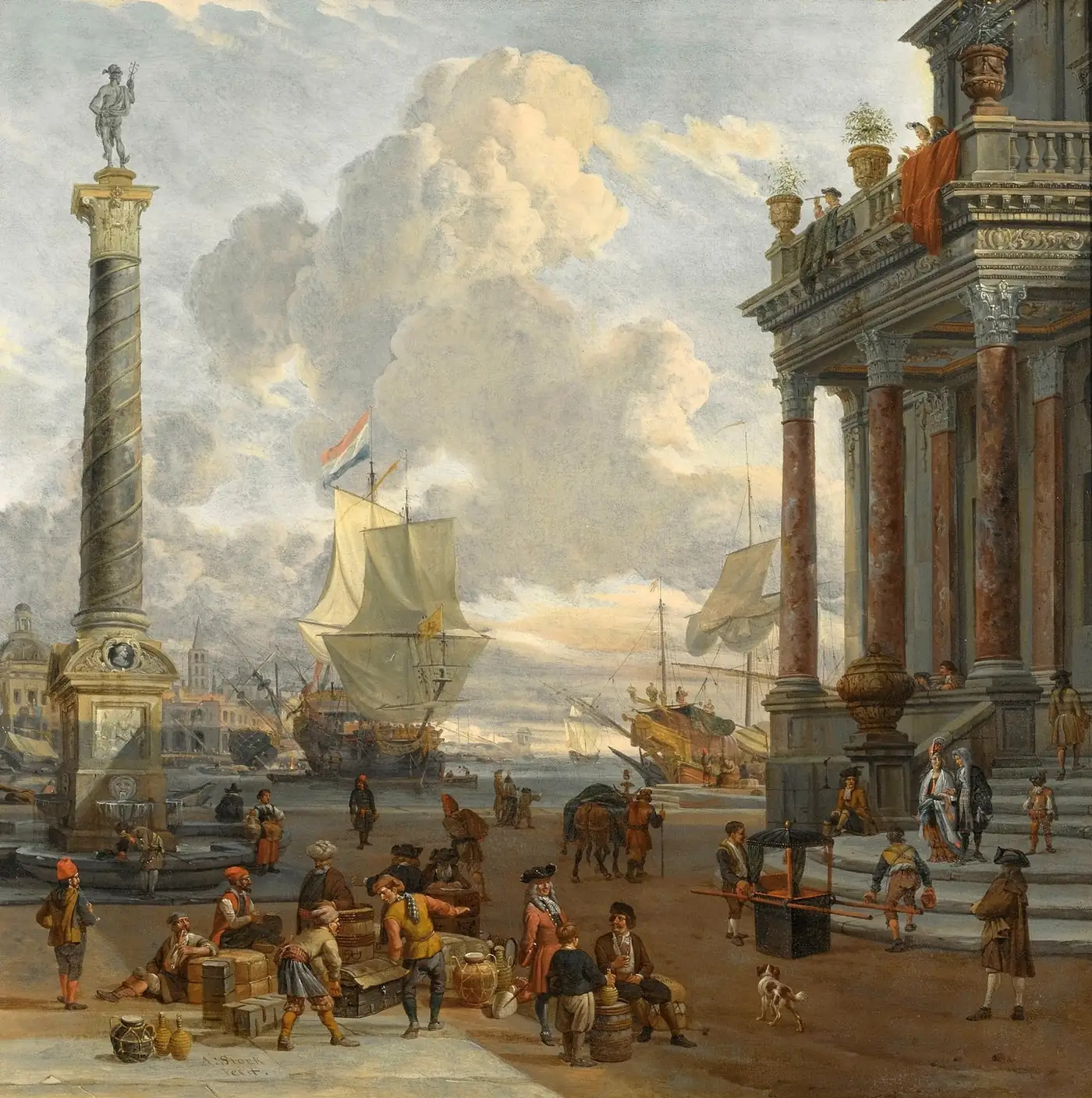
Mercantilism was the belief that a nation prospers by exporting more than it imports and storing the surplus as gold and silver. It shaped European economic policy from roughly 1500 to 1800, though nobody codified it as a formal theory while it was being practiced. Adam Smith popularized the name in 1776, when he argued against what he called "the mercantile system" in The Wealth of Nations. The label eventually covered about 250 years of government practice, assembled gradually by monarchs who needed funds for wars and merchants who wanted shelter from foreign competition. The core rules were straightforward: sell manufactured products to other countries, buy only raw inputs from abroad, and use tariffs or outright bans to stop competing imports. A country should also build a merchant fleet to keep shipping revenue at home, and acquire colonies as suppliers of raw materials and guaranteed buyers of finished products.
How European governments practiced mercantilism
Mercantilist thinking started from the assumption that the world's wealth was a fixed quantity. One country's gain was another's loss. Gold and silver mattered above all because they paid for armies and navies. A ruler who ran out of precious metal during a war could lose it.
From that assumption, standard policies followed. Governments shielded domestic manufacturers with tariffs. They subsidized industries that earned foreign silver, especially textiles. They built merchant fleets that could serve as naval reserves in wartime. They kept wages low so exports stayed cheap.
England passed a Navigation Act in 1651, aimed mainly at the Dutch, who at the time carried more of Europe's trade than anyone else. The law required that goods entering England travel in English ships or in ships from the producing country. Under later acts, colonial products like sugar and tobacco had to go to England first, even if the buyer was somewhere else. Colonies were restricted in manufacturing goods that competed with English industry. The rivalry with the Dutch turned violent almost immediately: the two countries went to war in 1652.
In France, Jean-Baptiste Colbert managed the kingdom's fiscal affairs under Louis XIV starting in 1665 and held the role until his death in 1683. Colbert came from a family of cloth merchants in Reims and had risen through royal service as an aide to Cardinal Mazarin. He used state-chartered monopolies, royal factories, canal projects, and tariff walls to direct wealth toward the French crown. He also chartered trading companies to handle France's colonial commerce.
Colonies were central to the whole system. Chartered trading companies like the East India Company held monopolies over commerce with entire regions. Colonies supplied raw materials that would otherwise be bought from a rival, and they served as captive markets forced to buy from the home country. The plantation economies in the Caribbean and Brazil, along with the Atlantic slave trade that provided their labor, were mercantilist enterprises. Colonial economies were deliberately kept underdeveloped, and the costs fell on people with no political voice.
American colonists resented the restrictions on what industries they could run and which foreign markets they could reach. Those grievances were among the causes of the American Revolution.
How Adam Smith challenged mercantilism
Adam Smith, a Scottish moral philosopher, published The Wealth of Nations in 1776 after about ten years of work. The book argued that mercantilism's central assumption was wrong. A country's real wealth is what its people can produce and consume, not the precious metal stored in vaults. Both sides of a trade benefit, because each gives up what it produces efficiently and receives what it does not.
David Ricardo put this into formal terms as comparative advantage in 1817. Even if one country is worse at making everything, it still benefits from trade by focusing on what it produces at the lowest relative cost.
Britain, having built an empire under mercantilist rules, gradually abandoned them. Parliament abolished the Corn Laws in 1846, opening British markets to cheaper foreign grain. For the next several decades Britain championed free trade, largely because its factories could undersell anyone else's.
What was the goal of mercantilism?
The primary goal was to fill the state's coffers with gold and silver. This was not simply about getting rich. Early modern rulers' central problem was paying for wars, and precious metals paid for hired soldiers and navies. A government with gold in its treasury could wage war. A government without it could be conquered by one that had it.
Trade disputes of the era frequently turned into shooting wars for exactly this reason. Mercantilist governments treated commerce as a way to fund national defense. They did not ask whether their people were better off overall. They asked whether the treasury could afford the next war.
Mercantilism today
Economists have called the mercantilist intuition a fallacy for about 250 years, but governments keep acting on it. Rapidly industrializing countries have repeatedly used tariffs, subsidized national champions, and managed their currencies to build up domestic industry: the United States and Germany in the 1800s, Japan and South Korea in the twentieth century, and China in the twenty-first.
The vocabulary has changed. Modern debates use terms like trade imbalances, subsidies for home industry, protecting critical supply chains, and restricting sales of strategic goods. The underlying logic has not. Countries still treat a trade surplus as a sign of strength, worry about depending on rivals for critical goods, and use tariffs to shield domestic producers. The mercantilist idea, that trade is a contest and relying on a competitor for critical goods is a form of weakness, remains one of the most durable assumptions in economic policy.