
Kingdom of Aksum
Aksum was an empire in the Ethiopian highlands that grew wealthy from Red Sea trade and became one of the first Christian kingdoms.
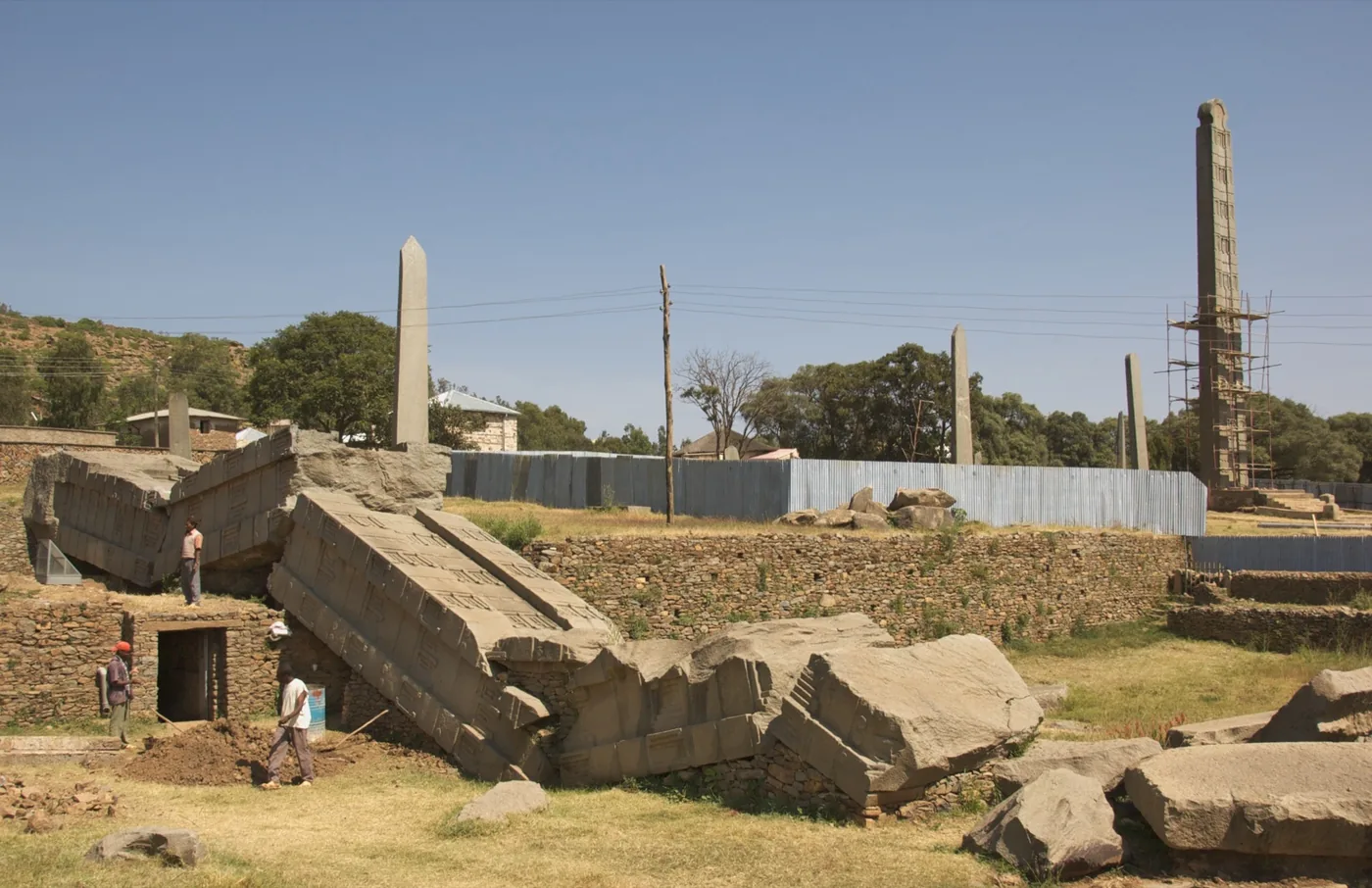
The Kingdom of Aksum was an empire based in the northern Ethiopian and Eritrean highlands, in the territory that is now split between Ethiopia and Eritrea. It lasted from roughly the first century to the tenth century AD. In the third century, the Persian prophet Mani named the four great powers of his world: Rome, Persia, China, and Aksum. The kingdom grew wealthy by controlling trade between the Roman Mediterranean and India through the Red Sea. No state in sub-Saharan Africa had minted coins before Aksum did, and it was among the earliest kingdoms in the world to make Christianity its official religion. It also left behind some of the tallest stone monuments ever carved in the ancient world.
How Aksum controlled the Red Sea trade
Aksum's wealth came from its position between two trading worlds. Its Red Sea port, Adulis, sat on the route connecting the Roman Mediterranean to India. African goods flowed out through Adulis: gold, ivory, tortoiseshell, and incense. Roman glass, wine, and cloth came in. Merchants from Egypt, Arabia, and India all passed through Aksumite territory, and the kingdom taxed the trade in both directions.
From the late third century, Aksum's kings struck their own coins in gold, silver, and bronze. These were the first coins minted by any state in sub-Saharan Africa. The coins carried inscriptions in Greek or Ge'ez, the local language, and followed Roman weight standards so that foreign traders would accept them.
The wealth from this trade paid for the kingdom's most visible monuments: carved granite stelae that marked the tombs of kings on the edge of the capital. The largest, the Great Stele, measures about 33 meters and would have been the tallest single stone monument ever raised in the ancient world. It collapsed during or shortly after its erection. The tallest stele that has stood continuously since antiquity is King Ezana's Stele, at 21 meters. A second large stele, about 24 meters tall, was taken to Rome by Italian troops in 1937 on Mussolini's orders. Italy returned it in 2005, and a UNESCO team re-erected it in Aksum in 2008.
How King Ezana made Aksum Christian
Around 330, King Ezana converted to Christianity, making Aksum among the earliest kingdoms to make the faith its state religion. About two decades earlier, Constantine had become the first Roman emperor to convert to Christianity.
The story of how Christianity reached Aksum starts with a philosopher named Meropius from the city of Tyre in the Roman Empire. He was traveling with two young relatives, Frumentius and Aedesius, when their ship was attacked at a Red Sea port. The crew was killed, but the boys were brought to the Aksumite court. The king made Aedesius his cup-bearer and Frumentius his steward. When the king died, Frumentius became tutor to the young prince Ezana and introduced him to Christianity.
After Ezana took the throne and converted, the old crescent-and-disc symbol on Aksumite coins gave way to the cross. Aksum became the first state in history to put the Christian cross on its money. Frumentius later traveled to Alexandria, where the patriarch Athanasius consecrated him as Aksum's first bishop. The church that Frumentius and Ezana established evolved into the Ethiopian Orthodox Tewahedo Church, which has tens of millions of members today.
Does Ethiopia have the Ark of the Covenant?
Ethiopian tradition says yes. According to the Kebra Nagast, a fourteenth-century Ethiopian text, a figure named Menelik brought the Ark of the Covenant from Jerusalem to Aksum. Menelik is said to be the son of King Solomon and the Queen of Sheba. The Ethiopian Orthodox Church teaches that the Ark still rests in a chapel next to the Church of Our Lady Mary of Zion in Aksum. A single monk is appointed as its guardian for life, and no one else is allowed to see it. Most historians doubt the claim, but it is a central belief of the Ethiopian Orthodox faith, and pilgrims visit the church in large numbers every year.
Why did Aksum decline?
Aksum's rise and fall both depended on the Red Sea. In the seventh century, Arab armies carried Islam out of the Arabian Peninsula and took control of the coasts and sea lanes that had fed Aksum's trade. The port of Adulis was abandoned sometime around the eighth century. The commerce that had sustained the kingdom for centuries shifted to new Muslim ports.
Cut off from its trading partners, Aksum shrank. Its mints stopped producing coins. Overfarming and deforestation wore down the land around the capital. Ethiopian political power shifted southward into the mountain interior, where successor kingdoms carried on. The Aksumite state collapsed around 960, but the Christian faith that Ezana adopted in the fourth century survived. The Ethiopian Orthodox Church that traces its origin to Aksum remains one of the oldest Christian institutions in the world.