
Benito Mussolini
Benito Mussolini founded fascism and ruled Italy as dictator from 1922 until 1943, when his own government voted him out.
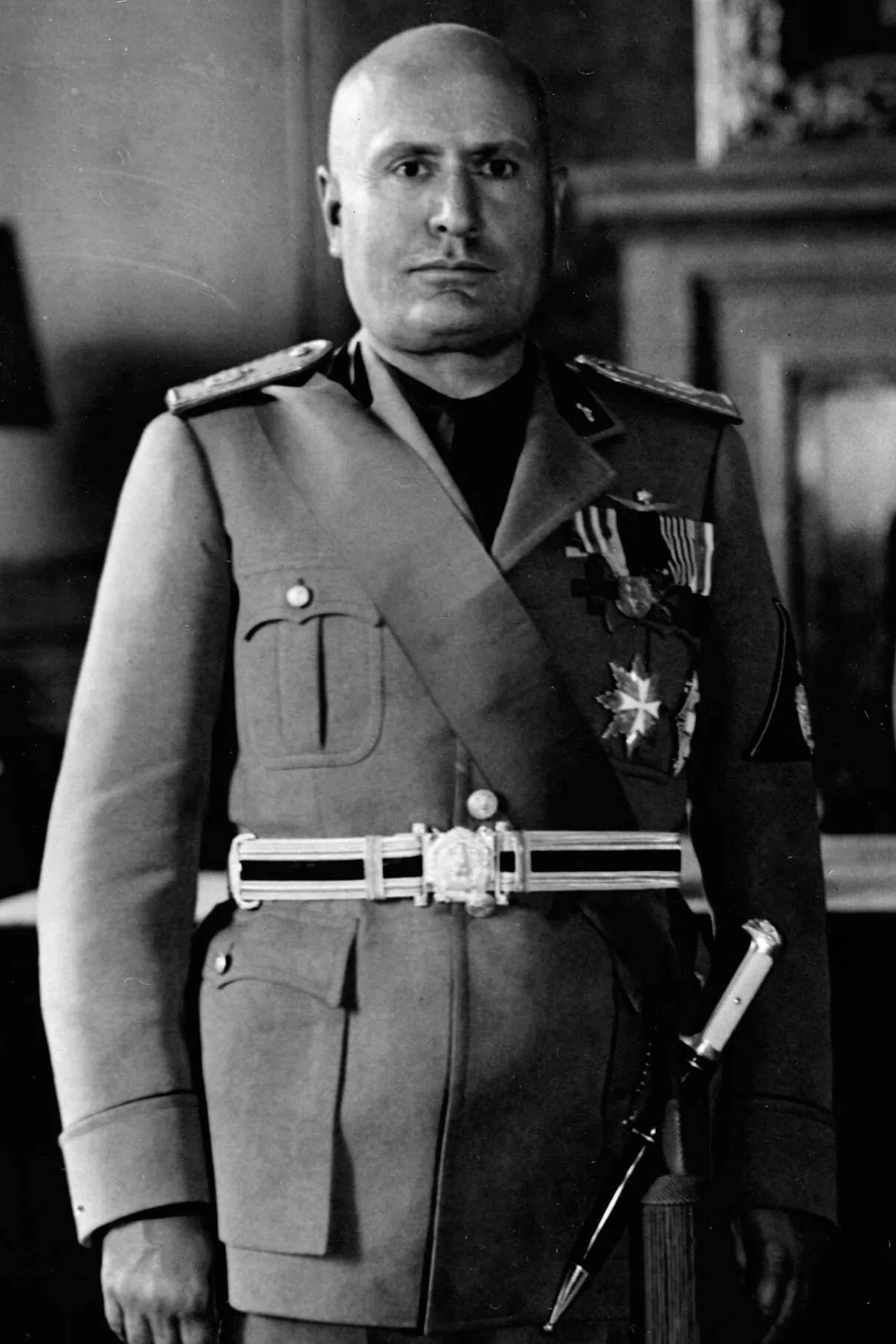
Benito Mussolini was the Italian dictator who founded fascism and ruled Italy from 1922 to 1943. He was born in 1883 in Predappio, a small town in the Romagna region of northern Italy. His father was a blacksmith and a socialist who named him after Benito Juárez, the Mexican president who overthrew Emperor Maximilian. Mussolini spent his early career as a socialist newspaper editor before breaking with the left over World War I. He built a movement based on nationalism, paramilitary violence, and hostility to democracy. After taking power at 39, he became the model that Adolf Hitler studied and copied. His decision to enter World War II on Germany's side destroyed his regime and cost him his life.
How Mussolini rose to power
Mussolini spent his first three decades on the political left. In 1912, at 29, the Italian Socialist Party made him editor of its national newspaper, Avanti!. Under his leadership, the paper's circulation rose from 20,000 to 100,000.
In 1914, Mussolini broke with the party over World War I. The socialists opposed Italy entering the war. Mussolini supported it. The party expelled him as a traitor after he started his own newspaper, Il Popolo d'Italia.
Italy finished the war among the victors, but the outcome felt hollow. About 600,000 Italian soldiers had died, and the territory Italy gained fell short of what nationalists had expected. Italians called it "the mutilated victory." Workers occupied factories and peasants seized land in 1919 and 1920, frightening the country's landowners and industrialists.
Mussolini organized squads of ex-soldiers and young nationalists, the blackshirts, who attacked socialist organizers, set fire to union halls, and shut down strikes by force. Local landowners and factory owners paid them for it.
In October 1922, Mussolini staged the March on Rome. It was more a political threat than a real military operation. His blackshirts gathered outside the capital while Mussolini waited in Milan. Prime Minister Luigi Facta asked King Victor Emmanuel III to declare martial law and stop them. The king refused and asked Mussolini to become prime minister instead. Mussolini took the overnight train from Milan to Rome. At 39, he was the youngest prime minister Italy had yet had.
How Mussolini built a dictatorship
Mussolini did not become a dictator overnight. In 1923, the Acerbo Law guaranteed that the party with the most votes, if it won at least a quarter of the national vote, would receive two-thirds of the seats in parliament, handing the fascists an unbeatable majority.
Giacomo Matteotti, a socialist member of parliament, publicly accused the fascists of rigging the 1924 election. In June 1924, a fascist squad abducted and murdered him. The scandal nearly brought Mussolini down. But the opposition parties could not agree on a response, and in January 1925 Mussolini went on the offensive. He told parliament he accepted personal responsibility for all of it. Within two years, he banned every other political party.
Mussolini's most lasting domestic achievement was the 1929 Lateran Treaty, which ended a standoff between the Italian government and the Vatican that had lasted since Italian unification in 1870. The treaty recognized Vatican City as an independent state and confirmed Catholicism as Italy's official religion. Mussolini also drained the Pontine Marshes south of Rome, turning swampland into farmland and new towns. The famous claim that he made the trains run on time was largely propaganda.
In 1935, Mussolini invaded Ethiopia, a fellow member of the League of Nations, with bombers and mustard gas. The war made him popular at home but isolated Italy in Europe. He sent troops to fight in the Spanish Civil War and annexed Albania in 1939. In 1938, Italy adopted antisemitic race laws for which there was no real domestic demand. Mussolini adopted them to stay aligned with Hitler's Germany.
How did Mussolini die?
Italian partisans captured and shot Mussolini on April 28, 1945, on the shore of Lake Como, while he was fleeing toward Switzerland. Partisans hung his body and that of his mistress, Clara Petacci, upside down from the roof of a filling station in Milan's Piazzale Loreto.
Mussolini had entered World War II in June 1940, believing France was already beaten and wanting a share of the victory. Italy was not ready for war. Italian forces suffered defeats in Greece, North Africa, and the Soviet Union. After the Allied invasion of Sicily in July 1943, the Fascist Grand Council voted Mussolini out of power. King Victor Emmanuel III had him arrested and imprisoned at a ski hotel high in the Gran Sasso mountains. In September 1943, German commandos landed gliders on the mountainside and rescued him. Hitler installed Mussolini as the head of a puppet state, the Italian Social Republic, in German-occupied northern Italy.
The puppet state lasted less than two years. By April 1945, Allied armies were advancing through northern Italy, and Mussolini fled toward Switzerland. Partisans stopped him near the village of Dongo on April 27. He was 61.
Mussolini's influence on Hitler
Mussolini pioneered the political tools that Nazism later adopted: a party with its own armed militia, a cult built around one leader, the display of ancient Roman imperial symbols, and the merging of party and government. In the 1920s, Hitler openly regarded Mussolini as a model.
By the late 1930s, Germany had become the dominant partner, and Mussolini found himself following Hitler rather than leading. Mussolini created the political model that fascist movements across Europe copied. His decision to enter World War II in 1940 destroyed the regime he had spent two decades building.