
Alhambra and Granada
The Alhambra is a fortified palace in Granada, Spain, built by the Nasrid sultans of the last Muslim kingdom on the Iberian Peninsula.
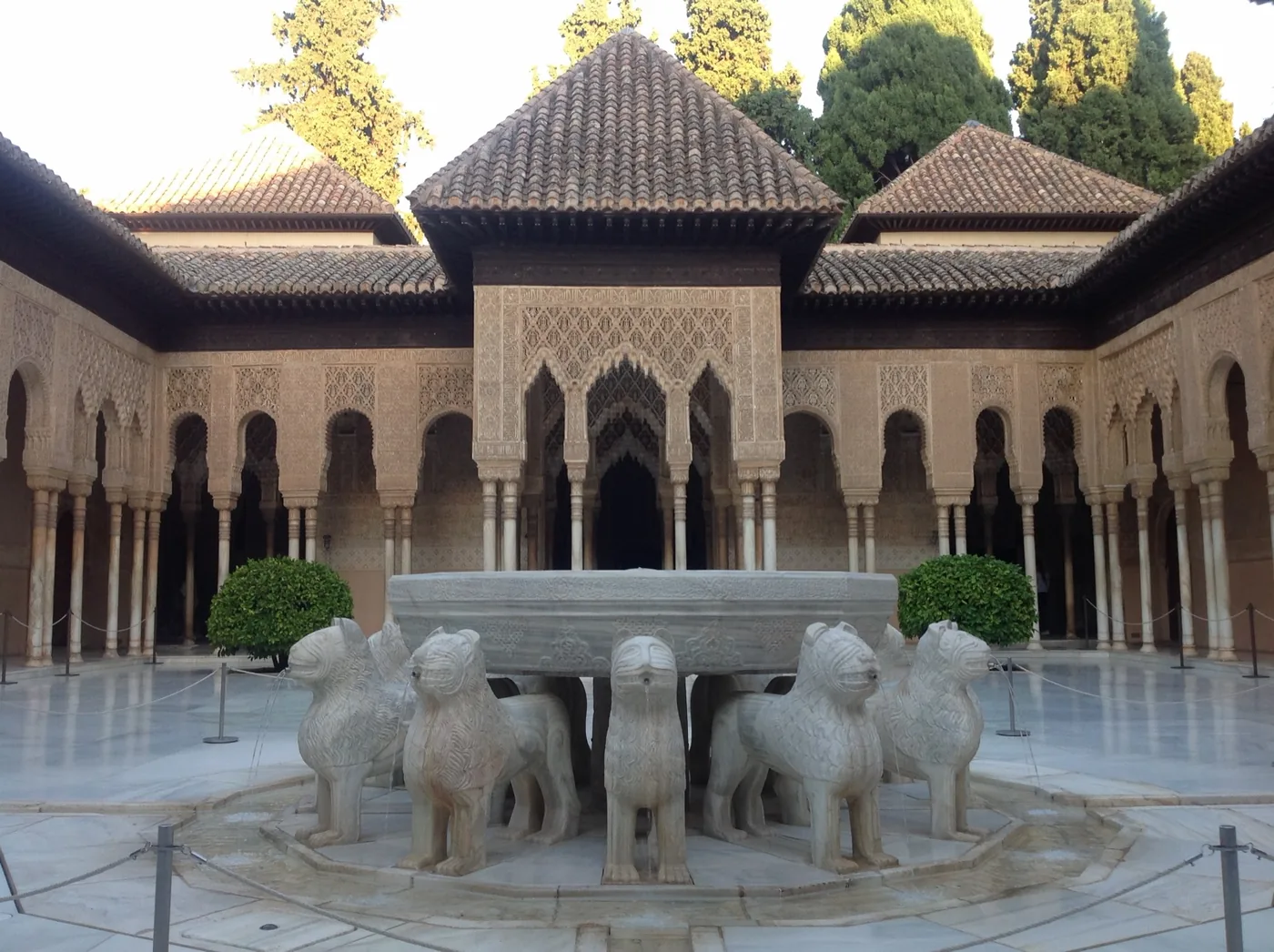
The Alhambra is a palace and fortress on a hill above the city of Granada, in southern Spain. Built mostly in the fourteenth century by the Nasrid sultans, it is the finest surviving example of Islamic palace architecture in Europe. The name comes from the Arabic al-Hamra, meaning "the red one," for the reddish color of its rammed-earth walls. Inside, the courtyards and halls are covered in carved stucco, patterned tile, and Arabic calligraphy. The Nasrid motto, "there is no victor but God," appears thousands of times across the walls. The Alhambra was the seat of the Emirate of Granada, the last Muslim kingdom on the Iberian Peninsula, which held on for nearly 250 years after the rest of al-Andalus had fallen to Christian kingdoms.
How the Nasrids kept the last Muslim kingdom alive
By the mid-1200s, Christian kingdoms had conquered nearly all of Muslim-ruled Spain. In 1238, Muhammad I ibn al-Ahmar established the Emirate of Granada in a strip of mountainous land in the far south, founding the Nasrid dynasty. It was a small kingdom, but a wealthy one. The plain below Granada was rich farmland, producing silk and grain, and the port of Almeria connected it by sea to Morocco.
Granada survived for 250 years because its rulers were practical. The Nasrids paid tribute to the Kingdom of Castile, accepting the status of vassals. When Castile pressed too hard, they sought help from the Marinid dynasty in Morocco. When North African allies grew threatening, they leaned back toward Castile. The Sierra Nevada mountains shielded the kingdom, and its small size made a full invasion expensive for uncertain gain. The Nasrids outlasted coups, dynastic feuds, and repeated Christian campaigns by making themselves useful to Castile and difficult to conquer.
How the Nasrid sultans built the Alhambra
Muhammad I began fortifying the hilltop above Granada in the 1230s, but the palace complex that survives today is mostly the work of two later sultans. Yusuf I, who ruled from 1333 to 1354, built the Comares Palace, including the Hall of the Ambassadors with its immense wooden ceiling, and expanded the royal baths. Yusuf I was stabbed to death by a madman while praying in the Great Mosque of Granada on the day of Eid al-Fitr in 1354. His son Muhammad V, fifteen years old, took the throne. Five years later a palace coup sent Muhammad V into exile at the Marinid court in Fez. He returned in 1362 with Castilian help and ruled for another twenty-nine years. During that second reign he built the Court of the Lions, a marble courtyard ringed by slender columns with a fountain resting on twelve stone lions at its center.
The Alhambra's outer walls are plain military fortifications, but the interiors are among the most refined in the Islamic world. The ceilings feature honeycombed muqarnas, a type of decorative vaulting carved into thousands of small cells. The walls are layered with carved stucco, glazed tile in geometric patterns, and bands of Arabic calligraphy. On a neighboring hill sits the Generalife, a summer residence with terraced gardens and water channels, built in the late 1200s and redecorated by Sultan Ismail I in 1319.
How Ferdinand and Isabella conquered Granada
For most of its history, Granada survived because Castile had other wars to fight. That changed in 1469, when Ferdinand of Aragon married Isabella of Castile, uniting Spain's two largest Christian kingdoms. By 1482, Ferdinand and Isabella turned their full military strength against Granada.
The war lasted ten years. Ferdinand and Isabella's armies besieged city after city across the emirate, cutting it off from its ports and farmland. Granada's last sultan, Boabdil (Muhammad XII), surrendered the Alhambra on January 2, 1492. It was the end of nearly eight centuries of Muslim rule on the Iberian Peninsula.
A famous legend says that as Boabdil rode south into exile, he stopped at a high pass in the mountains, looked back at Granada for the last time, and wept. His mother told him he cried like a woman for what he could not defend as a man. The pass is still called the Suspiro del Moro, "the Moor's sigh." The story appears in sixteenth-century chronicles and is probably an embellishment, but it has endured for five hundred years.
What happened to the Alhambra after 1492?
Ferdinand and Isabella's grandson, Emperor Charles V, began building a large Renaissance palace inside the Alhambra complex in 1527, though it was not finished for centuries. Over time the Nasrid palaces fell into neglect. Napoleon's troops used the Alhambra as barracks during the French occupation of Granada from 1810 to 1812 and blew up several towers when they withdrew.
The American writer Washington Irving, already famous for The Legend of Sleepy Hollow, stayed in the Alhambra for several months in 1829, lodging in its empty rooms. He published Tales of the Alhambra in 1832, a collection of sketches and legends that introduced the palace to English-speaking readers and helped spark a restoration effort. Spain declared the Alhambra a national monument in 1870, and UNESCO named it a World Heritage Site in 1984. In 2024 the complex drew about 2.7 million visitors, making it one of Spain's most visited monuments.