
Al-Andalus
Al-Andalus was the name for Muslim-ruled Iberia, lasting from 711 to 1492, with Cordoba as its greatest city.
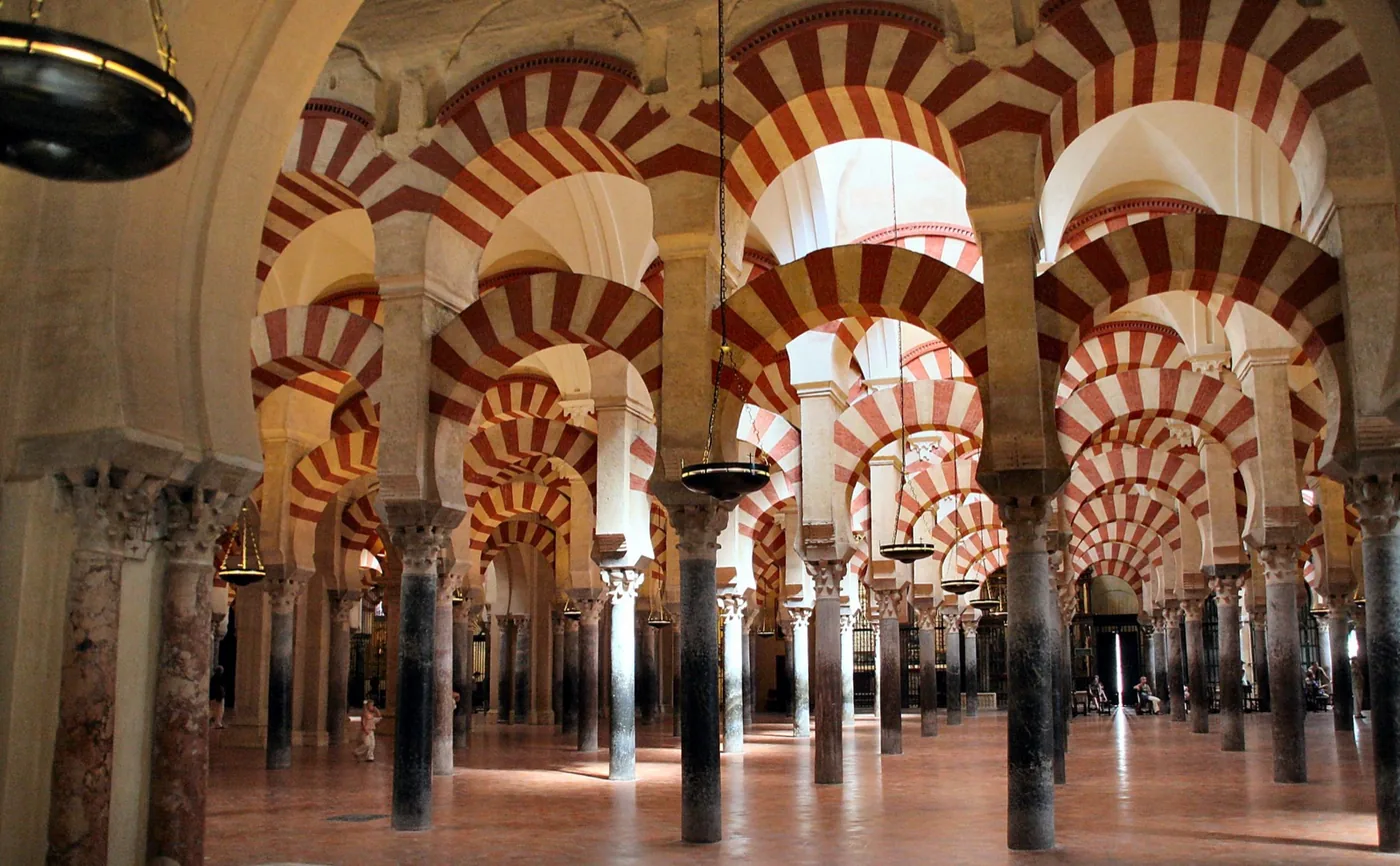
Al-Andalus is the Arabic name for the parts of the Iberian Peninsula under Muslim rule. At its greatest extent, it covered most of modern Spain and Portugal. Muslim rule began in 711, when an army from North Africa overthrew the Visigothic kingdom, and it did not fully end until 1492, when the last Muslim state, the Emirate of Granada, fell to Ferdinand and Isabella. For nearly eight centuries, al-Andalus was home to some of the most advanced cities in Europe. Its capital, Cordoba, was by the tenth century probably the largest city in Western Europe. Hroswitha of Gandersheim, a Saxon nun writing in the tenth century, called it "the ornament of the world."
How Cordoba became the largest city in Europe
In 711, an army of Berbers and Arabs crossed the Strait of Gibraltar under the command of Tariq ibn Ziyad. They defeated the Visigothic king Roderic at the Battle of Guadalete that July, and within a few years they controlled most of the peninsula.
In 755, a young prince named Abd al-Rahman arrived in Iberia as a fugitive. He was one of the last surviving members of the Umayyad dynasty, which had ruled the Islamic world from Damascus until the Abbasid family overthrew them and killed most of the royal household. Abd al-Rahman escaped the killings by swimming across the Euphrates River while Abbasid horsemen watched from the bank. He spent the next several years crossing North Africa, mostly with a single companion, a Greek freedman named Bedr, before reaching Iberia. He established an independent emirate at Cordoba, breaking with the Abbasid caliphs.
In 929, his descendant Abd al-Rahman III declared himself caliph. Under him and his son al-Hakam II, Cordoba reached its peak. The city had paved streets, public baths, and street lamps that allowed a traveler to ride for miles at night. Its population may have been several hundred thousand, at a time when Paris and London held only tens of thousands. Al-Hakam II was a devoted patron of learning. His royal library reportedly held around 400,000 cataloged volumes. The largest libraries in Christian Europe at the time held only a few hundred books. Physicians, astronomers, and mathematicians worked under his patronage. The Great Mosque of Cordoba, begun in 785 and enlarged over two centuries, remains the outstanding monument of the period.
How al-Andalus fell apart
Al-Andalus was never a single stable state for long. After 1031, the caliphate collapsed into dozens of small kingdoms called taifas, which spent as much energy fighting each other as defending against the Christian kingdoms to the north.
The taifa rulers twice called in help from North Africa. The Almoravids arrived in 1086 after the Christian king Alfonso VI took Toledo, and they defeated the Christians at the Battle of Sagrajas. Then they stayed and took over most of al-Andalus for themselves. When Almoravid power weakened, the Almohads replaced them in the 1140s. Neither dynasty stopped the Christian advance permanently.
The Christian kingdoms pushed steadily south. Cordoba fell to the Kingdom of Castile in 1236. Seville followed in 1248. By the late thirteenth century, only the mountainous Emirate of Granada survived, its rulers based at the Alhambra, paying tribute to Castile. It lasted another two centuries until Ferdinand and Isabella conquered it in January 1492, ending nearly eight hundred years of Muslim rule in Iberia.
What does al-Andalus mean?
The origin of the name is debated. The most widely accepted explanation traces it to the Vandals, a Germanic people who briefly settled in southern Iberia in the early fifth century before moving to North Africa. The Arabic name may come from the Late Latin Vandalicia, meaning "land of the Vandals." Other theories link it to a Gothic word for land parcels or to an Atlantic root, but these have less support. The modern region of Andalusia in southern Spain takes its name from al-Andalus, though al-Andalus at its peak covered far more territory.
Muslims, Christians, and Jews in al-Andalus
Muslims, Christians, and Jews all lived in al-Andalus under an arrangement historians sometimes call convivencia, Spanish for coexistence. At its best, it was remarkably productive. Ibn Rushd, a philosopher and judge whose Latin name was Averroes, was born in Cordoba in 1126. His commentaries on Aristotle shaped European thought for centuries. The Jewish scholar Maimonides was born in Cordoba around 1138. After Christian forces took Toledo in 1085, the city became the main channel through which Greek and Arabic learning returned to Christian Europe. Translators there turned Arabic versions of Aristotle, Ptolemy, and Galen into Latin, filling gaps in European knowledge that had lasted centuries.
But convivencia had clear limits. Non-Muslims paid the jizya, a special tax, and lived under legal restrictions. Periods of relative openness alternated with violence. In 1066, a Muslim mob in Granada killed around 4,000 Jews. Under the Almohads in the twelfth century, Jews and Christians faced forced conversion or exile. Maimonides himself fled Cordoba as a boy when the Almohads took the city in 1148.
Al-Andalus left lasting marks on Spain and on Europe. Around 4,000 Arabic-origin words survive in modern Spanish, from aceite (oil) to azucar (sugar). Irrigation systems built under Muslim rule still water parts of southern Spain. The Great Mosque of Cordoba, begun in 785, still stands. It has served as a Catholic cathedral since 1236, but the original prayer hall and its rows of red-and-white double arches remain.